

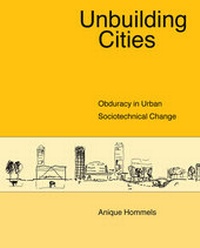
Unbuilding Cities
Obduracy in Urban Sociotechnical Change
Published on 15. November 2005
Book
Hardback
296 pages
978-0-262-08340-9 (ISBN)
Description
City planning initiatives and redesign of urban structures often become
mired in debate and delay. Despite the fact that cities are considered to be dynamic
and flexible spaces -- never finished but always under construction -- it is very
difficult to change existing urban structures; they become fixed, obdurate, securely
anchored in their own histories as well as in the histories of their surroundings.
In Unbuilding Cities, Anique Hommels looks at the tension between the malleability
of urban space and its obduracy, focusing on sites and structures that have been
subjected to "unbuilding" -- redesign or reconfiguration. She brings the concepts of
science and technology studies (STS) to bear on the study of cities. Viewing the
city as a large sociotechnological artifact, she demonstrates the usefulness of STS
tools that were developed to analyze other technological artifacts and explores in
detail the role of obduracy in sociotechnical change. Her analysis distinguishes
three concepts of obduracy: interactionist, in which actors with diverging views are
constrained by fixed ways of thinking and interacting; relational, in which change
is difficult because of technology's embeddedness in sociotechnical networks; and
enduring, in which persistent traditions influence the development of technology
over time.Hommels examines the tensions between obduracy and change in three urban
redesign projects in the Netherlands: a renovated city center that fell into
drabness and disrepair; a highway system that runs through a densely populated urban
area; and a high-rise housing project, designed according to modernist precepts and
built for middle-class families, that became a haven for unemployment and crime.
Unbuilding Cities contributes to a productive fusion of STS and urban
studies.
mired in debate and delay. Despite the fact that cities are considered to be dynamic
and flexible spaces -- never finished but always under construction -- it is very
difficult to change existing urban structures; they become fixed, obdurate, securely
anchored in their own histories as well as in the histories of their surroundings.
In Unbuilding Cities, Anique Hommels looks at the tension between the malleability
of urban space and its obduracy, focusing on sites and structures that have been
subjected to "unbuilding" -- redesign or reconfiguration. She brings the concepts of
science and technology studies (STS) to bear on the study of cities. Viewing the
city as a large sociotechnological artifact, she demonstrates the usefulness of STS
tools that were developed to analyze other technological artifacts and explores in
detail the role of obduracy in sociotechnical change. Her analysis distinguishes
three concepts of obduracy: interactionist, in which actors with diverging views are
constrained by fixed ways of thinking and interacting; relational, in which change
is difficult because of technology's embeddedness in sociotechnical networks; and
enduring, in which persistent traditions influence the development of technology
over time.Hommels examines the tensions between obduracy and change in three urban
redesign projects in the Netherlands: a renovated city center that fell into
drabness and disrepair; a highway system that runs through a densely populated urban
area; and a high-rise housing project, designed according to modernist precepts and
built for middle-class families, that became a haven for unemployment and crime.
Unbuilding Cities contributes to a productive fusion of STS and urban
studies.
More details
Series
Language
English
Place of publication
Cambridge, Mass.
United States
Publishing group
MIT Press Ltd
Target group
Professional and scholarly
Illustrations
27 illus.
Dimensions
Height: 229 mm
Width: 178 mm
Thickness: 0 mm
Weight
749 gr
ISBN-13
978-0-262-08340-9 (9780262083409)
Copyright in bibliographic data and cover images is held by Nielsen Book Services Limited or by the publishers or by their respective licensors: all rights reserved.
Schweitzer Classification
Person
Anique Hommels is Assistant Professor in the Department of Technology and
Society Studies, Faculty of Arts and Culture, University of Maastricht,
Netherlands.
Society Studies, Faculty of Arts and Culture, University of Maastricht,
Netherlands.