

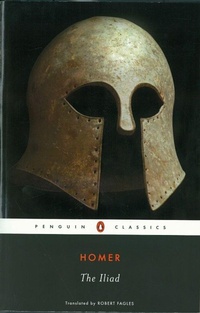
The Iliad
Published on 27. February 1992
Book
Paperback/Softback
704 pages
978-0-14-044592-3 (ISBN)
Description
A work of tremendous influence that has inspired writers from his ancient Greek contemporaries to modernist writers such as T.S. Eliot, Homer's epic poem The Iliad is translated by Robert Fagles with an introduction and notes by Bernard Knox in Penguin Classics.
One of the foremost achievements in Western literature, Homer's Iliad tells the story of the darkest episode in the Trojan War. At its centre is Achilles, the greatest warrior-champion of the Greeks, and his refusal to fight after being humiliated by his leader Agamemnon. But when the Trojan Hector kills Achilles' close friend Patroclus, Achilles storms back into battle to take revenge - although knowing this will ensure his own early death. Interwoven with this tragic sequence of events are powerfully moving descriptions of the ebb and flow of battle, of the domestic world inside Troy's besieged city of Ilium, and of the conflicts between the Gods on Olympus as they argue over the fate of mortals.
Seven Greek cities claim the honour of being the birthplace of Homer (c. 8th-7th century BC), the poet to whom the composition of the Iliad and Odyssey are attributed. The Iliad is the oldest surviving work of Western literature, but the identity - or even the existence - of Homer himself is a complete mystery, with no reliable biographical information having survived.
If you enjoyed The Iliad, you might like The Odyssey, also available in Penguin Classics.
'An astonishing performance'
Peter Levi
'Plain and direct, noble, above all rapid ... leading the reader forward with an irresistible flow. [Fagles'] version is imbued with humanity'
Oliver Taplin, The New York Times Book Review
'Robert Fagles has given us an Iliad to read aloud: eloquent, rhythmical, and full of power'
Jasper Griffin, Oxford University
One of the foremost achievements in Western literature, Homer's Iliad tells the story of the darkest episode in the Trojan War. At its centre is Achilles, the greatest warrior-champion of the Greeks, and his refusal to fight after being humiliated by his leader Agamemnon. But when the Trojan Hector kills Achilles' close friend Patroclus, Achilles storms back into battle to take revenge - although knowing this will ensure his own early death. Interwoven with this tragic sequence of events are powerfully moving descriptions of the ebb and flow of battle, of the domestic world inside Troy's besieged city of Ilium, and of the conflicts between the Gods on Olympus as they argue over the fate of mortals.
Seven Greek cities claim the honour of being the birthplace of Homer (c. 8th-7th century BC), the poet to whom the composition of the Iliad and Odyssey are attributed. The Iliad is the oldest surviving work of Western literature, but the identity - or even the existence - of Homer himself is a complete mystery, with no reliable biographical information having survived.
If you enjoyed The Iliad, you might like The Odyssey, also available in Penguin Classics.
'An astonishing performance'
Peter Levi
'Plain and direct, noble, above all rapid ... leading the reader forward with an irresistible flow. [Fagles'] version is imbued with humanity'
Oliver Taplin, The New York Times Book Review
'Robert Fagles has given us an Iliad to read aloud: eloquent, rhythmical, and full of power'
Jasper Griffin, Oxford University
More details
Language
English
Place of publication
London
United Kingdom
Publishing group
Penguin Books Ltd
Product notice
Paperback (UK-B)
Dimensions
Height: 196 mm
Width: 129 mm
Thickness: 33 mm
Weight
470 gr
ISBN-13
978-0-14-044592-3 (9780140445923)
Copyright in bibliographic data and cover images is held by Nielsen Book Services Limited or by the publishers or by their respective licensors: all rights reserved.
Schweitzer Classification
Other editions
Additional editions
Persons
Homer was probably born around 725BC on the Coast of Asia Minor, now the coast of Turkey, but then really a part of Greece. Homer was the first Greek writer whose work survives. Both works attributed to Homer - The Iliad and The Odyssey - are over ten thousand lines long in the original.
Content
The IliadTranslator's Preface
Introduction
Introduction
The Spelling and Pronunciation of Homeric Names
Maps
1. Homeric Geography: Mainland Greece
2. Homeric Geography: The Peloponnese
3. Homeric Geography: The Aegean and Asia Minor
Inset: Troy and Vicinity
Homer: The Iliad
Book 1: The Rage of Achilles
Book 2: The Great Gathering of Armies
Book 3: Helen Reviews the Champions
Book 4: The Truce Erupts in War
Book 5: Diomedes Fights the Gods
Book 6: Hector Returns to Troy
Book 7: Ajax Duels with Hector
Book 8: The Tide of Battle Turns
Book 9: The Embassy to Achilles
Book 10: Marauding Through the Night
Book 11: Agamemnon's Day of Glory
Book 12: The Trojans Storm the Rampart
Book 13: Battling for the Ships
Book 14: Hera Outflanks Zeus
Book 15: The Achaean Armies at Bay
Book 16: Patroclus Fights and Dies
Book 17: Menelaus' Finest Hour
Book 18: The Shield of Achilles
Book 19: The Champion Arms for Battle
Book 20: Olympian Gods in Arms
Book 21: Achilles Fights the River
Book 22: The Death of Hector
Book 23: Funeral Games for Patroclus
Book 24: Achilles and Priam
Notes
The Genealogy of the Royal House of Troy
Textual Variants from the Oxford Classical Text
Notes on the Translation
Suggestions for Further Reading
Pronouncing Glossary
Introduction
Introduction
The Spelling and Pronunciation of Homeric Names
Maps
1. Homeric Geography: Mainland Greece
2. Homeric Geography: The Peloponnese
3. Homeric Geography: The Aegean and Asia Minor
Inset: Troy and Vicinity
Homer: The Iliad
Book 1: The Rage of Achilles
Book 2: The Great Gathering of Armies
Book 3: Helen Reviews the Champions
Book 4: The Truce Erupts in War
Book 5: Diomedes Fights the Gods
Book 6: Hector Returns to Troy
Book 7: Ajax Duels with Hector
Book 8: The Tide of Battle Turns
Book 9: The Embassy to Achilles
Book 10: Marauding Through the Night
Book 11: Agamemnon's Day of Glory
Book 12: The Trojans Storm the Rampart
Book 13: Battling for the Ships
Book 14: Hera Outflanks Zeus
Book 15: The Achaean Armies at Bay
Book 16: Patroclus Fights and Dies
Book 17: Menelaus' Finest Hour
Book 18: The Shield of Achilles
Book 19: The Champion Arms for Battle
Book 20: Olympian Gods in Arms
Book 21: Achilles Fights the River
Book 22: The Death of Hector
Book 23: Funeral Games for Patroclus
Book 24: Achilles and Priam
Notes
The Genealogy of the Royal House of Troy
Textual Variants from the Oxford Classical Text
Notes on the Translation
Suggestions for Further Reading
Pronouncing Glossary