

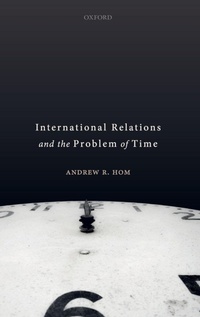
International Relations and the Problem of Time
Published on 27. May 2020
Book
Hardback
312 pages
978-0-19-885001-4 (ISBN)
Description
What is time and how does it influence our knowledge of international politics? For decades International Relations (IR) paid little explicit attention to time. Recently this began to change as a range of scholars took an interest in the temporal dimensions of politics. Yet IR still has not fully addressed the issue of why time matters in international politics, nor has it reflected on its own use of time -- how temporal ideas affect the way we work to understand political phenomena. Moreover, IR remains beholden to two seemingly contradictory visions of time: the time of the clock and a longstanding tradition treating time as a problem to be solved.
International Relations and the Problem of Time develops a unique response to these interconnected puzzles. It reconstructs IR's temporal imagination by developing an argument that all times - from natural rhythms to individual temporal experience - spring from social and practical timing activities, or efforts to establish meaningful and useful relationships in complex and dynamic settings. In IR's case, across a surprisingly wide range of approaches scholars employ narrative timing techniques to make sense of confounding processes and events.
This innovative account of time provides a more systematic and rigorous explanation for time in international politics. It also develops provocative insights about IR's own history, its key methodological commitments, supposedly 'timeless' statistical methods, historical institutions, and the critical vanguard of time studies. This book invites us to reimagine time, and in so doing to significantly rethink the way we approach the analysis of international politics.
International Relations and the Problem of Time develops a unique response to these interconnected puzzles. It reconstructs IR's temporal imagination by developing an argument that all times - from natural rhythms to individual temporal experience - spring from social and practical timing activities, or efforts to establish meaningful and useful relationships in complex and dynamic settings. In IR's case, across a surprisingly wide range of approaches scholars employ narrative timing techniques to make sense of confounding processes and events.
This innovative account of time provides a more systematic and rigorous explanation for time in international politics. It also develops provocative insights about IR's own history, its key methodological commitments, supposedly 'timeless' statistical methods, historical institutions, and the critical vanguard of time studies. This book invites us to reimagine time, and in so doing to significantly rethink the way we approach the analysis of international politics.
Reviews / Votes
IR theorists have only recently begun to engage deliberately with the fact that world politics takes place in time as well as space. Hom's International Relations and the Problem of Time shows what we can achieve by applying social theory to this challenge. Swapping Saint Augustine for Norbert Elias, it employs the concept of timing to map the temporal dimensions of IR theorizing. In so doing, it reveals what makes IR theory tick. * Cian O'Driscoll, Australian National University, International Studies Review * Hom's book attempts to make comprehensive sense of the way time figures in IR scholarship and in the experiential realm of international politics. More broadly, it contributes to debates about time/timing across the social sciences and humanities. It also makes a contribution to ongoing methodological and theoretical debates in IR on the nature of the international realm and how it should be studied. * Kimberly Hutchings, Queen Mary Unversity of London, Perspectives on Politics * [A]n illuminating read-and a very timely one (pun fully intended), both in its contributions to methodological conversations and in its interventions into theoretical debates. * Samarjit Ghosh, OEzyegin University, International Affairs * Explores the relationship between international relations (IR) and time, proposing that time is fundamental to international politics and IR because both practical and theoretical domains are constituted by timing activities and temporal frames of reference. * Journal of Economic Literature (Volume 59, no. 1) *More details
Language
English
Place of publication
Oxford
United Kingdom
Target group
Professional and scholarly
Dimensions
Height: 240 mm
Width: 161 mm
Thickness: 21 mm
Weight
634 gr
ISBN-13
978-0-19-885001-4 (9780198850014)
Copyright in bibliographic data and cover images is held by Nielsen Book Services Limited or by the publishers or by their respective licensors: all rights reserved.
Schweitzer Classification
Other editions
Additional editions
Andrew R. Hom
International Relations and the Problem of Time
E-Book
05/2020
1st Edition
OUP eBook
€57.99
Available for download
Andrew R. Hom
International Relations and the Problem of Time
E-Book
05/2020
1st Edition
OUP eBook
€66.49
Available for download
Person
Andrew Hom is a Senior Lecturer in International Relations at the University of Edinburgh and an Associate Editor of the journal, International Relations. He is the co-editor of Moral Victories: The Ethics of Winning Wars (OUP, 2017) and Time, Temporality, and Global Politics (e-IR, 2016). His work can also be found in the Australian Journal of Politics and History, International Studies Quarterly, International Studies Review, Military Review, Millennium, Review of International Studies, Security Dialogue, the Oxford Handbook of Time and Politics, and the Routledge Handbook of Ethics and International Relations.
Content
Introduction: Two Minutes to Midnight
Part One: Timing Theory and International Relations
1: Timing: The Basic Framework
2: Why Timing Matters
3: Telling Time: A Theory of Narrative Timing
Part Two: Varieties of Timing in International Relations
4: Disciplinary History: Timing Crises in International Relations
5: Methodologies: Narrative Reasoning about a Time-bound World
6: Quantitative Approaches: Mathematical Metaphors for Eternity
7: Historical Institutionalism: From Pathological to Temporal Institutions
8: Critical Approaches: Past Times, Fast Times, and the Rapture of Rupture
Conclusion: Retiming and Reclaiming International Relations
Part One: Timing Theory and International Relations
1: Timing: The Basic Framework
2: Why Timing Matters
3: Telling Time: A Theory of Narrative Timing
Part Two: Varieties of Timing in International Relations
4: Disciplinary History: Timing Crises in International Relations
5: Methodologies: Narrative Reasoning about a Time-bound World
6: Quantitative Approaches: Mathematical Metaphors for Eternity
7: Historical Institutionalism: From Pathological to Temporal Institutions
8: Critical Approaches: Past Times, Fast Times, and the Rapture of Rupture
Conclusion: Retiming and Reclaiming International Relations