

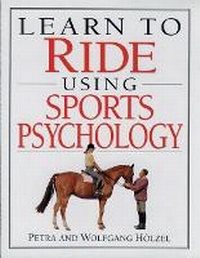
Learn to Ride Using Sports Psychology
Will be published approx. on 6. February 2006
Book
Hardback
160 pages
978-1-872082-86-8 (ISBN)
Description
Using the techniques of sports psychology, this handbook offers an approach on learning to ride. The authors, instructors of international repute, discuss methods for overcoming fear, focusing the mind and positive thinking, and offer advice on how to eradicate faults, make rapid progress and eliminate competition nerves. They examine the precise detail of how to ride, starting from the basics. They analyze the rider's position at halt and in motion, in walk, trot and canter, and over jumps, and describe the aids for a variety of ridden exercises, including circles, turns, half-turns, leg-yield, half turn on the forehand and rein-back. The instruction is so specific that in every exercise the rider should know, even before starting to ride the movement, exactly what he is supposed to be doing and how he should set about achieving it. Using feedback and mental rehearsal, he should also know how to repeat the movement successfully.
More details
Language
English
Place of publication
Haslemere
United Kingdom
Publishing group
Quiller Publishing Ltd
Dimensions
Height: 246 mm
Width: 189 mm
ISBN-13
978-1-872082-86-8 (9781872082868)
Copyright in bibliographic data and cover images is held by Nielsen Book Services Limited or by the publishers or by their respective licensors: all rights reserved.
Schweitzer Classification
Persons
Content
Part one Psychological training: what is psychological training?; the six most important skills for controlling the mind; exercises which can be done without a horse. Part two Coping with fear and learning how to fall. Part three Beginnings: choosing a riding school; first contact with the horse; leading; mounting and dismounting. Part four The fundamentals of riding: methods of teaching and learning; the basic seat; the aids and their effects; half-halts. Part five Individual exercises: transitions; the half turn on the forehand; leg-yielding; riding turns, circles and curves; rein-back. Part six Jumping and the light or half seat: riding in the light or half seat; jumping. Part seven Putting it all together: riding a simple dressage test; riding a simple jumping course. Part eight Entering your first competition.