

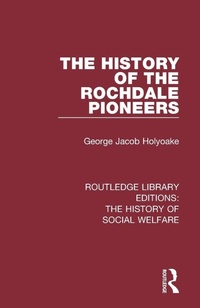
The History of the Rochdale Pioneers
1st Edition
Published on 27. February 2018
Book
Paperback/Softback
212 pages
978-1-138-20472-0 (ISBN)
Description
First published in 1893, this tenth edition of The History of the Rochdale Pioneers, is an example of the nineteenth-century tradition of self-help manuals. It describes the origins and the development of the Rochdale Equitable Pioneers Society, the problems faced by the Rochdale Pioneers through economically tough times and how the collective were able to overcome these difficulties.
This book will be of interest to those studying the history of social welfare, class and economics, as well as the Co-operative Movement.
This book will be of interest to those studying the history of social welfare, class and economics, as well as the Co-operative Movement.
More details
Series
Language
English
Place of publication
London
United Kingdom
Publishing group
Taylor & Francis Ltd
Target group
College/higher education
Dimensions
Height: 198 mm
Width: 129 mm
Thickness: 12 mm
Weight
231 gr
ISBN-13
978-1-138-20472-0 (9781138204720)
Copyright in bibliographic data and cover images is held by Nielsen Book Services Limited or by the publishers or by their respective licensors: all rights reserved.
Schweitzer Classification
Other editions
Additional editions
George Jacob Holyoake
The History of the Rochdale Pioneers
E-Book
09/2016
Routledge
€52.49
Available for download
George Jacob Holyoake
The History of the Rochdale Pioneers
E-Book
09/2016
Routledge
€52.49
Available for download
George Jacob Holyoake
The History of the Rochdale Pioneers
Book
09/2016
1st Edition
Routledge
€215.41
Shipment within 10-20 days
Person
George Jacob Holyoake (1817-1906) was a pioneering British social reformer, secularist, and writer known for his influential work in advocating for secularism and free thought. Born in Birmingham, Holyoake initially worked in various trades before becoming a prominent figure in the reform movement. His commitment to secularism and the separation of church and state is most notably captured in his seminal work, The Principles of Secularism. Holyoake's contributions to social reform extend beyond his writing; he was a key figure in the development of secularism as a political and philosophical movement. His advocacy for free thought challenged the prevailing religious doctrines of his time, and he was a vocal proponent of rationalism and humanism. Holyoake's efforts were instrumental in promoting secular ethics and civil rights, influencing public policy and educational reform. Throughout his career, Holyoake faced significant opposition and even imprisonment for his views, but he remained steadfast in his pursuit of a society guided by reason and justice. His legacy endures through his writings and the ongoing impact of secularist principles in modern discourse.
Content
Part I: 1844-57; 1. The First Efforts and the Kind of people who made them 2. Appointment of a Deputation to Masters - Great Debate in the Flannel Weavers' Parliament 3. The Doffers Appear at the Opening Day - Moral Buying as well as Moral Selling 4. The Society Tried by Two Well-Known Difficulties - Prejudice and Sectarianism 5. Enemies Within and Enemies Without, and how they were Conquered 6. The Great Flour Mill Panic 7. Successive Steps of Success - The Rochdale Store on a Saturday Night 8. Anecdotes of the Members - The Working Class Stand by the Store and they 'Know the Reason Why' 9. Rules and Aims of the Society 10. The Old Co-operators - Why They Failed. The New Co-operators - Why they Succeed 11. An Illustrative Chapter 12. An Old Pioneer's Account of the Origin of the Store; Part II - 1857-78; 13. The Weavers' Dream 14. The Famous Twenty-Eight 15. Legal Impediments to Economy 16. Querulous Outsiders 17. Four Dangerous Years 18. Halting on the Way 19. Story of the Corn Mill 20. Origin of the 'Wholesale' 21. Co-operative Administration 22. The Branch Store Agitation 23. Other Characteristics of the Rochdale Pioneers 24. Contests for Principle 25. Dead Pioneers; Part III: 1982; 26. The Rochdale Congress of 1892