

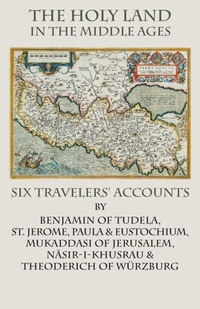
The Holy Land in the Middle Ages
Six Travelers' Accounts
Italica Press
Published on 10. December 2016
Book
Paperback/Softback
412 pages
978-1-59910-313-6 (ISBN)
Description
This completely revised and updated edition presents texts written by medieval Christian, Muslim and Jewish travelers to the Holy Land, including:
St. Jerome, The Pilgrimage of Holy Paula, c.382 CE
Paula & Eustochium, Letter to Marcella on the ¿Holy Places, 386
Mukaddasi of Jerusalem, Description of Palestine, 985
Diary of a Journey through Syria and Palestine, 1047
Theoderich of Würzburg, Guide to the Holy Land, c.1172
Benjamin of Tudela, Description of the Holy Land, ¿from his Itinerary, c.1173
The Holy Land in the Middle Ages also features:
over 400 pages
nearly 100 black & white and color photos, historical drawings, and prints
7 building plans
Gazetteer of places, buildings, and holy sites
Gallery of 9 City Views of Jerusalem from the 6th to ¿the 16th century
Gallery of 8 Maps of the Holy Land from c.1200 to 1630
Maps of the Holy Land and Jerusalem
In a region often caricatured by the images and rhetoric of crusade and jihad, it's important to realize that through most of its medieval history the Holy Land was host to countless curious and devout travelers of all three faiths. They sailed to the same ports, walked and rode the same roads, lodged in the same cities and towns and visited and revered the same secular and sacred sites. The Holy Land in the Middle Ages offers important texts documenting these centuries of peaceful co-existence.
There has been a revival of "crusade studies" in recent years, sometimes marked by contentious claims of "clash of civilizations," the deeply violent nature of the religions of the book and the ineluctable structures of colonialism and militarism. But the following accounts offer a different narrative: of devotion that goes beyond religious labels, of a mixture of peoples and faiths that left room for curiosity and for a practical tolerance of the other. As the following pages reveal, the narrators of these works were less interested in issues of religious contention, territorial domination or cultural hegemony and more in the history, legends, art and architecture, the sounds, smells and tastes, the peoples, products and goods, and in the topography and sacred geography of the Holy Land.
410 pages. Index, bibliography. Over 100 illustrations in color and b&w.
St. Jerome, The Pilgrimage of Holy Paula, c.382 CE
Paula & Eustochium, Letter to Marcella on the ¿Holy Places, 386
Mukaddasi of Jerusalem, Description of Palestine, 985
Diary of a Journey through Syria and Palestine, 1047
Theoderich of Würzburg, Guide to the Holy Land, c.1172
Benjamin of Tudela, Description of the Holy Land, ¿from his Itinerary, c.1173
The Holy Land in the Middle Ages also features:
over 400 pages
nearly 100 black & white and color photos, historical drawings, and prints
7 building plans
Gazetteer of places, buildings, and holy sites
Gallery of 9 City Views of Jerusalem from the 6th to ¿the 16th century
Gallery of 8 Maps of the Holy Land from c.1200 to 1630
Maps of the Holy Land and Jerusalem
In a region often caricatured by the images and rhetoric of crusade and jihad, it's important to realize that through most of its medieval history the Holy Land was host to countless curious and devout travelers of all three faiths. They sailed to the same ports, walked and rode the same roads, lodged in the same cities and towns and visited and revered the same secular and sacred sites. The Holy Land in the Middle Ages offers important texts documenting these centuries of peaceful co-existence.
There has been a revival of "crusade studies" in recent years, sometimes marked by contentious claims of "clash of civilizations," the deeply violent nature of the religions of the book and the ineluctable structures of colonialism and militarism. But the following accounts offer a different narrative: of devotion that goes beyond religious labels, of a mixture of peoples and faiths that left room for curiosity and for a practical tolerance of the other. As the following pages reveal, the narrators of these works were less interested in issues of religious contention, territorial domination or cultural hegemony and more in the history, legends, art and architecture, the sounds, smells and tastes, the peoples, products and goods, and in the topography and sacred geography of the Holy Land.
410 pages. Index, bibliography. Over 100 illustrations in color and b&w.
More details
Series
Edition
Unabridged edition
Language
English
Edition type
Unabridged edition
Product notice
Paperback (trade)
Unsewn / adhesive bound
Illustrations
Illustrations
Dimensions
Height: 216 mm
Width: 140 mm
Thickness: 22 mm
Weight
516 gr
ISBN-13
978-1-59910-313-6 (9781599103136)
Copyright in bibliographic data and cover images is held by Nielsen Book Services Limited or by the publishers or by their respective licensors: all rights reserved.
Schweitzer Classification