

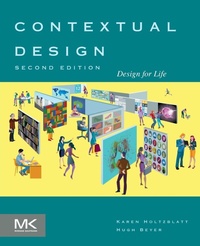
Contextual Design
Design for Life
2nd Edition
Published on 15. December 2016
Book
Paperback/Softback
530 pages
978-0-12-800894-2 (ISBN)
Description
Contextual Design: Design for Life, Second Edition, describes the core techniques needed to deliberately produce a compelling user experience. Contextual design was first invented in 1988 to drive a deep understanding of the user into the design process. It has been used in a wide variety of industries and taught in universities all over the world. Until now, the basic CD approach has needed little revision, but with the wide adoption of handheld devices, especially smartphones, the way technology is integrated into people's lives has fundamentally changed. Contextual Design V2.0 introduces both the classic CD techniques and the new techniques needed to "design for life", fulfilling core human motives while supporting activities.
This completely updated and revised edition is written in a clear, informal style without excessive jargon, and is the must-have book for any UX Design library. Users will find coverage of mobile devices and consumer and business products, all illustrated with new examples, case studies, and discussions on how to use CD with the agile development and other project requirements methods.
This completely updated and revised edition is written in a clear, informal style without excessive jargon, and is the must-have book for any UX Design library. Users will find coverage of mobile devices and consumer and business products, all illustrated with new examples, case studies, and discussions on how to use CD with the agile development and other project requirements methods.
More details
Series
Edition
2nd edition
Language
English
Place of publication
San Francisco
United States
Publishing group
Elsevier Science & Technology
Target group
College/higher education
Dimensions
Height: 233 mm
Width: 189 mm
Thickness: 32 mm
Weight
1112 gr
ISBN-13
978-0-12-800894-2 (9780128008942)
Copyright in bibliographic data and cover images is held by Nielsen Book Services Limited or by the publishers or by their respective licensors: all rights reserved.
Schweitzer Classification
Other editions
Additional editions
E-Book
11/2016
2nd Edition
Morgan Kaufmann
€57.95
Available for download
Previous edition
Book
12/1997
Morgan Kaufmann
€102.93
Article exhausted; check for reprint
Persons
Karen Holtzblatt is a co-founder of InContext Enterprises, Inc., a firm that works with companies, coaching teams to design products, product strategies, and information systems from customer data. Karen Holtzblatt developed the Contextual Inquiry field data gathering technique that forms the core of Contextual Design and is now taught and used world-wide. Hugh Beyer is a co-founder of InContext Enterprises, Inc., a firm that works with companies, coaching teams to design products, product strategies, and information systems from customer data. Hugh Beyer has pioneered the link between the customer-centered front end and object-oriented design.
Content
Part 1. Gathering User Data
1. Introduction
2. User Data Drives Design
3. Principles of Contextual Inquiry
4. The Interpretation Session
Part 2. Revealing the World
5. From Data to Insight: Contextual Design Models
6. The Affinity Diagram
7. Building Experience Models
8. Traditional Contextual Design Models
Part 3. Reinventing Life: Ideation with User Data
9. Inventing the Next Product Concept
10. The Bridge From Data to Design: The Wall Walk
11. Ideation: Visioning and the Cool Drilldown
Part 4. Defining the Product
12. The Challenge of Product Design
13. Storyboards
14. The User Environment Design
15. Interaction Patterns
Part 5. Making It Real
16. Making It Real
17. Validating the Design
18. Prioritization and Rollout
19. Project Planning and Execution
20. Conclusion
1. Introduction
2. User Data Drives Design
3. Principles of Contextual Inquiry
4. The Interpretation Session
Part 2. Revealing the World
5. From Data to Insight: Contextual Design Models
6. The Affinity Diagram
7. Building Experience Models
8. Traditional Contextual Design Models
Part 3. Reinventing Life: Ideation with User Data
9. Inventing the Next Product Concept
10. The Bridge From Data to Design: The Wall Walk
11. Ideation: Visioning and the Cool Drilldown
Part 4. Defining the Product
12. The Challenge of Product Design
13. Storyboards
14. The User Environment Design
15. Interaction Patterns
Part 5. Making It Real
16. Making It Real
17. Validating the Design
18. Prioritization and Rollout
19. Project Planning and Execution
20. Conclusion