

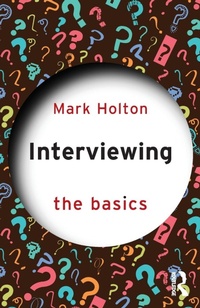
Interviewing: The Basics
The Basics
1st Edition
Published on 1. October 2024
Book
Paperback/Softback
214 pages
978-1-032-27440-9 (ISBN)
Description
This text outlines the relative merits of qualitative interviewing to new and emerging scholars in an accessible way. This is achieved not by providing an exhaustive 'how-to' guide but in introducing researchers to the interview technique and using examples of 'best practice' from across the social sciences.
To ensure the book is both accessible and inclusive, efforts have been made to include case studies from a diverse range of authors, including those from different ethnic and social backgrounds, from outside Western Europe/North America, and from non-academic sources. This book will therefore introduce the reader to the key themes surrounding interview design, implementation, analysis and presentation, using examples and case studies from research across the social sciences.
Crucially, the book will not provide exhaustive guidance on how to conduct the techniques. Instead, each chapter includes a range of interview design activities for readers to try which might help them engage with the chapter topics, as well as a 'Summary' box which comprises a short annotated reading list of key texts relating to each of the chapter topics and a checklist of things to consider relating to the chapter topics.
To ensure the book is both accessible and inclusive, efforts have been made to include case studies from a diverse range of authors, including those from different ethnic and social backgrounds, from outside Western Europe/North America, and from non-academic sources. This book will therefore introduce the reader to the key themes surrounding interview design, implementation, analysis and presentation, using examples and case studies from research across the social sciences.
Crucially, the book will not provide exhaustive guidance on how to conduct the techniques. Instead, each chapter includes a range of interview design activities for readers to try which might help them engage with the chapter topics, as well as a 'Summary' box which comprises a short annotated reading list of key texts relating to each of the chapter topics and a checklist of things to consider relating to the chapter topics.
More details
Series
Language
English
Place of publication
London
United Kingdom
Publishing group
Taylor & Francis Ltd
Target group
College/higher education
General and Undergraduate Core
Illustrations
5 s/w Abbildungen, 5 s/w Zeichnungen, 5 s/w Tabellen
5 Tables, black and white; 5 Line drawings, black and white; 5 Illustrations, black and white
Dimensions
Height: 198 mm
Width: 129 mm
Thickness: 12 mm
Weight
246 gr
ISBN-13
978-1-032-27440-9 (9781032274409)
Copyright in bibliographic data and cover images is held by Nielsen Book Services Limited or by the publishers or by their respective licensors: all rights reserved.
Schweitzer Classification
Other editions
Additional editions

Mark Holton
Interviewing: The Basics
Book
10/2024
1st Edition
Routledge
€215.77
Shipment within 10-20 days
Person
Mark Holton is a human geographer who focuses on the social and cultural geographies of young people and youth culture. Mark has considerable experience in designing and utilising conventional and experimental qualitative techniques across a range of externally-funded research projects. This has resulted in a variety of methods-related outputs for leading academic journals (e.g. Area and Mobilities); chapters for academic reference titles (e.g. Handbook of Qualitative Research in Education and The SAGE Encyclopaedia of Higher Education); and online research methods guides (e.g. Oxford Bibliographies and SAGE Research Methods). Most recently, Mark co-edited Creative Methods for Human Geographers, a 29-chapter book that introduces, mainly novice, researchers to a range of creative approaches to research design.
Content
0.Preface - about qualitative interviewing. Part One - Preparing Interviews. 1.'A conversation with a purpose'? 2.Where do I begin? - The basics of interview design. 3.Structuring an interview - designing interview questions. 4.Making sense of positionality and power in interviews. 5.Ethics and ethical issues. Part Two - Doing Interviews. 6.'Doing' interviews. 7.Using non-verbal materials in interview practice. 8.Digital interviewing. Part Three - Handling Interview Data. 9.What happens next? - On transcribing, coding and analysis. 10.Presenting data - putting your participants' words on the page.