

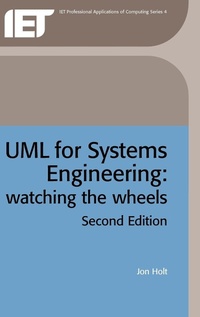
UML for Systems Engineering
Watching the wheels
2nd Edition
Published on 10. September 2004
Book
Hardback
376 pages
978-0-86341-354-4 (ISBN)
Description
Up until a few years ago there were many different modelling languages available to software developers. However, this vast array of choice only served to hinder communication and as a result the Unified Modelling Language (UML) was born. Although the UML has its roots firmly in the software world, the benefits of adopting a standard visual notation have been recognised in many other fields, not least of which is the field of systems engineering. This book concentrates on systems-based applications, rather than the traditional software applications that are more usually associated with the UML. Now fully updated to reflect the changes to UML for its version 2.0 release, this new edition has been substantially re-written and includes new material on systems architectures and life cycle management.
More details
Series
Edition
2nd edition
Language
English
Place of publication
Stevenage
United Kingdom
Target group
Professional and scholarly
Dimensions
Height: 240 mm
Width: 161 mm
Thickness: 24 mm
Weight
730 gr
ISBN-13
978-0-86341-354-4 (9780863413544)
Copyright in bibliographic data and cover images is held by Nielsen Book Services Limited or by the publishers or by their respective licensors: all rights reserved.
Schweitzer Classification
Other editions
Additional editions
E-Book
11/2008
2nd Edition
Institution of Engineering and Technology
€349.99
Available for download
Person
Jon Holt is the founder-director of Brass Bullet Ltd, a company specialising in systems engineering consultancy, services and training. He is actively involved in promoting systems engineering through the IET and other professional bodies.
Content
Chapter 1: Systems engineering
Chapter 2: Modelling
Chapter 3: Structural modelling
Chapter 4: Behavioural modelling
Chapter 5: The UML diagrams
Chapter 6: Modelling standards, processes and procedures
Chapter 7: Modelling requirements
Chapter 8: Life cycle management
Chapter 9: System architectures
Chapter 10: Extending the UML
Chapter 11: Tools
Chapter 2: Modelling
Chapter 3: Structural modelling
Chapter 4: Behavioural modelling
Chapter 5: The UML diagrams
Chapter 6: Modelling standards, processes and procedures
Chapter 7: Modelling requirements
Chapter 8: Life cycle management
Chapter 9: System architectures
Chapter 10: Extending the UML
Chapter 11: Tools