

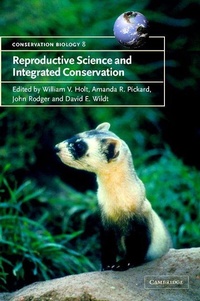
Reproductive Science and Integrated Conservation
Published on 5. December 2002
Book
Paperback/Softback
426 pages
978-0-521-01110-5 (ISBN)
Description
Reproduction is essential to the continuation and evolution of life on this planet and is therefore a centrally important process in the conservation of wildlife. However, reproductive mechanisms are well understood in only a handful of vertebrate species, mostly domestic livestock and laboratory animals. This means that attempts to develop and implement management policies for wildlife conservation, and especially for endangered species that, by definition, are difficult to study, are often based on poor data or no data at all. In Reproductive Science and Integrated Conservation leading authorities provide glimpses of reproductive diversity in fishes, amphibia, reptiles, birds and mammals. Conservation plans are founded on the assumption that reproduction will be successful, but what if it fails? This book reviews the many factors that influence reproduction, including genetics, behaviour and nutrition, and experts assess the potential conservation relevance of the recent rapid advances in reproductive technology and medicine.
Reviews / Votes
'This is a readable and engrossing book. This book reviews the many factors that influence reproduction. Sixth formers, students and zoo educators would benefit from reading the book if they have an interest in conservation. Long time biologists like me may be absorbed in the topic and heartily encouraged.' Journal of Biological Education '... it is a realistic look at the current state of conservation biology and those who have an interest in cryopreservation for the purposes of conservation will find much of its content of value.' CryoLettersMore details
Series
Language
English
Place of publication
Cambridge
United Kingdom
Target group
Professional and scholarly
Product notice
Paperback (trade)
Illustrations
34 Tables, unspecified; 12 Halftones, unspecified; 41 Line drawings, unspecified
Dimensions
Height: 229 mm
Width: 152 mm
Thickness: 23 mm
Weight
614 gr
ISBN-13
978-0-521-01110-5 (9780521011105)
Copyright in bibliographic data and cover images is held by Nielsen Book Services Limited or by the publishers or by their respective licensors: all rights reserved.
Schweitzer Classification
Other editions
Additional editions
William V. Holt | Amanda R. Pickard | John C. Rodger
Reproductive Science and Integrated Conservation
E-Book
12/2004
1st Edition
Cambridge University Press
€73.99
Available for download
Persons
William V. Holt is a Senior Research Fellow at the Institute of Zoology, Zoological Society of London, and heads the Reproductive Biology Group. Amanda Pickard is a Research Fellow at the Institute of Zoology, Zoological Society of London. John Rodger is Director of the Australian Government's multi-organisation Cooperative Research Centre for Conservation and Management of Marsupials. David Wildt is Senior Scientist and Head, Department of Reproductive Sciences, Smithsonian National Zoological Park, Washington.
Content
List of contributors; Foreword Richard Stone; Part I. Introduction: 1. Toward more effective reproductive science for conservation David E. Wildt, Susie Ellis, Donald Janssen and Jennifer Buff; Part II. Reproduction and Population Viability: Introduction; 2. Behaviour and reproduction Alan Dixson, Nancy Harvey, Marilyn Patton and Joanna Setchell; 3. Nutrition and its interaction with reproductive processes Tom G. McEvoy and John J. Robinson; 4. Environmental chemicals and the threat to male fertility in mammals: evidence and perspective Helen S. Baillie, Allan A. Pacey and Harry D. M. Moore; 5. Assessing the consequences of inbreeding for population fitness: past challenges and future prospects Andrea C. Taylor; 6. Impacts of inbreeding on components of reproductive success Karen Koeninger Ryan, Robert C. Lacy and Susan W. Margulis; 7. The major histocompatibility complex (MHC) in declining populations: an example of adaptive variation Philip Hedrick; 8. When is the birth rate the key factor associated with population dynamics? Tim Coulson and Elodie Hudson; Part III. Reproductive Techniques for Conservation Management: Introduction; 9. Reproductive and welfare monitoring for the management of ex-situ populations Amanda R. Pickard; 10. Non-invasive endocrine measures of reproduction and stress in wild populations Steven L. Monfort; 11. Ultrasound for analysis of reproductive function in wildlife species Thomas B. Hildebrandt, Janine L. Brown, Robert Hermes and Frank Goritz; 12. Role of embryo technologies in genetic management and conservation of wildlife Naida M. Loskutoff; 13. Application of nuclear transfer technology to wildlife species J. K. Critser, L. K. Riley and R. S. Prather; Part IV. Integrated Conservation Management: Introduction; 14. Integrating reproductive sciences into recovery programmes for declining and extinct marsupial populations Peter D. Temple-Smith; 15. Captive breeding and predator control: a successful strategy for conservation in Western Australia Terry Fletcher and Keith Morris; 16. Black-footed ferret: model for assisted reproductive technologies contributing to in situ conservation JoGayle Howard, Paul E. Marinari and David E. Wildt; 17. Genetic resource banks for species conservation W. V. Holt, Teresa Abaigar, P. F. Watson and D. E. Wildt; 18. Fertility control for wildlife John C. Rodger; 19. Contraceptive vaccine development Karen E. Mate and Lyn A. Hinds; 20. Field applications of fertility control for wildlife management Phil Cowan, Roger Pech and Paul Curtis; Part V. Reproductive Science in Non-Mammalian Species: Introduction; 21. Reproductive technologies and challenges in avian conservation and management Ann M. Donoghue, Juan Manuel Blanco, George F. Gee, Yvonne Kirkby and David E. Wildt; 22. Reptile reproduction and endocrinology Valentine A. Lance; 23. Reproductive research and the worldwide amphibian extinction crisis Terri L. Roth and Amy Obringer; 24. Reproduction in fishes in relation to conservation Gordon McGregor Reid and Heather Hall; Part VI. Conclusion: 25. Postscript - sex, wildlife and vindication W. V. Holt, A. R. Pickard, J. C. Rodger and D. E. Wildt; Index.