

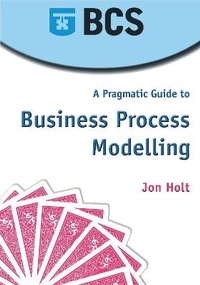
A Pragmatic Guide to Business Process Modelling
Published on 1. September 2005
Book
Paperback/Softback
160 pages
978-1-902505-66-4 (ISBN)
Description
Improving processes, productivity and profitability within your organisation is often best achieved by having a detailed knowledge of business process modelling. It is considered a core competency for anyone involved in managing change and Jon Holt's expert text explores all the main aspects including process analysis and process documentation. Applying the standard modelling notation (UML), the result is a detailed, step-by-step guide to the entire modelling process.
More details
Language
English
Place of publication
Swindon
United Kingdom
Publishing group
BCS Learning & Development Limited
Target group
Professional and scholarly
Illustrations
111 Illustrations
Dimensions
Height: 246 mm
Width: 172 mm
Thickness: 10 mm
Weight
394 gr
ISBN-13
978-1-902505-66-4 (9781902505664)
Copyright in bibliographic data and cover images is held by Nielsen Book Services Limited or by the publishers or by their respective licensors: all rights reserved.
Schweitzer Classification
Other editions
New editions
Book
07/2009
2nd Edition
British Computer Society
€69.51
Article is exhausted; no reprint
Person
Jon Holt is the founder-director of Brass Bullet Ltd, a software and systems engineering consultancy company based in Swansea, South Wales. He holds a number of positions at universities both in the UK and the USA and is a Fellow of the BCS and the IEE. His work interests include all aspects of process modelling, standards and education.
Content
Introduction; The magic of processes; Background; Risk; The Process; Process modelling; Standards, processes, procedures and guidelines; Problems with processes; Modelling techniques; The UML; Requirements for process modelling; Requirements for modelling; Requirements for processes; Tailoring processes; The process meta-model; Conclusions; Modelling; Introduction; Modelling; UML modelling; Consistency; Conclusions; The meta-model expanded; The requirements view; The process structure view; The process content view; The process behaviour view; The information view; The stakeholder view; The process instance view; Applying the meta-model; Process mapping; Introduction; A process for process mapping; Tailoring the process mapping process; Conclusions; Case studies; References & bibliography; Glossary