

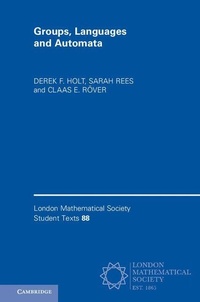
Groups, Languages and Automata
Published on 23. February 2017
Book
Hardback
306 pages
978-1-107-15235-9 (ISBN)
Description
Fascinating connections exist between group theory and automata theory, and a wide variety of them are discussed in this text. Automata can be used in group theory to encode complexity, to represent aspects of underlying geometry on a space on which a group acts, and to provide efficient algorithms for practical computation. There are also many applications in geometric group theory. The authors provide background material in each of these related areas, as well as exploring the connections along a number of strands that lead to the forefront of current research in geometric group theory. Examples studied in detail include hyperbolic groups, Euclidean groups, braid groups, Coxeter groups, Artin groups, and automata groups such as the Grigorchuk group. This book will be a convenient reference point for established mathematicians who need to understand background material for applications, and can serve as a textbook for research students in (geometric) group theory.
Reviews / Votes
'The authors study how automata can be used to determine whether a group has a solvable word problem or not. They give detailed explanations on how automata can be used in group theory to encode complexity, to represent certain aspects of the underlying geometry of a space on which a group acts, its relation to hyperbolic groups ... it will convince the reader of the beauty and richness of Group Theory.' Charles Traina, MAA Reviews 'There are copious references and separate indices for notation, subjects, and names of earlier researchers. In summary, this text (written by three experts on the subjects) is a mostly self-contained condensation of hundreds of individual articles. It will serve as a valuable one-stop resource for both researchers and students.' Eric M. Freden, MathSciNetMore details
Series
Language
English
Place of publication
Cambridge
United Kingdom
Target group
Professional and scholarly
Illustrations
Worked examples or Exercises; 35 Line drawings, black and white
Dimensions
Height: 235 mm
Width: 157 mm
Thickness: 21 mm
Weight
599 gr
ISBN-13
978-1-107-15235-9 (9781107152359)
Copyright in bibliographic data and cover images is held by Nielsen Book Services Limited or by the publishers or by their respective licensors: all rights reserved.
Schweitzer Classification
Other editions
Additional editions
Derek F. Holt | Sarah Rees | Claas E. Roever
Groups, Languages and Automata
Book
02/2017
Cambridge University Press
€49.50
Shipment within 15-20 days
Derek F. Holt
Groups, Languages and Automata
E-Book
02/2017
Cambridge University Press
€30.49
Available for download
Derek F. Holt | Sarah Rees | Claas E. Roever
Groups, Languages and Automata
E-Book
02/2017
Cambridge University Press
€36.99
Available for download
Persons
Derek F. Holt is a professor of mathematics at the University of Warwick. He authored the successful Handbook of Computational Group Theory, which has now become the standard text in the subject, and he co-authored The Maximal Subgroups of Low-Dimensional Groups (with John N. Bray and Colva M. Roney-Dougal, Cambridge, 2013). Holt was also one of five co-authors of the seminal book Word Processing in Groups (1992) on the theory of automatic groups, and has contributed mathematical software to the Magma and GAP systems. In 1981, he was awarded the London Mathematical Society Junior Whitehead Prize. Sarah Rees is a professor of pure mathematics at the University of Newcastle upon Tyne. She is an active researcher in the fields covered in this book, and has supervised a number of graduate students in this area. Claas E. Roever is a lecturer in mathematics at the National University of Ireland, Galway. He began researching the topics covered in this book during a post-doctoral position in Newcastle and has since contributed to the rapid development of this area of mathematics.
Content
Preface; Part I. Introduction: 1. Group theory; 2. Formal languages and automata theory; 3. Introduction to the word problem; Part II. Finite State Automata and Groups: 4. Rewriting systems; 5. Automatic groups; 6. Hyperbolic groups; 7. Geodesics; 8. Subgroups and co-set systems; 9. Automata Groups; Part III. The Word Problem: 10. Solubility of the word problem; 11. Context-free and one-counter word problems; 12. Context-sensitive word problems; 13. Word problems in other language classes; 14. The co-word problem and the conjugacy problem; References; Index of notation; Index of names; Index of topics and terminology.