

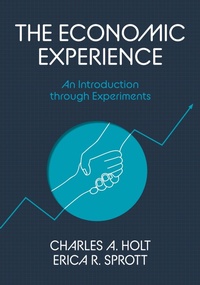
The Economic Experience
An Introduction through Experiments
Published on 29. July 2025
Book
Hardback
248 pages
978-0-691-26409-7 (ISBN)
Description
An innovative introduction to economic behavior that uses interactive experiments to promote experience-based discovery
This book presents a unique active-learning approach to economic thinking, providing a behavioral perspective on basic economic concepts ranging from trust to trade. Each chapter features a classroom experiment where students engage directly with the material as market participants, and chapters come with warm-up exercises, quizzes, and incisive summaries. The Economic Experience empowers students to develop insights into essential economic principles and goes beyond merely documenting behavioral anomalies by showing students how to navigate and anticipate them through hands-on learning and team building.
Encourages discovery of key behavioral insights with interactive class simulations
Provides a Socratic structure through lab reports for interpreting and applying lessons from experiment results while interacting with fellow students
Includes "What Economists Do" sections that highlight key applications and policy issues
Covers standard topics such as gains from trade, marginal analysis, and the resilience of competitive markets
Enables students to experience the negative effects of market imperfections related to monopoly power, non-price rent seeking, corruption, congestion, and inadequate incentives for the provision of public goods
Introduces notions of risk and strategic behavior in games and auctions
Explains foundational macroeconomic concepts such as financial markets and the role of money while addressing behavioral issues like bank runs and asset market price bubbles that may arise in a macroeconomic setting
Is supported by a free website that instructors can use to set up classroom experiments online
This book presents a unique active-learning approach to economic thinking, providing a behavioral perspective on basic economic concepts ranging from trust to trade. Each chapter features a classroom experiment where students engage directly with the material as market participants, and chapters come with warm-up exercises, quizzes, and incisive summaries. The Economic Experience empowers students to develop insights into essential economic principles and goes beyond merely documenting behavioral anomalies by showing students how to navigate and anticipate them through hands-on learning and team building.
Encourages discovery of key behavioral insights with interactive class simulations
Provides a Socratic structure through lab reports for interpreting and applying lessons from experiment results while interacting with fellow students
Includes "What Economists Do" sections that highlight key applications and policy issues
Covers standard topics such as gains from trade, marginal analysis, and the resilience of competitive markets
Enables students to experience the negative effects of market imperfections related to monopoly power, non-price rent seeking, corruption, congestion, and inadequate incentives for the provision of public goods
Introduces notions of risk and strategic behavior in games and auctions
Explains foundational macroeconomic concepts such as financial markets and the role of money while addressing behavioral issues like bank runs and asset market price bubbles that may arise in a macroeconomic setting
Is supported by a free website that instructors can use to set up classroom experiments online
More details
Language
English
Place of publication
New Jersey
United States
Target group
College/higher education
Product notice
Trade binding
Illustrations
44 b/w illus. 51 tables.
Dimensions
Height: 254 mm
Width: 178 mm
Thickness: 18 mm
Weight
717 gr
ISBN-13
978-0-691-26409-7 (9780691264097)
Copyright in bibliographic data and cover images is held by Nielsen Book Services Limited or by the publishers or by their respective licensors: all rights reserved.
Schweitzer Classification
Other editions
Additional editions
E-Book
07/2025
Penguin Random House South Africa
€38.99
Available for download
Persons
Charles A. Holt is the A. Willis Robertson Professor of Political Economy at the University of Virginia. His books include Experimental Economics (with Douglas D. Davis), Markets, Games, and Strategic Behavior, and Quantal Response Equilibrium (with Jacob K. Goeree and Thomas R. Palfrey) (all Princeton). Erica R. Sprott is a doctoral student at the Harvard Kennedy School and a National Science Foundation Graduate Research Fellow.
Content
Preface
Chapter 1 Trust, Reciprocity, and Fairness
Chapter 2 Specialization, Production, and Gains from Trade
Chapter 3 Demand: Functions, Shifts, and Marginal Analysis
Chapter 4 Market Equilibrium and the Role of Price
Chapter 5 Opportunity Cost and the Supply Side
Chapter 6 Cost Functions and Supply for a Price Taker
Chapter 7 Elasticity, Marginal Revenue, and Monopoly
Chapter 8 Social Dilemmas and Public Goods
Chapter 9 Common Pool Dilemmas: Congestion and Corruption
Chapter 10 Rent Seeking and Non-Market Allocations
Chapter 11 Risk and Loss Aversion
Chapter 12 Games of Coordination, Cooperation, and Competition
Chapter 13 Auctions and the Winner's Curse
Chapter 14 Banking in the Shadow of Behavioral Instability
Chapter 15 Asset Markets and Present Value
Chapter 16 Macro Markets for Labor and Consumer Goods
Index
Chapter 1 Trust, Reciprocity, and Fairness
Chapter 2 Specialization, Production, and Gains from Trade
Chapter 3 Demand: Functions, Shifts, and Marginal Analysis
Chapter 4 Market Equilibrium and the Role of Price
Chapter 5 Opportunity Cost and the Supply Side
Chapter 6 Cost Functions and Supply for a Price Taker
Chapter 7 Elasticity, Marginal Revenue, and Monopoly
Chapter 8 Social Dilemmas and Public Goods
Chapter 9 Common Pool Dilemmas: Congestion and Corruption
Chapter 10 Rent Seeking and Non-Market Allocations
Chapter 11 Risk and Loss Aversion
Chapter 12 Games of Coordination, Cooperation, and Competition
Chapter 13 Auctions and the Winner's Curse
Chapter 14 Banking in the Shadow of Behavioral Instability
Chapter 15 Asset Markets and Present Value
Chapter 16 Macro Markets for Labor and Consumer Goods
Index