

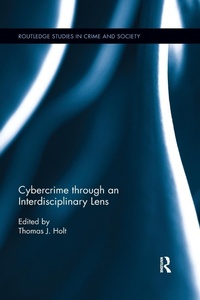
Cybercrime Through an Interdisciplinary Lens
1st Edition
Published on 5. March 2019
Book
Paperback/Softback
256 pages
978-0-367-22633-6 (ISBN)
Description
Research on cybercrime has been largely bifurcated, with social science and computer science researchers working with different research agendas. These fields have produced parallel scholarship to understand cybercrime offending and victimization, as well as techniques to harden systems from compromise and understand the tools used by cybercriminals. The literature developed from these two fields is diverse and informative, but until now there has been minimal interdisciplinary scholarship combining their insights in order to create a more informed and robust body of knowledge.
This book offers an interdisciplinary approach to research on cybercrime and lays out frameworks for collaboration between the fields. Bringing together international experts, this book explores a range of issues from malicious software and hacking to victimization and fraud. This work also provides direction for policy changes to both cybersecurity and criminal justice practice based on the enhanced understanding of cybercrime that can be derived from integrated research from both the technical and social sciences. The authors demonstrate the breadth of contemporary scholarship as well as identifying key questions that could be addressed in the future or unique methods that could benefit the wider research community.
This edited collection will be key reading for academics, researchers, and practitioners in both computer security and law enforcement. This book is also a comprehensive resource for postgraduate and advanced undergraduate students undertaking courses in social and technical studies.
This book offers an interdisciplinary approach to research on cybercrime and lays out frameworks for collaboration between the fields. Bringing together international experts, this book explores a range of issues from malicious software and hacking to victimization and fraud. This work also provides direction for policy changes to both cybersecurity and criminal justice practice based on the enhanced understanding of cybercrime that can be derived from integrated research from both the technical and social sciences. The authors demonstrate the breadth of contemporary scholarship as well as identifying key questions that could be addressed in the future or unique methods that could benefit the wider research community.
This edited collection will be key reading for academics, researchers, and practitioners in both computer security and law enforcement. This book is also a comprehensive resource for postgraduate and advanced undergraduate students undertaking courses in social and technical studies.
Reviews / Votes
"This innovative, and very interesting, book brings new perspectives to a phenomenon that has been around for many decades. I found all of the chapters to be thought-provoking in terms of the new perspectives they bring to this old problem. I recommend the book in the highest possible terms, for those who study cybercrime, for law enforcement and for the intelligent citizen who would like to learn more about this often neglected criminal threat."Susan W. Brenner, Professor and Samuel A. McCray Chair in Law, University of Dayton School of Law, USA
"What I find so refreshing about Tom Holt's new collection is that it brings new and established authors together to present a range of different interdisciplinary perspectives on cybercrime. It marks a welcome shift in approach and will help improve our collective understanding of a phenomena that is progressively intruding into every aspect of our everyday lives."
David S. Wall, Professor of Criminology, Centre for Criminal Justice Studies, University of Leeds, UK
"With the scourge of cybercrime permeating nearly all online activity, it is imperative that we understand the nature of the threat and how it is evolving. This requires solid research within a broad range of social and technical disciplines, including criminology and computer science. Cybercrime Through an Interdisciplinary Lens offers a wealth of information and insight about the state of that research and how to move it forward."
Dorothy Denning, Distinguished Professor, Department of Defense Analysis, Naval Postgraduate School, USA
More details
Series
Language
English
Place of publication
London
United Kingdom
Publishing group
Taylor & Francis Ltd
Target group
College/higher education
Illustrations
18 s/w Abbildungen, 18 s/w Zeichnungen, 18 s/w Tabellen
18 Tables, black and white; 18 Line drawings, black and white; 18 Illustrations, black and white
Dimensions
Height: 234 mm
Width: 156 mm
Thickness: 15 mm
Weight
412 gr
ISBN-13
978-0-367-22633-6 (9780367226336)
Copyright in bibliographic data and cover images is held by Nielsen Book Services Limited or by the publishers or by their respective licensors: all rights reserved.
Schweitzer Classification
Other editions
Additional editions
Thomas Holt
Cybercrime Through an Interdisciplinary Lens
Book
12/2016
1st Edition
Routledge
€233.30
Shipment within 10-20 days
Thomas Holt
Cybercrime Through an Interdisciplinary Lens
E-Book
12/2016
Routledge
€64.49
Available for download
Thomas Holt
Cybercrime Through an Interdisciplinary Lens
E-Book
12/2016
Routledge
€64.49
Available for download
Person
Thomas J. Holt is an Associate Professor in the School of Criminal Justice at Michigan State University, USA.
Content
1. Situating the Problem of Cybercrime in a Multidisciplinary Context, Thomas J. Holt
2. The Evolution of Cybercrime, 2006-2016, Peter Grabosky
3. Cybercrime Research at the Crossroads: Where the Field Currently Stands and Innovative Strategies to Move Forward, Adam M. Bossler
4. Conducting Large-Scale Analyses of Underground Hacker Communities, Victor Benjamin, Sagar Samtani and Hsinchun Chen
5. The Evolving Nature of Nation State: Malicious Online Actor Relationships, Max Kilger
6. Exploring the possibility of 'moral hazard' among victims of identity fraud: The relation between reimbursement for unauthorized cash withdrawals and risky online behavior, Johan van Wilsem
7. Ransomware and Cryptocurrency: Partners in Crime, Gail-Joon Ahn, Adam Doupe, Ziming Zhao and Kevin Liao
8. Organizational Cybervictimization: Data Breach Prevention Using a Victimological Approach, Mark Stockman, Joseph Nedelec and William Mackey
9. Sanction Threat and Friendly Persuasion Effects on System Trespassers' Behaviors During a System Trespassing Event, Hattie Jones, David Maimon and Wuling Ren
10. Gendering cybercrime, Alice Hutchings and Yi Ting Chua
11. Seeing the Forest Through the Trees: Identifying Key Players in the Online Distribution of Child Sexual Exploitation Material, Bryce G. Westlake and Richard Frank
12. Adaptation Strategies of Cyber Criminals to Interventions from Public and Private Sectors, Floor Jansen and Jarmo van Lenthe
2. The Evolution of Cybercrime, 2006-2016, Peter Grabosky
3. Cybercrime Research at the Crossroads: Where the Field Currently Stands and Innovative Strategies to Move Forward, Adam M. Bossler
4. Conducting Large-Scale Analyses of Underground Hacker Communities, Victor Benjamin, Sagar Samtani and Hsinchun Chen
5. The Evolving Nature of Nation State: Malicious Online Actor Relationships, Max Kilger
6. Exploring the possibility of 'moral hazard' among victims of identity fraud: The relation between reimbursement for unauthorized cash withdrawals and risky online behavior, Johan van Wilsem
7. Ransomware and Cryptocurrency: Partners in Crime, Gail-Joon Ahn, Adam Doupe, Ziming Zhao and Kevin Liao
8. Organizational Cybervictimization: Data Breach Prevention Using a Victimological Approach, Mark Stockman, Joseph Nedelec and William Mackey
9. Sanction Threat and Friendly Persuasion Effects on System Trespassers' Behaviors During a System Trespassing Event, Hattie Jones, David Maimon and Wuling Ren
10. Gendering cybercrime, Alice Hutchings and Yi Ting Chua
11. Seeing the Forest Through the Trees: Identifying Key Players in the Online Distribution of Child Sexual Exploitation Material, Bryce G. Westlake and Richard Frank
12. Adaptation Strategies of Cyber Criminals to Interventions from Public and Private Sectors, Floor Jansen and Jarmo van Lenthe