

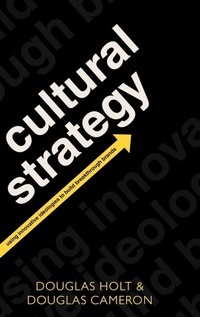
Cultural Strategy
Using Innovative Ideologies to Build Breakthrough Brands
1st Edition
Published on 28. October 2010
Book
Hardback
408 pages
978-0-19-958740-7 (ISBN)
Description
Market innovation has long been dominated by the worldview of engineers and economists: build a better mousetrap and the world will take notice. But there's another important way to build new businesses: with innovative ideologies rather than innovative mousetraps. Consider Coca-Cola, Nike, Jack Daniel's, Marlboro, Starbucks, Corona, Oprah, The Body Shop: all built with innovative ideologies. Further many "better mousetraps" are much more compelling to consumers when bundled with innovative ideologies; consider BMW, Apple, and Whole Foods.
Cultural Strategy provides a step-by-step guide for managers and entrepreneurs to build businesses in this simple but effective way. Holt and Cameron analyse a series of classic cases that relied on these bold, innovative strategies: Nike, Marlboro, Starbucks, Jack Daniels, vitaminwater, and Ben & Jerry's. They then demonstrate how the theory works as an actionable strategy model, drawing upon their consulting work. They show how cultural strategy takes start-up brands into the mass market (Fat Tire beer), overcomes "better mousetraps" wars in a technology driven category (ClearBlue pregnancy test), effectively challenges a seemingly insurmountable incumbent (FUSE music channel vs MTV), and develops a social innovation (The Freelancers Union).
Holt and Cameron also describe the best organizational model for pursuing this approach, which they term "the cultural studio". The book demonstrates that the top consumer marketing companies are consistently poor at this type of innovation because they rely on an antithetic organization structure, what the authors term "the brand bureaucracy". To succeed at cultural innovation requires not only a very different approach to strategy, but a new way of organizing as well.
Cultural Strategy provides a step-by-step guide for managers and entrepreneurs to build businesses in this simple but effective way. Holt and Cameron analyse a series of classic cases that relied on these bold, innovative strategies: Nike, Marlboro, Starbucks, Jack Daniels, vitaminwater, and Ben & Jerry's. They then demonstrate how the theory works as an actionable strategy model, drawing upon their consulting work. They show how cultural strategy takes start-up brands into the mass market (Fat Tire beer), overcomes "better mousetraps" wars in a technology driven category (ClearBlue pregnancy test), effectively challenges a seemingly insurmountable incumbent (FUSE music channel vs MTV), and develops a social innovation (The Freelancers Union).
Holt and Cameron also describe the best organizational model for pursuing this approach, which they term "the cultural studio". The book demonstrates that the top consumer marketing companies are consistently poor at this type of innovation because they rely on an antithetic organization structure, what the authors term "the brand bureaucracy". To succeed at cultural innovation requires not only a very different approach to strategy, but a new way of organizing as well.
Reviews / Votes
...May well be one of the most important books on advertising and branding in the past ten years. * Richard Huntington, Adliterate.com *More details
Language
English
Place of publication
Oxford
United Kingdom
Target group
Professional and scholarly
Dimensions
Height: 240 mm
Width: 161 mm
Thickness: 26 mm
Weight
769 gr
ISBN-13
978-0-19-958740-7 (9780199587407)
Copyright in bibliographic data and cover images is held by Nielsen Book Services Limited or by the publishers or by their respective licensors: all rights reserved.
Schweitzer Classification
Other editions
Additional editions
Douglas Holt | Douglas Cameron
Cultural Strategy
Using Innovative Ideologies to Build Breakthrough Brands
Book
08/2012
Oxford University Press
€38.00
Available immediately
Douglas Holt | Douglas Cameron
Cultural Strategy
Using Innovative Ideologies to Build Breakthrough Brands
E-Book
10/2010
OUP eBook
€25.99
Available for download
Persons
Douglas Holt is the founding partner of The Cultural Strategy Group, a consulting firm that specializes in helping managers, entrepreneurs, and activists develop cultural strategies. He was previously a professor at the Harvard Business School and Oxford University's Said Business School. A leading expert on branding and innovation, he pioneered cultural branding in his best-selling book How Brands Become Icons. Holt has developed cultural strategies for a wide range of brands including Coca-Cola, Microsoft, Ben & Jerry's, Sprite, Jack Daniel's, MINI, MasterCard, Fat Tire beer, Qdoba, Georgia Coffee, Planet Green, and Mike's Hard Lemonade, along with a number of not-for-profit organizations. He has lectured on these ideas at management seminars and talks worldwide, including the World Economic Forum.
Douglas Cameron is co-founder and Chief Strategy Officer at Amalgamated, an influential non-traditional advertising agency known for developing provocative cultural content across multiple media platforms. He began his career at Cliff Freeman & Partners, the most lauded creative shop of its time. He entered the world of marketing inadvertently: travelling the world as a bagpiper, he was invited by David Ogilvy to perform at his French castle. Ogilvy insisted he take up advertising. He worked with Holt extensively developing cultural strategies at Cliff Freeman and Amalgamated, which led to his role as co-author of Cultural Strategy. He graduated from Dartmouth College, where he received the English department (1)s top graduating honour.
Douglas Cameron is co-founder and Chief Strategy Officer at Amalgamated, an influential non-traditional advertising agency known for developing provocative cultural content across multiple media platforms. He began his career at Cliff Freeman & Partners, the most lauded creative shop of its time. He entered the world of marketing inadvertently: travelling the world as a bagpiper, he was invited by David Ogilvy to perform at his French castle. Ogilvy insisted he take up advertising. He worked with Holt extensively developing cultural strategies at Cliff Freeman and Amalgamated, which led to his role as co-author of Cultural Strategy. He graduated from Dartmouth College, where he received the English department (1)s top graduating honour.
Content
1. Rethinking Blue Oceans ; PART I: CULTURAL INNOVATION THEORY ; 2. Nike: Reinventing the American Dream ; 3. Jack Daniel's: Mythologizing the Company to Revive Frontier Masculinity ; 4. Ben & Jerry's: Provoking Ideological Flashpoints to Launch a Sustainable Business Myth ; 5. Starbucks: Trickling Down New Cultural Capital Codes ; 6. Patagonia: How Social Enterprises Cross the Cultural Chasm ; 7. Vitaminwater: Creating a "Better Mousetrap" with Myth ; 8. Marlboro: The Power of Cultural Codes ; 9. Cultural Innovation Theory ; PART II: APPLYING THE CULTURAL STRATEGY MODEL ; 10. Clearblue Pregnancy Tests: Branding a New Technology ; 11. Fat Tire Beer: Crossing the Cultural Chasm ; 12. Fuse Music Television: Challenging Incumbents with Cultural Jujitsu ; 13. Freelancers Union: Branding a Social Innovation ; PART III: ORGANIZING FOR CULTURAL INNOVATION ; 14. The Brand Bureaucracy and the Rise of Sciency Marketing ; 15. The Cultural Studio Forms Underground: Levi's 501s in Europe ; 16. The Cultural Studio Forms Above Ground: ESPN