

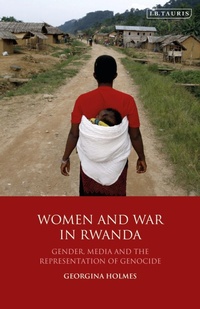
Women and War in Rwanda
Gender, Media and the Representation of Genocide
Published on 31. October 2019
Book
Paperback/Softback
344 pages
978-1-83860-579-7 (ISBN)
Description
Focusing on television media reporting of the 1994 genocide in Rwanda and its aftermath, this book explores how African states directly involved in conflict, western states with geopolitical interests in Africa's Great Lakes region, militia groups, human rights activists and NGOs use gendered media narratives strategically, often engaging in politics of revisionism and denial, to change the behaviour of other actors in the international system.
Critically analysing BBC documentary films and news features and drawing on interviews with British, Rwandan and Congolese journalists, filmmakers, political commentators and human rights activists Georgina Holmes argues that documentary films and political discussion programmes are postcolonial contact zones, wherein competing actors perform in an attempt to influence international political decision-making on military and humanitarian intervention and public perceptions of genocide and war.
The book breaks new ground in understanding how Rwandan and Congolese women actively engage in producing and shaping international public discourse on genocide and war, despite being depicted as silent, passive victims of conflict. This book is essential reading on the gendered dynamics of media reporting on conflicts and will appeal to anyone with an interest in Feminist Security Studies, Political Communication, Media and Film Studies, African Studies, Genocide Studies and International Relations.
Critically analysing BBC documentary films and news features and drawing on interviews with British, Rwandan and Congolese journalists, filmmakers, political commentators and human rights activists Georgina Holmes argues that documentary films and political discussion programmes are postcolonial contact zones, wherein competing actors perform in an attempt to influence international political decision-making on military and humanitarian intervention and public perceptions of genocide and war.
The book breaks new ground in understanding how Rwandan and Congolese women actively engage in producing and shaping international public discourse on genocide and war, despite being depicted as silent, passive victims of conflict. This book is essential reading on the gendered dynamics of media reporting on conflicts and will appeal to anyone with an interest in Feminist Security Studies, Political Communication, Media and Film Studies, African Studies, Genocide Studies and International Relations.
More details
Language
English
Place of publication
United Kingdom
Publishing group
Bloomsbury Publishing PLC
Target group
College/higher education
Illustrations
6 bw integrated
Dimensions
Height: 216 mm
Width: 140 mm
Thickness: 19 mm
Weight
441 gr
ISBN-13
978-1-83860-579-7 (9781838605797)
Copyright in bibliographic data and cover images is held by Nielsen Book Services Limited or by the publishers or by their respective licensors: all rights reserved.
Schweitzer Classification
Other editions
Additional editions
E-Book
10/2013
1st Edition
I.B. Tauris
€38.49
Available for download
Person
Georgina Holmes holds a PhD in International Relations from SOAS, and a JD specialising in public relations. She is an Honorary Research Associate in the Department of Politics and International Relations at Royal Holloway, University of London.
Content
List of Illustrations
Acknowledgements
Abbreviations
Maps
Introduction
1. Contextualizing media events: war and genocide in Rwanda and the east of Congo
2. Rwandan women and war
3. Militarizing women, preparing for genocide: Hutu extremist magazine Kangura 1990-94
4. Newsnight
5. Remembering genocide, forgetting politics: the BBC's institutional narrative post-1994
6. 'Living on gold should be a blessing should be a blessing, instead it is a curse' ; mass rape in the Congo
Conclusion
Notes
Bibliography
Index
Acknowledgements
Abbreviations
Maps
Introduction
1. Contextualizing media events: war and genocide in Rwanda and the east of Congo
2. Rwandan women and war
3. Militarizing women, preparing for genocide: Hutu extremist magazine Kangura 1990-94
4. Newsnight
5. Remembering genocide, forgetting politics: the BBC's institutional narrative post-1994
6. 'Living on gold should be a blessing should be a blessing, instead it is a curse' ; mass rape in the Congo
Conclusion
Notes
Bibliography
Index