

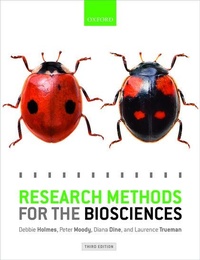
Research Methods for the Biosciences
3rd Edition
Published on 10. November 2016
Book
Paperback/Softback
488 pages
978-0-19-872849-8 (ISBN)
Description
Scientific research is a proven and powerful tool for discovering the answers to biological questions. As such, today's students need to be well-versed in experimental design, analysis, and the communication of research. Furthermore, they must appreciate how all of these aspects are interlinked--how, for example, statistics can be used to inform the design of a particular experiment. As a resource which skillfully integrates all of the key aspects relating to biological research, Research Methods for the Biosciences is the perfect guide for undergraduates.
The exceptionally clear layout takes students through choosing a project and planning their research; collecting, evaluating, and analyzing their data; and finally reporting their results. Research methods, which can often seem abstract, are brought to life through the use of examples taken from real undergraduate research. Friendly guidance and advice is provided throughout the text, and little prior knowledge or mathematical experience is required. Since statistics is a subject best learned through doing, frequent worked examples appear throughout Part Two 'Handling your data', showing step-by-step how to carry out the various statistical tests. In addition, online software walkthroughs and video screencasts clearly demonstrate how to use software such as SPSS, Minitab, Excel and R to carry out statistical analyses.
Online Resource Centre
The Online Resource Centre to accompany Research Methods for the Biosciences features:
For students:
? New video screencasts showing how to carry out statistical tests using software
? Statistical software walkthroughs for SPSS, Excel, and Minitab
? Additional statistical tests not included in the main text
? Full details of calculations given in the in-text boxes
? Interactive and printable decision tree, to help you design your experiment
? Interactive and printable risk assessment form
? Integrative exercises to help students test their understanding of the topics in the book
For lecturers:
? A test bank of questions
? Figures from the book available to download
The exceptionally clear layout takes students through choosing a project and planning their research; collecting, evaluating, and analyzing their data; and finally reporting their results. Research methods, which can often seem abstract, are brought to life through the use of examples taken from real undergraduate research. Friendly guidance and advice is provided throughout the text, and little prior knowledge or mathematical experience is required. Since statistics is a subject best learned through doing, frequent worked examples appear throughout Part Two 'Handling your data', showing step-by-step how to carry out the various statistical tests. In addition, online software walkthroughs and video screencasts clearly demonstrate how to use software such as SPSS, Minitab, Excel and R to carry out statistical analyses.
Online Resource Centre
The Online Resource Centre to accompany Research Methods for the Biosciences features:
For students:
? New video screencasts showing how to carry out statistical tests using software
? Statistical software walkthroughs for SPSS, Excel, and Minitab
? Additional statistical tests not included in the main text
? Full details of calculations given in the in-text boxes
? Interactive and printable decision tree, to help you design your experiment
? Interactive and printable risk assessment form
? Integrative exercises to help students test their understanding of the topics in the book
For lecturers:
? A test bank of questions
? Figures from the book available to download
More details
Edition
3rd Revised edition
Language
English
Place of publication
Oxford
United Kingdom
Target group
Professional and scholarly
Edition type
Revised edition
Illustrations
93 line drawings
Dimensions
Height: 248 mm
Width: 189 mm
Thickness: 24 mm
Weight
905 gr
ISBN-13
978-0-19-872849-8 (9780198728498)
Copyright in bibliographic data and cover images is held by Nielsen Book Services Limited or by the publishers or by their respective licensors: all rights reserved.
Schweitzer Classification
Other editions
Previous edition
Debbie Holmes | Peter Moody | Diana Dine
Research Methods for Biosciences
Book
09/2010
2nd Edition
Oxford University Press
€44.56
Article exhausted; check for reprint
Persons
Debbie Holmes, Diana Dine, Peter Moody, and Laurence Trueman are all senior lecturers in the Department of Applied Sciences, Geography and Archaeology at the University of Worcester. Between them, the authors have wide experience of teaching across a broad range of biological and environmental science-based subject areas, and developing web-based resources to support their undergraduate teaching.
Author
Senior Lecturer, GeneticsSenior Lecturer, Genetics, University of Worcester
Senior Lecturer, ComputingSenior Lecturer, Computing, University of Worcester
Senior Lecturer, Environmental ScienceSenior Lecturer, Environmental Science, University of Worcester
Senior Lecturer, Human Nutrition,Senior Lecturer, Human Nutrition, University of Worcester
Content
PLANNING YOUR EXPERIMENT; HANDLING YOUR DATA; REPORTING YOUR RESULTS