


Power and Politeness in the Workplace
A Sociolinguistic Analysis of Talk at Work
Published on 21. February 2003
Book
Paperback/Softback
208 pages
978-0-582-36877-4 (ISBN)
Description
This book provides insights into the way we all talk at work. It contains a wealth of material illustrating the way people communicate with each other in their ordinary everyday encounters in the workplaces. The analysis focusses on how and why people 'do' power and politeness in the workplace. It examines the strategies involved in balancing the demands of the workplace and maintaining good relationships with colleagues.
Drawing on a large and very varied corpus of data, the authors explore specific types of workplace talk, such as giving advice and instructions, solving problems, running meetings, making decisions and less obviously types of workpace talk such humour and small talk.
Drawing on a large and very varied corpus of data, the authors explore specific types of workplace talk, such as giving advice and instructions, solving problems, running meetings, making decisions and less obviously types of workpace talk such humour and small talk.
More details
Series
Language
English
Place of publication
London
United Kingdom
Publishing group
Taylor & Francis Ltd
Target group
Professional and scholarly
Dimensions
Height: 229 mm
Width: 159 mm
Thickness: 13 mm
Weight
584 gr
ISBN-13
978-0-582-36877-4 (9780582368774)
Copyright in bibliographic data and cover images is held by Nielsen Book Services Limited or by the publishers or by their respective licensors: all rights reserved.
Schweitzer Classification
Other editions
New editions
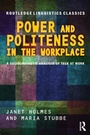
Janet Holmes | Maria Stubbe
Power and Politeness in the Workplace
A Sociolinguistic Analysis of Talk at Work
Book
02/2015
2nd Edition
Routledge
€79.30
Shipment within 10-20 days
Additional editions

Book
09/2016
1st Edition
Routledge
€139.86
Article exhausted; check different version
Previous edition

Janet Holmes
Power and Politeness in the Workplace
Book
Longman
€49.60
The article will not be published
Persons
Janet Holmes holds a Personal Chair in Linguistics at Victoria University of Wellington, where she teaches a variety of sociolinguistics courses. She is Director of the Wellington Corpus of Spoken New Zealand English and of a FRST-funded research project on Language in the Workplace. She was elected a Fellow of the Royal Society of New Zealand in 1994.
She has published on a wide range of topics including New Zealand English, language and gender, sexist language, pragmatic particles, compliments and apologies, and most recently on workplace discourse. Her publications include a textbook, An Introduction to Sociolinguistics, a book on language and gender, Women, Men and Politeness, and the recently edited collection of papers Gendered Speech in Social Context.
Maria Stubbe is a Research Fellow with the Language in the Workplace Project, based in the School of Linguistics and Applied Language Studies at Victoria University of Wellington. Her previous publications have focused on the analysis of spoken discourse in the areas of New Zealand English, language and gender and spoken communication in ethnically and linguistically diverse workplaces. She is currently also working on developing practical applications of the project's research findings for use by workplace practiitoners.
She has published on a wide range of topics including New Zealand English, language and gender, sexist language, pragmatic particles, compliments and apologies, and most recently on workplace discourse. Her publications include a textbook, An Introduction to Sociolinguistics, a book on language and gender, Women, Men and Politeness, and the recently edited collection of papers Gendered Speech in Social Context.
Maria Stubbe is a Research Fellow with the Language in the Workplace Project, based in the School of Linguistics and Applied Language Studies at Victoria University of Wellington. Her previous publications have focused on the analysis of spoken discourse in the areas of New Zealand English, language and gender and spoken communication in ethnically and linguistically diverse workplaces. She is currently also working on developing practical applications of the project's research findings for use by workplace practiitoners.
Content
1. POWER, POLITENESS AND THE WORKPLACE CONTEXT
Power, politeness and context
Power
Politeness
Context
The Wellington Language in the Workplace Project
Brief Outline of content of the book
Notes
2. FROM OFFICE TO PRODUCTION LINE: CONSTRUCTING A CORPUS OF WORKPLACE DATA
Designing a Method of Collecting Workplace Data
Collecting the Data
Conclusion
Notes
3. GETTING THINGS DONE AT WORK
Being Direct Downwards
Mitigation and Management Between Equals
Getting the Boss to Cooperate - requests and indirectives
Hints
Conclusion
Notes
4. WORKPLACE MEETINGS
Introduction
Types of Meetings
How are Meetings Structured?
Managing Interaction in Meetings
Doing Power and Politeness in Meetings: 2 case studies
Conclusion
Notes
5. SMALL TALK AND SOCIAL CHAT AT WORK
The Distribution of Social Talk in the Workplace
Social Functions of non-task orientated talk at Work
Conclusion
Notes
6. HUMOUR IN THE WORKPLACE
Functions of Humour in the Workplace
Humour and Workplace Culture
Conclusion
Notes
7. MISCOMMUNICATION AND PROBLEMATIC TALK AT WORK
Miscommunication
Negotiating with the Boss
Negotiating 'downwards'
Problems, Power and Partnership
Conclusion
Notes
8. CONCLUSION: SOME IMPLICATIONS AND APPLICATIONS
Introduction
Getting integrated at work
Reflection as a Learning Strategy for the Workplace
Conclusion
Notes
Power, politeness and context
Power
Politeness
Context
The Wellington Language in the Workplace Project
Brief Outline of content of the book
Notes
2. FROM OFFICE TO PRODUCTION LINE: CONSTRUCTING A CORPUS OF WORKPLACE DATA
Designing a Method of Collecting Workplace Data
Collecting the Data
Conclusion
Notes
3. GETTING THINGS DONE AT WORK
Being Direct Downwards
Mitigation and Management Between Equals
Getting the Boss to Cooperate - requests and indirectives
Hints
Conclusion
Notes
4. WORKPLACE MEETINGS
Introduction
Types of Meetings
How are Meetings Structured?
Managing Interaction in Meetings
Doing Power and Politeness in Meetings: 2 case studies
Conclusion
Notes
5. SMALL TALK AND SOCIAL CHAT AT WORK
The Distribution of Social Talk in the Workplace
Social Functions of non-task orientated talk at Work
Conclusion
Notes
6. HUMOUR IN THE WORKPLACE
Functions of Humour in the Workplace
Humour and Workplace Culture
Conclusion
Notes
7. MISCOMMUNICATION AND PROBLEMATIC TALK AT WORK
Miscommunication
Negotiating with the Boss
Negotiating 'downwards'
Problems, Power and Partnership
Conclusion
Notes
8. CONCLUSION: SOME IMPLICATIONS AND APPLICATIONS
Introduction
Getting integrated at work
Reflection as a Learning Strategy for the Workplace
Conclusion
Notes