

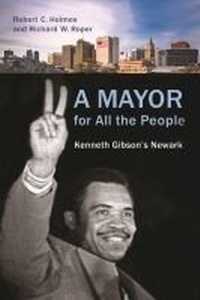
A Mayor for All the People
Kenneth Gibson's Newark
Will be published approx. on 30. November 2019
Book
Paperback/Softback
256 pages
978-0-8135-9877-2 (ISBN)
Description
In 1970, Kenneth Gibson was elected as Newark, New Jersey's first African-American mayor, a position he held for an impressive sixteen years. Yet even as Gibson served as a trailblazer for black politicians, he presided over a troubled time in the city's history, as Newark's industries declined and its crime and unemployment rates soared.
This book offers a balanced assessment of Gibson's leadership and his legacy, from the perspectives of the people most deeply immersed in 1970s and 1980s Newark politics: city employees, politicians, activists, journalists, educators, and even fellow big-city mayors like David Dinkins. The contributors include many of Gibson's harshest critics, as well as some of his closest supporters, friends, and family members-culminating in an exclusive interview with Gibson himself, reflecting on his time in office.
Together, these accounts provide readers with a compelling inside look at a city in crisis, a city that had been rocked by riots three years before Gibson took office and one that Harper's magazine named "America's worst city" at the start of his second term. At its heart, it raises a question that is still relevant today: how should we evaluate a leader who faced major structural and economic challenges, but never delivered all the hope and change he promised voters?
This book offers a balanced assessment of Gibson's leadership and his legacy, from the perspectives of the people most deeply immersed in 1970s and 1980s Newark politics: city employees, politicians, activists, journalists, educators, and even fellow big-city mayors like David Dinkins. The contributors include many of Gibson's harshest critics, as well as some of his closest supporters, friends, and family members-culminating in an exclusive interview with Gibson himself, reflecting on his time in office.
Together, these accounts provide readers with a compelling inside look at a city in crisis, a city that had been rocked by riots three years before Gibson took office and one that Harper's magazine named "America's worst city" at the start of his second term. At its heart, it raises a question that is still relevant today: how should we evaluate a leader who faced major structural and economic challenges, but never delivered all the hope and change he promised voters?
More details
Language
English
Place of publication
New Brunswick, NJ
United States
Target group
Professional and scholarly
Illustrations
15 black & white photos
Dimensions
Height: 229 mm
Width: 152 mm
Weight
333 gr
ISBN-13
978-0-8135-9877-2 (9780813598772)
Copyright in bibliographic data and cover images is held by Nielsen Book Services Limited or by the publishers or by their respective licensors: all rights reserved.
Schweitzer Classification
Other editions
Additional editions
E-Book
11/2019
1st Edition
Rutgers University Press
€51.99
Available for download
E-Book
11/2019
1st Edition
Rutgers University Press
€51.99
Available for download
Persons
Robert C. Holmes is a clinical professor of law at Rutgers University. He served in the Gibson administration as executive director of the Newark Housing Development and Rehabilitation Corporation, then was later named executive director of the Newark Watershed Conservation and Development Corporation. He has also served as Assistant Commissioner of the New Jersey Department of Community Affairs and as a Partner in the law firm Wilentz Goldman and Spitzer.
Richard W. Roper is a policy consultant whose many positions in local, state, regional, and federal government agencies also included stints as director of the Program for New Jersey Affairs and assistant dean of Princeton University's Woodrow Wilson School of Public and International Affairs. He later served as planning department director at the Port Authority of New York and New Jersey and as a Senior Fellow at the Rockefeller Institute of Government at the state University of New York.
Richard W. Roper is a policy consultant whose many positions in local, state, regional, and federal government agencies also included stints as director of the Program for New Jersey Affairs and assistant dean of Princeton University's Woodrow Wilson School of Public and International Affairs. He later served as planning department director at the Port Authority of New York and New Jersey and as a Senior Fellow at the Rockefeller Institute of Government at the state University of New York.