

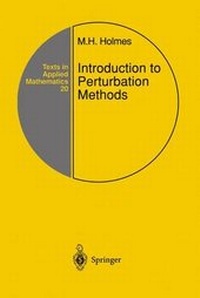
Introduction to Perturbation Methods
Published on 31. July 2012
Book
Paperback/Softback
XIII, 356 pages
978-1-4612-5349-5 (ISBN)
Description
This introductory graduate text is based on a graduate course the author has taught repeatedly over the last ten years to students in applied mathematics, engineering sciences, and physics. Each chapter begins with an introductory development involving ordinary differential equations, and goes on to cover such traditional topics as boundary layers and multiple scales. However, it also contains material arising from current research interest, including homogenisation, slender body theory, symbolic computing, and discrete equations. Many of the excellent exercises are derived from problems of up-to-date research and are drawn from a wide range of application areas.
More details
Series
Edition
Softcover reprint of the original 1st ed. 1995
Language
English
Place of publication
NY
United States
Target group
College/higher education
Product notice
Paperback (trade)
Illustrations
2
2 s/w Tabellen
black & white illustrations
Dimensions
Height: 23.5 cm
Width: 15.5 cm
Thickness: 18 mm
Weight
539 gr
ISBN-13
978-1-4612-5349-5 (9781461253495)
DOI
10.1007/978-1-4612-5347-1
Schweitzer Classification
Other editions
Additional editions
Mark H. Holmes
Introduction to Perturbation Methods
Book
06/1998
Springer
€86.62
Article exhausted; check for reprint
Content
1: Introduction to Asymptotic Approximations.- 1.1 Introduction.- 1.2 Taylor's Theorem and l'Hospital's Rule.- 1.3 Order Symbols.- 1.4 Asymptotic Approximations.- 1.4.1 Asymptotic Expansions.- 1.4.2 Accuracy versus Convergence of an Asymptotic Series.- 1.4.3 Manipulating Asymptotic Expansions.- 1.5 Asymptotic Solution of Algebraic and Transcendental Equations.- 1.6 Introduction to the Asymptotic Solution of Differential Equations.- 1.7 Uniformity.- 1.8 Symbolic Computing.- 2: Matched Asymptotic Expansions.- 2.1 Introduction.- 2.2 Introductory Example.- 2.3 Examples with Multiple Boundary Layers.- 2.4 Interior Layers.- 2.5 Corner Layers.- 2.6 Partial Differential Equations.- 2.7 Difference Equations.- 3: Multiple Scales.- 3.1 Introduction.- 3.2 Introductory Example.- 3.3 Slowly Varying Coefficients.- 3.4 Forced Motion Near Resonance.- 3.5 Boundary Layers.- 3.6 Introduction to Partial Differential Equations.- 3.7 Linear Wave Propagation.- 3.8 Nonlinear Waves.- 3.9 Difference Equations.- 4: The WKB and Related Methods.- 4.1 Introduction.- 4.2 Introductory Example.- 4.3 Turning Points.- 4.4 Wave Propagation and Energy Methods.- 4.5 Wave Propagation and Slender Body Approximations.- 4.6 Ray Methods.- 4.7 Parabolic Approximations.- 4.8 Discrete WKB Method.- 5: The Method of Homogenization.- 5.1 Introduction.- 5.2 Introductory Example.- 5.3 Multidimensional Problem: Periodic Substructure.- 5.4 Porous Flow.- 6: Introduction to Bifurcation and Stability.- 6.1 Introduction.- 6.2 Introductory Example.- 6.3 Analysis of a Bifurcation Point.- 6.4 Linearized Stability.- 6.5 Relaxation Dynamics.- 6.6 An Example Involving a Nonlinear Partial Differential Equation.- 6.7 Bifurcation of Periodic Solutions.- 6.8 Systems of Ordinary Differential Equations.- Appendix AI: Solution and Properties of Transition Layer Equations.- A1.1 Airy Functions.- A1.2 Confluent Hypergeometric Functions.- A1.3 Higher-Order Turning Points.- Appendix A2: Asymptotic Approximations of Integrals.- A2.1 Introduction.- A2.2 Watson's Lemma.- A2.3 Laplace's Approximation.- A2.4 Stationary Phase Approximation.- Appendix A3: Numerical Solution of Nonlinear Boundary-Value Problems.- A3.1 Introduction.- A3.2 Examples.- A3.3 Computer Code.- References.