

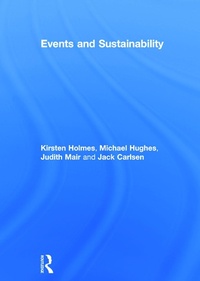
Events and Sustainability
1st Edition
Published on 26. March 2015
Book
Hardback
222 pages
978-0-415-74449-2 (ISBN)
Description
Increasing concerns over climate and environmental change, the global economic and financial crisis and impacts on host communities, audiences, participants and destinations has reinforced the need for more sustainable approaches to events. Sustainability now features as part of the bid process for many mega-events, such as the Olympic Games, as well as significant regional and local events, where the event organisers are required by funding bodies and governments to generate broader outcomes for the locality.
This book is the first to offer students a comprehensive introduction to the full range of issues and topics relevant to event sustainability including impacts, operating and policy environments, stimulating urban regeneration and creating lasting legacies, as well as practical knowledge on how to achieve a sustainable event. Taking a holistic approach drawing on multidisciplinary theory it offers insight into the economic, socio-cultural and environmental impacts and how these can be adapted or mitigated. Theory and practice are linked through integrated case studies based on a wide range of event types from mega events to community festivals to show impacts, best practice and how better sustainable practice can be achieved in the future. Learning objectives, discussion questions and further reading suggestions are included to aid understanding and further knowledge; additional resources for lecturers and students including power point slides, video and web links are available online.
Events and Sustainability is essential reading for all events management students and future managers.
This book is the first to offer students a comprehensive introduction to the full range of issues and topics relevant to event sustainability including impacts, operating and policy environments, stimulating urban regeneration and creating lasting legacies, as well as practical knowledge on how to achieve a sustainable event. Taking a holistic approach drawing on multidisciplinary theory it offers insight into the economic, socio-cultural and environmental impacts and how these can be adapted or mitigated. Theory and practice are linked through integrated case studies based on a wide range of event types from mega events to community festivals to show impacts, best practice and how better sustainable practice can be achieved in the future. Learning objectives, discussion questions and further reading suggestions are included to aid understanding and further knowledge; additional resources for lecturers and students including power point slides, video and web links are available online.
Events and Sustainability is essential reading for all events management students and future managers.
Reviews / Votes
"As sustainability is now a key driver of most activity, Events and Sustainability is a 'must read' text for event management students. It is a well structured text that comprehensively addresses all of the key dimensions of sustainable events in a highly accessible fashion. Each chapter sets clear learning outcomes and provides highly relevant case studies and thought provoking discussion questions. Events and Sustainability will also make a valuable reference for event practitioners." - Professor Leo Jago, Professor in Hospitality and Events, University of Surrey"Against an environment of increased commoditisation and competition, austerity in the west and abundance in emerging economies never has an understanding of the role of sustainability to today's economy and society been more important. This text offers a pragmatic, enlightened and realistic insight into the increasing challenges and opportunities that are facing festivals and events in to order to develop and deliver more sustainable events. The combined use of context setting, key theory, international case studies; public and private sector examples and activities and discussion makes this a must read for any student or practitioner studying or interested in the future sustainability of events."- Dr. Jane Ali-Knight, Director, Edinburgh Institute: Festivals, Events and Tourism, Edinburgh Napier University
More details
Language
English
Place of publication
London
United Kingdom
Publishing group
Taylor & Francis Ltd
Target group
College/higher education
Product notice
sewn/stitched
Cloth over boards
Illustrations
12 s/w Zeichnungen, 12 s/w Tabellen, 12 s/w Abbildungen
12 Tables, black and white; 12 Line drawings, black and white; 12 Illustrations, black and white
Dimensions
Height: 252 mm
Width: 179 mm
Thickness: 17 mm
Weight
562 gr
ISBN-13
978-0-415-74449-2 (9780415744492)
Copyright in bibliographic data and cover images is held by Nielsen Book Services Limited or by the publishers or by their respective licensors: all rights reserved.
Schweitzer Classification
Other editions
New editions

Carmel Foley | Judith Mair | Kirsten Holmes
Events and Sustainability
Book
approx. 10/2026
2nd Edition
Taylor & Francis
€191.50
Not yet published
Additional editions
Kirsten Holmes | Michael Hughes | Judith Mair
Events and Sustainability
Book
03/2015
1st Edition
Routledge
€81.89
Shipment within 15-20 days
Kirsten Holmes | Michael Hughes | Judith Mair
Events and Sustainability
E-Book
03/2015
Routledge
€69.99
Available for download
Kirsten Holmes | Michael Hughes | Judith Mair
Events and Sustainability
E-Book
03/2015
Routledge
€69.99
Available for download
Persons
Kirsten Holmes is an Associate Professor in Tourism at Curtin University, Western Australia. She has 14 years' experience of teaching event management and event sustainability in the UK and Australia. Her research examines volunteerism in tourism and leisure settings, with a focus on events.
Michael Hughes is a Senior Lecturer in Environmental Management at Murdoch University, Perth, Western Australia. He has a keen interest in environmental management, policy and sustainability. Michael has published on perceptions of nature, industrial development in remote natural areas and the value of wildlife tourism.
Judith Mair is a Senior Lecturer in Event Management in the UQ Business School, University of Queensland, Australia. She is author of Conferences and Conventions: A Research Perspective. Her research interests include events, tourism and sustainability and she has published many journal articles on these topics in international journals.
Jack Carlsen has 30 years of academic experience and is currently an Adjunct Professor at Curtin University, Western Australia. He has an extensive research track record, which has produced more than 150 career publications on various topics related to sustainable tourism planning, markets, development and evaluation.
Michael Hughes is a Senior Lecturer in Environmental Management at Murdoch University, Perth, Western Australia. He has a keen interest in environmental management, policy and sustainability. Michael has published on perceptions of nature, industrial development in remote natural areas and the value of wildlife tourism.
Judith Mair is a Senior Lecturer in Event Management in the UQ Business School, University of Queensland, Australia. She is author of Conferences and Conventions: A Research Perspective. Her research interests include events, tourism and sustainability and she has published many journal articles on these topics in international journals.
Jack Carlsen has 30 years of academic experience and is currently an Adjunct Professor at Curtin University, Western Australia. He has an extensive research track record, which has produced more than 150 career publications on various topics related to sustainable tourism planning, markets, development and evaluation.
Content
1. Introduction to sustainable events 2. The internal and external environment for sustainable event organisers 3. Sustainable events and public policy 4. Sustainable events and urban regeneration 5. Economic impacts of events 6. Environmental impacts of events 7. Socio-cultural impacts of events 8. Delivering the sustainable event 9. Employment, volunteering and sustainable events 10. Risk and crisis management for sustainable events 11. The challenge of creating sustainable event legacies 12. Creating sustainable legacies from events 13. Developing sustainable events - summary and future directions