

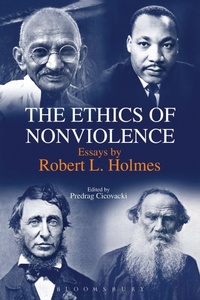
The Ethics of Nonviolence
Essays by Robert L. Holmes
Published on 15. August 2013
Book
Paperback/Softback
272 pages
978-1-62356-805-4 (ISBN)
Description
Robert Holmes is one of the leading proponents of nonviolence in the United States, and his influence extends to the rest of the world. However, he has never presented his views on nonviolence in full-length book form. The Ethics of Nonviolence brings together his best essays on the topic, both classic works and more obscure pieces, as well as several important essays that have never been published.
Holmes started his career by following Dewey and James, and then turned toward metaethics. The Vietnam War finally led him toward moral problems related to war and violence. For the last forty years he has been a great proponent of nonviolence and pacifism in the style of Tolstoy and Gandhi.
If ethics is meant to be more than a purely academic exercise, the theoretical ethics of philosophy must be shown to be relevant to applied morality; the ongoing process of making moral judgments must add value to the world we live in. For Robert Holmes, no aspect of reality is more in need of ethical thinking and reform than the culture of war and violence that cannot be ignored. There are morally viable alternatives to this violence, Holmes argues, and he scrutinizes the sources and implications of such positions. Holmes shows that nonviolence and pacifism can lead us toward a more peaceful and humanely dignified world.
Holmes started his career by following Dewey and James, and then turned toward metaethics. The Vietnam War finally led him toward moral problems related to war and violence. For the last forty years he has been a great proponent of nonviolence and pacifism in the style of Tolstoy and Gandhi.
If ethics is meant to be more than a purely academic exercise, the theoretical ethics of philosophy must be shown to be relevant to applied morality; the ongoing process of making moral judgments must add value to the world we live in. For Robert Holmes, no aspect of reality is more in need of ethical thinking and reform than the culture of war and violence that cannot be ignored. There are morally viable alternatives to this violence, Holmes argues, and he scrutinizes the sources and implications of such positions. Holmes shows that nonviolence and pacifism can lead us toward a more peaceful and humanely dignified world.
Reviews / Votes
Long before Richard Rorty and Hilary Putnam praised in print the insights of William James and John Dewey, Robert Holmes shed light on the philosophical importance of the classical pragmatists. Long before Larry May and Jeff McMahan debated the merits of pacifism, just war theory, and war realism, Robert Holmes made the case for contingent pacifism. Holmes's distinctions among and insights concerning the various forms of pragmatism, pacifism, and nonviolence help debunk the easy dismissal of these views. The collected papers of Robert Holmes shed light on why those who summarily reject all forms of pragmatism, pacifism, or nonviolence do so because they continue to misrepresent these important but too often trivialized philosophical views. -- Rick Werner, John Stewart Kennedy Professor of Philosophy Hamilton College Clinton, NY, USA This welcome collection of essays by Robert L. Holmes reminds us why he is the leading theorist of nonviolence at work today. His careful and thorough treatment of issues together with his clear writing and deep insight all further the inevitable nonviolent revolution required for our violent world to be transformed so as to allow a sustainable human future. Such important work deserves very wide circulation, readership, and consideration. -- Duane L. Cady, Professor of Philosophy Emeritus, Hamline University, USA, and author of From Warism to Pacifism: A Moral Continuum The Ethics Of Nonviolence is by far the best book on the subject. Dr. Holmes has understood the nuances of the Gandhian Philosophy as few others have. His understanding of the philosophy and his ability to impart it to students is so unique that I often wish I was a young student again under his tutelage. Dr. Cicovacki must be commended for this outstanding collection of lectures. -- Arun Gandhi, President, Gandhi Worldwide Education Institute, Illinois, USA Holmes has written another cogent book on nonviolence that is also accessible to nonspecialists. His treatment of Dewey is excellent, as well as his reasoning about pragmatic and principled nonviolence. For readers familiar with his work, the appendix with Cicovacki's interview of him will be much appreciated. -- William C. Gay, Professor of Philosophy, UNC Charlotte, USA The Ethics of Nonviolence presents the clear and penetrating thinking of one of the foremost theorists of nonviolence in the world today. The readings not only offer insight into the development of Robert L. Holmes's thought, but more importantly, they reveal the theoretical and practical heart of his ethic of nonviolence, woven from such disparate threads as the ethics of Dewey, Mill, and Kant, critiques of Robert Nozick's libertarianism and St. Augustine's defense of just war, and also Holmes's own views on such contemporary yet eternal topics as evil, terrorism, and the philosophy of teaching. The final chapters treat readers to both his wisdom and his sense of humor. -- Barry L. Gan, Professor of Philosophy, St. Bonaventure University, USAMore details
Language
English
Place of publication
New York
United States
Publishing group
Bloomsbury Publishing Plc
Target group
College/higher education
Professional and scholarly
Product notice
Paperback (trade)
Dimensions
Height: 228 mm
Width: 151 mm
Thickness: 22 mm
Weight
415 gr
ISBN-13
978-1-62356-805-4 (9781623568054)
DOI
CBID177065
Copyright in bibliographic data and cover images is held by Nielsen Book Services Limited or by the publishers or by their respective licensors: all rights reserved.
Schweitzer Classification
Other editions
Additional editions
E-Book
06/2013
1st Edition
Bloomsbury Academic USA
€40.49
Available for download
E-Book
06/2013
1st Edition
Bloomsbury Academic USA
€40.49
Available for download
Persons
Robert L. Holmes is Professor Emeritus of Philosophy at the University of Rochester, USA. His main research is in philosophy of war, the ethics of nonviolence, and contemporary moral problems. He is the author of Basic Moral Philosophy (Wadsworth, 4th edition, 2006) and On War and Morality (Princeton University Press, 1989), co-author of Philosophical Inquiry (Prentice Hall, 2nd edition, 1968), and co-editor of Nonviolence in Theory and Practice (Wadsworth, 3rd edition, 1990). He has published over 75 scholarly papers.
Predrag Cicovacki is Professor of Philosophy at the College of the Holy Cross, MA, USA.
He has published over fifty philosophy papers published in English, Serbian, German, Russian, Chinese, and Slovenian and is the author or editor of nine books, including Albert Schweitzer's Ethical Vision: A Sourcebook (with Introduction, Oxford University Press, 2009).
Predrag Cicovacki is Professor of Philosophy at the College of the Holy Cross, MA, USA.
He has published over fifty philosophy papers published in English, Serbian, German, Russian, Chinese, and Slovenian and is the author or editor of nine books, including Albert Schweitzer's Ethical Vision: A Sourcebook (with Introduction, Oxford University Press, 2009).
Content
Introduction
1. John Dewey's Moral Philosophy in Contemporary Perspective
2. Consequentialism and its Consequences
3. The Limited Relevance of Analytical Ethics to the Problems of Bioethics
4. The Concept of Corporate Responsibility
5. University Neutrality and ROTC
6. The Philosophy of Political Realism in International Affairs
7. The Challenge of Nonviolence in the New World Order
8. St. Augustine and the Just War Theory
9. War, Power, and Nonviolence
10. Violence and Nonviolence
11. The Morality of Nonviolence
12. Terrorism, Violence, and Nonviolence
13. Understanding Evil from the Perspective of Nonviolence
14. Jallianwala Bagh and the Boston Tea Party:
Nonviolent Roots of the Indian and American Anti-Imperialism
15. Toward a Nonviolent American Revolution
16. My (Non-)Teaching Philosophy
Appendix 1: An Interview with Robert Holmes
Appendix 2: Bibliography of Robert Holmes' Publications
1. John Dewey's Moral Philosophy in Contemporary Perspective
2. Consequentialism and its Consequences
3. The Limited Relevance of Analytical Ethics to the Problems of Bioethics
4. The Concept of Corporate Responsibility
5. University Neutrality and ROTC
6. The Philosophy of Political Realism in International Affairs
7. The Challenge of Nonviolence in the New World Order
8. St. Augustine and the Just War Theory
9. War, Power, and Nonviolence
10. Violence and Nonviolence
11. The Morality of Nonviolence
12. Terrorism, Violence, and Nonviolence
13. Understanding Evil from the Perspective of Nonviolence
14. Jallianwala Bagh and the Boston Tea Party:
Nonviolent Roots of the Indian and American Anti-Imperialism
15. Toward a Nonviolent American Revolution
16. My (Non-)Teaching Philosophy
Appendix 1: An Interview with Robert Holmes
Appendix 2: Bibliography of Robert Holmes' Publications