

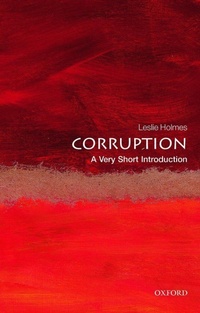
Corruption
A Very Short Introduction
Published on 23. April 2015
Book
Paperback/Softback
176 pages
978-0-19-968969-9 (ISBN)
Description
Corruption is one of the biggest global issues, ahead of extreme poverty, unemployment, the rising cost of food and energy, climate change, and terrorism. It is thought to be one of the principal causes of poverty around the globe. Its significance in the contemporary world cannot be undervalued.
In this Very Short Introduction Leslie Holmes considers why the international community has only highlighted corruption as a problem in the past two decades, despite its presence throughout the millennia. Holmes explores the phenomenon from several different perspectives, from the cultural differences affecting how corruption is defined, its impact, and its various causes to the possible remedies. Providing evidence of corruption and considering ways to address it around the world, this is an important introduction to a significant and serious global issue.
ABOUT THE SERIES: The Very Short Introductions series from Oxford University Press contains hundreds of titles in almost every subject area. These pocket-sized books are the perfect way to get ahead in a new subject quickly. Our expert authors combine facts, analysis, perspective, new ideas, and enthusiasm to make interesting and challenging topics highly readable.
In this Very Short Introduction Leslie Holmes considers why the international community has only highlighted corruption as a problem in the past two decades, despite its presence throughout the millennia. Holmes explores the phenomenon from several different perspectives, from the cultural differences affecting how corruption is defined, its impact, and its various causes to the possible remedies. Providing evidence of corruption and considering ways to address it around the world, this is an important introduction to a significant and serious global issue.
ABOUT THE SERIES: The Very Short Introductions series from Oxford University Press contains hundreds of titles in almost every subject area. These pocket-sized books are the perfect way to get ahead in a new subject quickly. Our expert authors combine facts, analysis, perspective, new ideas, and enthusiasm to make interesting and challenging topics highly readable.
Reviews / Votes
sensible [and] serious analysis * New Statesman, Peter Oborne * Holmes, a prolific writer on corruption, provides a wonderfully comprehensive and accessible introduction to all aspects of corruption ... Summing up: Highly recommended, undergraduates and above; general readers. Essential for all academic and public libraries. * Gillian Brock, Choice * a pithy yet global and comprehensive view of the subject * New Internationalist * Here the Australian sociologist Leslie Holmes has done us a huge favour in providing this easy and quick to read short guide to corruption * Concatenation *More details
Series
Language
English
Place of publication
Oxford
United Kingdom
Illustrations
6 black and white illustrations
Dimensions
Height: 174 mm
Width: 111 mm
Thickness: 15 mm
Weight
130 gr
ISBN-13
978-0-19-968969-9 (9780199689699)
Copyright in bibliographic data and cover images is held by Nielsen Book Services Limited or by the publishers or by their respective licensors: all rights reserved.
Schweitzer Classification
Other editions
Additional editions
E-Book
04/2015
OUP eBook
€5.49
Available for download
E-Book
04/2015
OUP eBook
€5.49
Available for download
Person
Leslie Holmes is Professor of Political Science at the University of Melbourne, and a recurrent visiting professor at the Graduate School of Social Research in Warsaw, the University of Bologna, and the People's University in Beijing. He has also taught at the International Anti-Corruption Academy in Vienna and at intensive workshops on corruption in Belgrade and Sofia. His principal research specialisations are corruption, communism, and post-communism. He has authored or edited 14 books and numerous articles and book chapters. His publications include Rotten States? (Duke UP, 2006), Communism (OUP, 2009), Post-Communist Democratization (co-authored with John Dryzek - CUP, 2002), and two edited collections, Terrorism, Organised Crime, and Corruption (Elgar, 2007) and Trafficking and Human Rights (Elgar, 2010). He has been a Fellow of the Academy of the Social Sciences in Australia since 1995.
Content
Preface ; 1. What is corruption? ; 2. Why corruption is a problem ; 3. Can we measure corruption? ; 4. Psycho-social and cultural causes ; 5. System-related causes ; 6. What can states do? ; 7. What else can be done? ; Further reading ; Index