

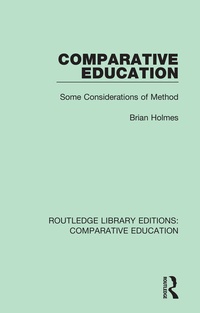
Comparative Education
Some Considerations of Method
1st Edition
Published on 27. November 2019
Book
Paperback/Softback
206 pages
978-1-138-54460-4 (ISBN)
Description
Originally published in 1981. Presented here is a coherent theory of Comparative Education research, based on the traditions and innovations established by such pioneers as Joseph Lauwerys and Nicholas Hans. From the author's substantive studies emerges a taxonomy for education based on Popper's critical dualism, and a way of analysing problems based on Dewey's reflective thinking and the social change theories of people such as Marx, Ogben and Pareto. Models of formal organisations drawn from Talcott Parsons show how systems analyses can be made in comparative perspective and how the processes of policy formulation, adoption and implementation can be studied.
The use of ideal typical normative models illustrates how comparative educationists can penetrate aspects of man's socially created worlds. These techniques are exemplified in succinct models against which debates about education in Western Europe (Plato), the USA (Dewey) and the USSR (Marx, Engels and Lenin) can be analysed. Against the crude use of comparative arguments and transplantation of foreign practices, Dr Holmes suggests that problems should be analysed and the outcomes of hypothetical solutions or policies should be tested under identified national circumstances. The distinctive feature of this book is that it takes account of the debate among social scientists, rejects both induction and ethnomethodology as adequate in themselves and brings together the problem-solving approach favoured by American research workers and the hypothetico-deductive method of enquiry advocated by natural scientists such as Sir Peter Medawar and Sir John Eccles.
The use of ideal typical normative models illustrates how comparative educationists can penetrate aspects of man's socially created worlds. These techniques are exemplified in succinct models against which debates about education in Western Europe (Plato), the USA (Dewey) and the USSR (Marx, Engels and Lenin) can be analysed. Against the crude use of comparative arguments and transplantation of foreign practices, Dr Holmes suggests that problems should be analysed and the outcomes of hypothetical solutions or policies should be tested under identified national circumstances. The distinctive feature of this book is that it takes account of the debate among social scientists, rejects both induction and ethnomethodology as adequate in themselves and brings together the problem-solving approach favoured by American research workers and the hypothetico-deductive method of enquiry advocated by natural scientists such as Sir Peter Medawar and Sir John Eccles.
More details
Series
Language
English
Place of publication
London
United Kingdom
Publishing group
Taylor & Francis Ltd
Target group
College/higher education
Professional and scholarly
Dimensions
Height: 216 mm
Width: 138 mm
Weight
453 gr
ISBN-13
978-1-138-54460-4 (9781138544604)
Copyright in bibliographic data and cover images is held by Nielsen Book Services Limited or by the publishers or by their respective licensors: all rights reserved.
Schweitzer Classification
Other editions
Additional editions
E-Book
05/2018
1st Edition
Routledge
€45.99
Available for download
E-Book
05/2018
1st Edition
Routledge
€45.99
Available for download
Book
05/2018
1st Edition
Routledge
€170.40
Shipment within 10-20 days
Person
Brian Holmes
Content
Introduction 1. Cultural Borrowing - Misconceived Comparative Education 2. Comparative Education, Scientific Method and Educational Planning 3. The Positivist Debate in Comparative Education - An Anglo-Saxon Perspective 4. A Framework for Analysis - 'Critical Dualism' (Conventionalism) 5. The Collection and Classification of Data - National Profiles 6. Ideal-Typical Normative Models 7. Plato's Just Society 8. Dewey's Reflective Man in a Changing Scientific Society 9. The Ideal-Typical Soviet Man. A Selected Guide to Ancillary Reading