

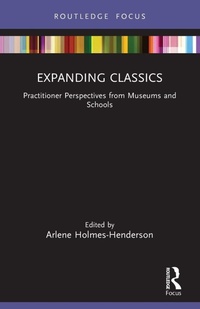
Expanding Classics
Practitioner Perspectives from Museums and Schools
1st Edition
Published on 28. October 2024
Book
Paperback/Softback
132 pages
978-1-032-02117-1 (ISBN)
Description
This volume explores innovative ways of expanding classical languages and cultures to educational and museum audiences.
It shows that classical subjects have an important role to play within society and can enrich individuals' lives in many different, and perhaps surprising, ways. Chapters present projects covering literacy and engagement with reading, empowering students to understand and use new types of vocabulary, discovering the personal relevance of ancient history and the resonance of ancient material culture and stories. Contributors demonstrate that classical subjects can be taught cost-effectively and inclusively by non-specialist teachers and in non-traditional settings. In their various ways, they highlight the need to rethink the role of Classics in twenty-first-century classrooms and communities. Recommendations are made for further development, including ways to improve research, policy and practice in the field of Classics education.
Expanding Classics presents an important series of case studies on classical learning, of interest to museum educators, teacher trainers, school leaders and curriculum designers, as well as those teaching in primary, secondary and further education settings in the UK and worldwide.
It shows that classical subjects have an important role to play within society and can enrich individuals' lives in many different, and perhaps surprising, ways. Chapters present projects covering literacy and engagement with reading, empowering students to understand and use new types of vocabulary, discovering the personal relevance of ancient history and the resonance of ancient material culture and stories. Contributors demonstrate that classical subjects can be taught cost-effectively and inclusively by non-specialist teachers and in non-traditional settings. In their various ways, they highlight the need to rethink the role of Classics in twenty-first-century classrooms and communities. Recommendations are made for further development, including ways to improve research, policy and practice in the field of Classics education.
Expanding Classics presents an important series of case studies on classical learning, of interest to museum educators, teacher trainers, school leaders and curriculum designers, as well as those teaching in primary, secondary and further education settings in the UK and worldwide.
More details
Series
Language
English
Place of publication
London
United Kingdom
Publishing group
Taylor & Francis Ltd
Target group
College/higher education
Professional and scholarly
Academic, Postgraduate, and Professional
Illustrations
22 s/w Abbildungen, 11 s/w Photographien bzw. Rasterbilder, 11 s/w Zeichnungen, 4 s/w Tabellen
4 Tables, black and white; 11 Line drawings, black and white; 11 Halftones, black and white; 22 Illustrations, black and white
Dimensions
Height: 216 mm
Width: 140 mm
Thickness: 8 mm
Weight
196 gr
ISBN-13
978-1-032-02117-1 (9781032021171)
Copyright in bibliographic data and cover images is held by Nielsen Book Services Limited or by the publishers or by their respective licensors: all rights reserved.
Schweitzer Classification
Other editions
Additional editions
E-Book
04/2023
1st Edition
Routledge
€27.49
Available for download
Book
04/2023
1st Edition
Routledge
€74.90
Shipment within 10-20 days
E-Book
04/2023
1st Edition
Routledge
€27.49
Available for download
Person
Arlene Holmes-Henderson is an Associate Professor of Classics and Ancient History at Durham University. She works at the intersection of research, policy and practice to improve access to the study of classical subjects in schools and communities in the UK and worldwide. She teaches in the School of Education and leads several research projects exploring the role of Classics in the curriculum.
Content
Introduction; 1. Ancient languages for 6- to 11-year-olds: Exploring three pedagogical approaches via a longitudinal study, Arlene Holmes-Henderson; 2. Including the excluded: Teaching Latin in an area of high socio-economic disadvantage, Peter Wright; 3. Using classical mythology to teach English as an Additional Language, Anna Bloor, Meghan McCabe and Arlene Holmes-Henderson; 4. Student perceptions of BAME people in the Roman world: A comparison of Latin textbooks, Alex Gruar; 5. Promoting inclusivity through teaching Ancient History, Anna McOmish; 6. Whose museum is it anyway? Connecting with communities at the Museum of Classical Archaeology, Cambridge, Susanne Turner; 7. Contested Collections: Using 3D replicas to present new narratives of objects with contested histories, Emma Payne and Laura Gibson.