

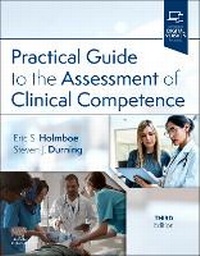
Practical Guide to the Assessment of Clinical Competence
3rd Edition
Published on 26. March 2024
Book
Paperback/Softback
464 pages
978-0-443-11226-3 (ISBN)
Description
**Selected for 2026 Doody's Core Titles in Medical Education**
Offering a multifaceted, practical approach to the complex topic of clinical assessment, Practical Guide to the Assessment of Clinical Competence, 3rd Edition, is designed to help medical educators employ better assessment methods, tools, and models directly into their training programs. World-renowned editors and expert contributing authors provide hands-on, authoritative guidance on outcomes-based assessment in clinical education, presenting a well-organized, diverse combination of methods you can implement right away. This thoroughly revised edition is a valuable resource for developing, implementing, and sustaining effective systems for assessing clinical competence in medical school, residency, and fellowship programs.
Helps medical educators and administrators answer complex, ongoing, and critical questions in today's changing medical education system: Is this undergraduate or postgraduate medical student prepared and able to move to the next level of training? To be a competent and trusted physician?
Provides practical suggestions and assessment approaches that can be implemented immediately in your training program, tools that can be used to assess and measure clinical performance, overviews of key educational theories, and strengths and weaknesses of every method
Covers assessment techniques, frameworks, high-quality assessment of clinical reasoning and procedural competence, psychometrics, and practical approaches to feedback
Includes expanded coverage of fast-moving areas where concepts now have solid research and data that support practical ways to connect judgments of ability to outcomes-including work-based assessments, clinical competency committees, milestones and entrustable professional assessments (EPAs), and direct observation
Offers examples of assessment instruments along with suggestions on how you can apply these methods and instruments in your own setting, as well as guidelines that apply across the medical education spectrum
Includes online access to videos of medical interviewing scenarios and more, downloadable assessment tools, and detailed faculty guidelines
An eBook version is included with purchase. The eBook allows you to access all of the text, figures, and references, with the ability to search, make notes and highlights, and have content read aloud
Offering a multifaceted, practical approach to the complex topic of clinical assessment, Practical Guide to the Assessment of Clinical Competence, 3rd Edition, is designed to help medical educators employ better assessment methods, tools, and models directly into their training programs. World-renowned editors and expert contributing authors provide hands-on, authoritative guidance on outcomes-based assessment in clinical education, presenting a well-organized, diverse combination of methods you can implement right away. This thoroughly revised edition is a valuable resource for developing, implementing, and sustaining effective systems for assessing clinical competence in medical school, residency, and fellowship programs.
Helps medical educators and administrators answer complex, ongoing, and critical questions in today's changing medical education system: Is this undergraduate or postgraduate medical student prepared and able to move to the next level of training? To be a competent and trusted physician?
Provides practical suggestions and assessment approaches that can be implemented immediately in your training program, tools that can be used to assess and measure clinical performance, overviews of key educational theories, and strengths and weaknesses of every method
Covers assessment techniques, frameworks, high-quality assessment of clinical reasoning and procedural competence, psychometrics, and practical approaches to feedback
Includes expanded coverage of fast-moving areas where concepts now have solid research and data that support practical ways to connect judgments of ability to outcomes-including work-based assessments, clinical competency committees, milestones and entrustable professional assessments (EPAs), and direct observation
Offers examples of assessment instruments along with suggestions on how you can apply these methods and instruments in your own setting, as well as guidelines that apply across the medical education spectrum
Includes online access to videos of medical interviewing scenarios and more, downloadable assessment tools, and detailed faculty guidelines
An eBook version is included with purchase. The eBook allows you to access all of the text, figures, and references, with the ability to search, make notes and highlights, and have content read aloud
Reviews / Votes
Review of the previous edition:"The book provides a state-of-the-art guide to competency-based outcomes assessment programs in the health professions. If followed, this guide will help any medical educator in the health professions identify better ways to implement assessment methods and measurement tools. What is also important about this book is that it provides conceptual models and popular approaches to assessment. The authors are practitioners who themselves have clearly struggled with improving and implementing effective measures of performance in the health professions and offer the best evidence from the literature as well as from their experience, resulting in this authoritative, excellent, practical guide to a compendium of assessment methods." --Reviewed by Klara K Papp, PhD (Case Western Reserve University School of Medicine) Doody's Score: 93, 4 Stars!
More details
Edition
3rd edition
Language
English
Place of publication
London
United Kingdom
Publishing group
Elsevier Health Sciences
Target group
College/higher education
Dimensions
Height: 276 mm
Width: 216 mm
Weight
920 gr
ISBN-13
978-0-443-11226-3 (9780443112263)
Copyright in bibliographic data and cover images is held by Nielsen Book Services Limited or by the publishers or by their respective licensors: all rights reserved.
Schweitzer Classification
Other editions
Previous edition
Eric S. Holmboe | Steven James Durning | Richard E. Hawkins
Practical Guide to the Evaluation of Clinical Competence
Book
06/2017
2nd Edition
Elsevier
€60.65
Article exhausted; check for reprint
Persons
As Chief, Research, Milestone Development and Evaluation Officer of the ACGME (Accreditation Council for Graduate Medical Education) and Senior Vice President for Quality Research and Academic Affairs at the American Board of Internal Medicine and American Board of Internal Medicine Foundation, he is on the cutting edge of assessment and evaluation requirements present and future. He is also Professor Adjunct of Medicine at Yale University. Prior to joining the ABIM in 2004, he was the was Associate Program Director, Yale Primary Care Internal Medicine Residency Program, Director of Student Clinical Assessment, Yale School of Medicine, Director of Faculty Development, Department of Medicine, and Assistant Director for the Yale Robert Wood Johnson Clinical Scholars Program. Prior to joining Yale in 2000, he served as division chief of General Internal Medicine at the National Naval Medical Center. His research interests include interventions to improve quality of care and methods in the evaluation of clinical competence. Dr. Holmobe also teaches a 2-3 day course at various hubs around the country which includes a comprehensive syllabus around practical assessment techniques. The first edition of the book was based on this successful intensive faculty development course, which itself was rigorously studied in randomized controlled trials, and now includes a copy of the text as part of the tuition. A Professor of Medicine and Pathology; Director, Graduate Programs in Health Professions Education (HPE); Director, Introduction to Clinical Reasoning Course at the Uniformed Services University of the Health Sciences, and Deputy Editor for Research for Academic Medicine, Dr. Durning is devoted to improving medical and health professions education and is considered a global leader in clinical reasoning. He is a prolific researcher and writer and is currently working on another book with Elsevier (recently Transmitted to Production) on how to carry out survey-based research in clinical education.
Content
1. Assessment in the Era of Outcomes-Based Education
2. Issues of Validity and Reliability for Assessments in Medical Education
3. Programmatic Assessment Using Systems Thinking
4. Evaluation Frameworks, Assessment Forms, and Rating Scales
5. Direct Observation
6. Standardized Patients
7. Assessing Clinical Reasoning In Vitro (NonWorkplace Assessment)
8. Assessing Clinical Reasoning in the Workplace
9. Workplace-Based Assessment of Procedural Skills
10. Evaluating Evidence-Based Practice
11. Clinical Performance Measures and Practice Review
12. Multisource Feedback
13. Simulation Overview
14. Feedback and Coaching
15. Portfolios
16. Group Process in Assessment
17. A Programmatic Approach to Identifying and Supporting the Struggling Learner
18. Program Evaluation
2. Issues of Validity and Reliability for Assessments in Medical Education
3. Programmatic Assessment Using Systems Thinking
4. Evaluation Frameworks, Assessment Forms, and Rating Scales
5. Direct Observation
6. Standardized Patients
7. Assessing Clinical Reasoning In Vitro (NonWorkplace Assessment)
8. Assessing Clinical Reasoning in the Workplace
9. Workplace-Based Assessment of Procedural Skills
10. Evaluating Evidence-Based Practice
11. Clinical Performance Measures and Practice Review
12. Multisource Feedback
13. Simulation Overview
14. Feedback and Coaching
15. Portfolios
16. Group Process in Assessment
17. A Programmatic Approach to Identifying and Supporting the Struggling Learner
18. Program Evaluation