

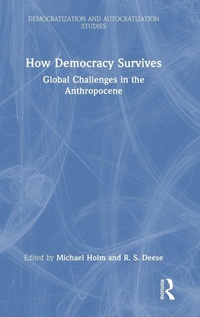
How Democracy Survives
Global Challenges in the Anthropocene
1st Edition
Published on 26. December 2022
Book
Hardback
270 pages
978-1-032-11142-1 (ISBN)
Description
How Democracy Survives explores how liberal democracy can better adapt to the planetary challenges of our time by evolving beyond the Westphalian paradigm of the nation state.
The authors bring perspectives from Africa, Asia, Europe, Latin America, and North America, their chapters engaging with the concept of transnational democracy by tracing its development in the past, assessing its performance in the present, and considering its potential for survival in this century and beyond. Coming from a wide array of intellectual disciplines and policymaking backgrounds, the authors share a common conviction that our global institutions-both governments and international organizations-must become more resilient, transparent, and democratically accountable in order to address the cascading political, economic, and social crises of this new epoch, such as climate change, mass migration, more frequent and severe natural disasters, and resurgent authoritarianism.
This book will be relevant for courses in international relations and political science, environmental politics, and the preservation of democracy and federalism around the world.
The Open Access version of this book, available at www.taylorfrancis.com, has been made available under a Creative Commons Attribution-Non Commercial-No Derivatives 4.0 license. Thanks to the support of libraries working with Knowledge Unlatched www.knowledgeunlatched.org
The authors bring perspectives from Africa, Asia, Europe, Latin America, and North America, their chapters engaging with the concept of transnational democracy by tracing its development in the past, assessing its performance in the present, and considering its potential for survival in this century and beyond. Coming from a wide array of intellectual disciplines and policymaking backgrounds, the authors share a common conviction that our global institutions-both governments and international organizations-must become more resilient, transparent, and democratically accountable in order to address the cascading political, economic, and social crises of this new epoch, such as climate change, mass migration, more frequent and severe natural disasters, and resurgent authoritarianism.
This book will be relevant for courses in international relations and political science, environmental politics, and the preservation of democracy and federalism around the world.
The Open Access version of this book, available at www.taylorfrancis.com, has been made available under a Creative Commons Attribution-Non Commercial-No Derivatives 4.0 license. Thanks to the support of libraries working with Knowledge Unlatched www.knowledgeunlatched.org
More details
Series
Language
English
Place of publication
London
United Kingdom
Publishing group
Taylor & Francis Ltd
Target group
College/higher education
Postgraduate and Undergraduate Advanced
Illustrations
1 s/w Abbildung, 1 s/w Zeichnung, 3 s/w Tabellen
3 Tables, black and white; 1 Line drawings, black and white; 1 Illustrations, black and white
Dimensions
Height: 240 mm
Width: 161 mm
Thickness: 20 mm
Weight
602 gr
ISBN-13
978-1-032-11142-1 (9781032111421)
Copyright in bibliographic data and cover images is held by Nielsen Book Services Limited or by the publishers or by their respective licensors: all rights reserved.
Schweitzer Classification
Other editions
Additional editions
E-Book
12/2022
1st Edition
Routledge
€0.00
Available for download
E-Book
12/2022
1st Edition
Routledge
€0.00
Available for download
Book
12/2022
1st Edition
Routledge
€60.60
Shipment within 10-20 days
Persons
Michael Holm teaches at Boston University, USA.
R. S. Deese teaches at Boston University, USA.
R. S. Deese teaches at Boston University, USA.
Content
Introduction Part I: The Forgotten Promise of 1945 1. The Other American Dream: The One World Order and Human Rights 2. We Were Once Colonized: Nehru, India and Afro-Asianism at the United Nations 3. The Peaceful Settlement of Disputes and Chapter VI of the UN Charter: Forgotten 'Cardinal Feature' of the Dumbarton Oaks Proposals? 4. The Postwar European Integration Process and the Progressive Construction of a Supranational Legal Order 5. Democracy and the Spectacle of Consent: The Forgotten Promise of the United Nations Part II: Globalizing Consent 6. Perceived Inequality and Democratic Support: A Close Analysis from the Asian Barometer Survey 7. Africa, its Diaspora, Transitional Justice, and Global Democracy: Towards a World Parliament 8. 'World Organization Through Democracy': Clarence Streit and the Genesis of the Present World Order 9. Current Proposals for Closer Cooperation among Democracies 10. Representation and Participation of Citizens at the United Nations: The Democratic Legitimacy of the UN and Ways to Improve It Part III: Confronting the Anthropocene 11. The Climate Commons and the Survival of Democracy 12. Democracies, Authoritarians, and Climate Change: Do Regime Types Matter? 13. Democracy to Avert Ecocide 14. What Disaster Response Can Teach Us about Democracy in the Anthropocene 15. Democracy in the Age of Automation, Robotics, and Advanced AI Epilogue