

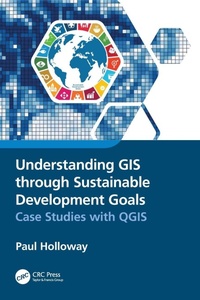
Understanding GIS through Sustainable Development Goals
Case Studies with QGIS
1st Edition
Will be published approx. on 20. July 2026
Book
Paperback/Softback
322 pages
978-1-032-11574-0 (ISBN)
Description
Understanding GIS through Sustainable Development Goals applies a pedagogical shift to learning GIS, as the readers employ the concepts and methodologies on real-world problems. This book provides 16 case studies across most of the Sustainable Development Goals (SDGs) with step-by-step practical instructions using QGIS(Quantum Geographic Information System) , an open-source software. It helps readers develop GIS skills on real-world data, while learning the fundamentals including spatial data models, projections, and spatial databases, different cartographic methods, such as graduated symbology, change maps, and dynamic visualization, as well as more intermediate and advanced spatial analysis such as geoprocessing, multiple criteria analysis, and spatial statistics. The topics chosen are taught in secondary and tertiary education institutions which make this a textbook for all students and educators.
Features:
Focuses on learning GIS through 16 real world case studies.
Introduces an open-source software that can be used beyond the classroom.
Analyzes Sustainable Development Goals in a global framework and provides an alternative approach to learning GIS.
Supports both secondary and tertiary educators and improves GIS education at all levels.
Contains a holistic range of case studies that extend across several disciplines, from geography education, environmental sciences, geosciences, natural sciences, social sciences, and digital humanities.
This is a textbook for all students and educators, providing 16 case studies across most of the SDGs with step-by-step practical instructions using QGIS, an open-source software.
Features:
Focuses on learning GIS through 16 real world case studies.
Introduces an open-source software that can be used beyond the classroom.
Analyzes Sustainable Development Goals in a global framework and provides an alternative approach to learning GIS.
Supports both secondary and tertiary educators and improves GIS education at all levels.
Contains a holistic range of case studies that extend across several disciplines, from geography education, environmental sciences, geosciences, natural sciences, social sciences, and digital humanities.
This is a textbook for all students and educators, providing 16 case studies across most of the SDGs with step-by-step practical instructions using QGIS, an open-source software.
More details
Language
English
Place of publication
London
United Kingdom
Publishing group
Taylor & Francis Ltd
Target group
College/higher education
Professional and scholarly
Professional and Undergraduate Core
Illustrations
216 Farbfotos bzw. farbige Rasterbilder, 13 s/w Zeichnungen, 27 farbige Zeichnungen, 4 farbige Tabellen, 7 s/w Photographien bzw. Rasterbilder, 243 farbige Abbildungen, 20 s/w Abbildungen
4 Tables, color; 27 Line drawings, color; 13 Line drawings, black and white; 216 Halftones, color; 7 Halftones, black and white; 243 Illustrations, color; 20 Illustrations, black and white
Dimensions
Height: 234 mm
Width: 156 mm
ISBN-13
978-1-032-11574-0 (9781032115740)
Copyright in bibliographic data and cover images is held by Nielsen Book Services Limited or by the publishers or by their respective licensors: all rights reserved.
Schweitzer Classification
Other editions
Additional editions
E-Book
04/2023
1st Edition
CRC Press
€138.99
Available for download
E-Book
04/2023
1st Edition
CRC Press
€138.99
Available for download
Book
04/2023
1st Edition
CRC Press
€173.70
Shipment within 10-20 days
Person
PAUL HOLLOWAY is a lecturer in Geographic Information Science and Systems in the Department of Geography at University College Cork, a principal investigator in the Environmental Research Institute at University College Cork, and the Vice President of the Irish Organization of Geographic Information. Paul's teaching and research interests include using GIS and spatial analysis to address a suite of environmental, ecological, and geographic issues. He teaches several undergraduate and graduate GIS courses at UCC and was presented with the President's Award for Excellence in Teaching in 2019. Paul's research is widely published, with more than 35 peer-reviewed publications in GIS focused journals, and he is currently involved in several nationally and internationally funded projects exploring the application and development of GIS across the biodiversity, agriculture, energy, health, and transport sectors.
Content
1. Introduction and Context. 2. Getting Started With QGIS. 3. Spatial Data Models. 4. Projections. 5. Attributes and Queries. 6. Data Management. 7. Location and Thematic Maps. 8. Choropleth Maps. 9. Change Maps. 10. Dynamic Visualization. 11. Neighborhoods. 12. Descriptive Statistics. 13. Density. 14. Interpolation. 15. Site Selection - Multiple Criteria Assessment. 16. Risk Analysis - Unique Condition Unit. 17. Site Selection - Map Algebra. 18. Route Selection. 19. Epilogue.