

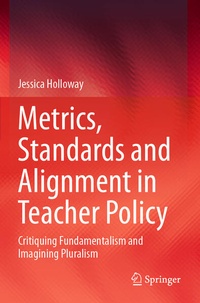
Metrics, Standards and Alignment in Teacher Policy
Description
Drawing from case studies from the USA, UK and Australia, it illustrates how a coalescence around metrics, standards and compliance is producing increasingly restricted notions of teachers and teaching. It shows how the rationalities and techniques associated with accountability and standardisation are limiting the possibilities for multiple conceptualisations of teaching and teachers to exist or emerge. Using pluralism as the main framework, it challenges the dangers associated with rigid compliance and alignment and argues that pluralism can help secure schools as socially and culturally responsive to the needs of the community.
Reviews / Votes
"This book is a significant undertaking to evaluate and (re)address teacher accountability and educational policy. . A real strength of this book lies in the call to action that reimagining schooling needs to begin with a greater, anti-racist vision that transcends the traditional notions of our discursive plains. . Holloway's interconnected consideration of teacher accountability and educational policy adds a new dimension to our understanding of the preparation and development . leadership of K-12 teachers in Australia and the USA." (Ameena L. Payne, Sarah Langman and Rafaan Daliri-Ngametua, Journal of Education Policy, June 10, 2022)More details
Other editions
Additional editions
Person
Content
Chapter 1: Teaching in Times of Turbulence.- Chapter 2: The Economic Discourse of Education: A Poststructural Perspective.- Chapter 3: Performativity, Datafication and the Techniques of Teacher Evaluation.- Chapter 4: Teacher Evaluation and the Control of Risky Teachers.- Chapter 5: Aligning Teacher Preparation, Professional Development and Evaluation: The Case of the TAP System.- Chapter 6: The Stories of TAP-y Teachers.- Chapter 7: The Onto-Epistemic Regime of Metrics, Data and Standards.- Chapter 8: Prepping for Accountability: Metrics and Standards in Teacher Education.- Chapter 9: Distributing Leadership: Sharing Responsibility and Maintaining Accountability.- Chapter 10: New Possibilities for Imagining Pluralism in Teacher Policy: A Contrast-Model.- Chapter 11: Democracy and Education: Why Pluralism Matters.