

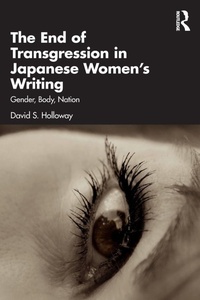
The End of Transgression in Japanese Women's Writing
Gender, Body, Nation
1st Edition
Published on 31. December 2024
Book
Paperback/Softback
170 pages
978-1-032-13984-5 (ISBN)
Description
This book argues for a new articulation of the ways in which transgression is theorized in contemporary literature by Japanese women.
Exploring the rhetorical and discursive mechanics of literary "bad girls" from fiction produced during the millennial turn (1990-2010), the book contends that women writers today deploy truant, unruly, restless, and aggressive female protagonists not to challenge the status quo but rather to reaffirm it. While Japanese women's fiction has long been invested in cultivating an uncomfortable politics of opposition through "unladylike" themes such as sex, sexuality, and violence, the book argues that today authors turn to such acts of defiance to quietly advocate for the primacy of Japanese social order. Showing how transgression has not only lost its political and disruptive valence in contemporary women's fiction, this book further reveals how discourses of dissent can be retooled to promote a conservative worldview.
A fascinating literary analysis which reads Japanese literature in relation to the receding value of rebellion today, this book will be of huge interest to students and scholars of Japanese literature, gender, and cultural studies.
Exploring the rhetorical and discursive mechanics of literary "bad girls" from fiction produced during the millennial turn (1990-2010), the book contends that women writers today deploy truant, unruly, restless, and aggressive female protagonists not to challenge the status quo but rather to reaffirm it. While Japanese women's fiction has long been invested in cultivating an uncomfortable politics of opposition through "unladylike" themes such as sex, sexuality, and violence, the book argues that today authors turn to such acts of defiance to quietly advocate for the primacy of Japanese social order. Showing how transgression has not only lost its political and disruptive valence in contemporary women's fiction, this book further reveals how discourses of dissent can be retooled to promote a conservative worldview.
A fascinating literary analysis which reads Japanese literature in relation to the receding value of rebellion today, this book will be of huge interest to students and scholars of Japanese literature, gender, and cultural studies.
More details
Language
English
Place of publication
London
United Kingdom
Publishing group
Taylor & Francis Ltd
Target group
College/higher education
Postgraduate and Undergraduate Advanced
Dimensions
Height: 234 mm
Width: 156 mm
Thickness: 10 mm
Weight
289 gr
ISBN-13
978-1-032-13984-5 (9781032139845)
Copyright in bibliographic data and cover images is held by Nielsen Book Services Limited or by the publishers or by their respective licensors: all rights reserved.
Schweitzer Classification
Other editions
Additional editions
E-Book
12/2024
1st Edition
Routledge
€51.49
Available for download
E-Book
12/2024
1st Edition
Routledge
€51.49
Available for download
Book
12/2024
1st Edition
Routledge
€195.10
Shipment within 10-20 days
Person
David S. Holloway was Assistant Professor of Japanese at the University of Rochester, USA.
Content
Introduction. "Literary Dislocations: Rediscovery and Reorientation" 1. "The Legacy of Transgression in Japanese Women's Fiction: Liberation, Liberty, Lightning" 2. "Class, Identity, and Recession in Millennial Japan" 3. "Skeletons of Desire: The Body in Kanehara Hitomi's Snakes and Earrings and Hydra" 4. "Gender and Body, Past and Present: Sakurai Ami's Innocent World and Tomorrow's Song" 5. "The Two Bodies of Kirino Natsuo: Grotesque and Real World" 6. "Conclusion: Chaos, Schizophrenia, and Reconciliation in Millennial Japan" Epilogue