

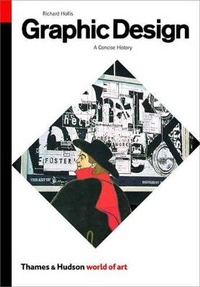
Graphic Design
A Concise History
Published on 20. August 2001
Book
Paperback/Softback
232 pages
978-0-500-20347-7 (ISBN)
Description
This authoritative documentary history begins with the poster and goes on to chart the development of word and image in brochures and magazines, advertising, corporate identity, television and electronic media, and the effects of technical innovations such as photography, the computer and digital technology.
With over 800 illustrations fully integrated with the text, this indispensable account is uniquely clear, comprehensive and absorbing.
With over 800 illustrations fully integrated with the text, this indispensable account is uniquely clear, comprehensive and absorbing.
Reviews / Votes
'Essential and affordable reading for students, designers and historians ... considered, well-informed and imaginative' - The EyeMore details
Series
Edition
Revised and expanded edition
Language
English
Place of publication
London
United Kingdom
Target group
College/higher education
Professional and scholarly
Edition type
Revised edition
Illustrations
With over 800 illustrations, 29 in colour
Dimensions
Height: 210 mm
Width: 150 mm
Weight
490 gr
ISBN-13
978-0-500-20347-7 (9780500203477)
Copyright in bibliographic data and cover images is held by Nielsen Book Services Limited or by the publishers or by their respective licensors: all rights reserved.
Schweitzer Classification
Other editions
Previous edition

Book
08/1994
Thames & Hudson Ltd
€31.08
Article exhausted; check for reprint
Person
Richard Hollis (b.1934) is a British graphic designer. He has taught at various art schools, written several books, and worked as a printer and magazine editor. Employed in Paris as publicity designer for Galeries Lafayette, he later went on to design the quarterly journal Modern Poetry in Translation, before becoming the art editor of the weekly magazine New Society and later designed John Berger's Ways of Seeing. He also designed the visual identity and marketing materials for the Whitechapel Art Gallery in London (1970-72 and 1978-85) and co-founded the School of Design at West of England College of Art.
Content
From graphic art to design 1890 to 1914; the Avant-garde and the origins of Modernism 1914-1940; national tendencies until 1940; the designer and the art director; variants of Modernism in Europe; psychedelia, protest and new techniques of the late 1960s; new waves - electronic technology; 1990 and beyond.