

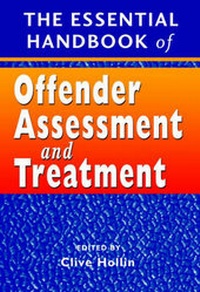
The Essential Handbook of Offender Assessment and Treatment
1st Edition
Published on 16. September 2003
Book
Paperback/Softback
304 pages
978-0-470-85436-5 (ISBN)
Description
This "Essential Handbook" provides the critical elements from its companion volume, the successful Handbook of Offender Assessment and Treatment. A comprehensive review of assessment and treatment, it covers the major offender groups: sex offenders, violent offenders, offenders with mental and personality disorders, and property offenders. A range of treatment approaches are also included, incorporating behavioural, cognitive, skills-based, anger management, school programs, and family-based approaches.
Whilst retaining its international, high quality appeal, The Essential Handbook of Offender Assessment and Treatment is a concise, portable edition for all clinicians, academics and researchers working with offenders across a range of settings.
Whilst retaining its international, high quality appeal, The Essential Handbook of Offender Assessment and Treatment is a concise, portable edition for all clinicians, academics and researchers working with offenders across a range of settings.
Reviews / Votes
"...concise and accessible...I would recommend this book to the target readership..." (Vista, Vol.9, No.2, 2005)More details
Language
English
Place of publication
New York
United States
Target group
Professional and scholarly
Dimensions
Height: 244 mm
Width: 170 mm
Thickness: 18 mm
Weight
535 gr
ISBN-13
978-0-470-85436-5 (9780470854365)
Copyright in bibliographic data and cover images is held by Nielsen Book Services Limited or by the publishers or by their respective licensors: all rights reserved.
Schweitzer Classification
Other editions
Additional editions
Clive R. Hollin
The Essential Handbook of Offender Assessment and Treatment
E-Book
10/2003
1st Edition
Wiley
€55.99
Available for download
Person
Clive R. Hollin is the editor of The Essential Handbook of Offender Assessment and Treatment, published by Wiley.
Content
About the Editor. List of Contributors.
Preface.
Foreword by David P. Farrington.
Chapter 1: To treat or not to treat? An historical perspective (Clive R. Hollin).
PART I: RISK ASSESSMENT.
Chapter 2: Assessing violence risk in mentally and personality disordered individuals (Christopher D.Webster and Gerard Bailes).
Chapter 3: Sex offender risk assessment (R. Karl Hanson).
PART II: APPROACHES TO TREATMENT.
Chapter 4: Behavioral approaches to correctional management and rehabilitation (Michael A. Milan).
Chapter 5: Programming in cognitive skills: The reasoning and rehabilitation programme (David Robinson and Frank J. Porporino).
Chapter 6: Family-based treatments (Cynthia Cupit Swenson, Scott W. Henggeler and Sonja K. Schoenwald).
Chapter 7: Delinquency prevention programs in schools (David LeMarquand and Richard E. Tremblay).
Chapter 8: Skills training (Clive R. Hollin and Emma J. Palmer).
Chapter 9: Anger treatment with offenders (Raymond W. Novaco, Mark Ramm and Laura Black).
PART III: ASSESSMENT AND TREATMENT OF OFFENDERS.
Chapter 10: Adult sexual offenders against women (William L. Marshall).
Chapter 11: The assessment and treatment of sexual offenders against children (Tony Ward, Stephen M. Hudson and Thomas R. Keenan).
Chapter 12: Firesetters (David J. Kolko).
Chapter 13: Assessment and treatment:Violent offenders (Devon L. L. Polaschek and Nikki Reynolds).
Chapter 14: Offenders with major mental disorders (Sheilagh Hodgins).
Chapter 15: Offenders with personality disorders (Mary McMurran).
Chapter 16: Property offences (James McGuire).
Epilogue.
Index.
Preface.
Foreword by David P. Farrington.
Chapter 1: To treat or not to treat? An historical perspective (Clive R. Hollin).
PART I: RISK ASSESSMENT.
Chapter 2: Assessing violence risk in mentally and personality disordered individuals (Christopher D.Webster and Gerard Bailes).
Chapter 3: Sex offender risk assessment (R. Karl Hanson).
PART II: APPROACHES TO TREATMENT.
Chapter 4: Behavioral approaches to correctional management and rehabilitation (Michael A. Milan).
Chapter 5: Programming in cognitive skills: The reasoning and rehabilitation programme (David Robinson and Frank J. Porporino).
Chapter 6: Family-based treatments (Cynthia Cupit Swenson, Scott W. Henggeler and Sonja K. Schoenwald).
Chapter 7: Delinquency prevention programs in schools (David LeMarquand and Richard E. Tremblay).
Chapter 8: Skills training (Clive R. Hollin and Emma J. Palmer).
Chapter 9: Anger treatment with offenders (Raymond W. Novaco, Mark Ramm and Laura Black).
PART III: ASSESSMENT AND TREATMENT OF OFFENDERS.
Chapter 10: Adult sexual offenders against women (William L. Marshall).
Chapter 11: The assessment and treatment of sexual offenders against children (Tony Ward, Stephen M. Hudson and Thomas R. Keenan).
Chapter 12: Firesetters (David J. Kolko).
Chapter 13: Assessment and treatment:Violent offenders (Devon L. L. Polaschek and Nikki Reynolds).
Chapter 14: Offenders with major mental disorders (Sheilagh Hodgins).
Chapter 15: Offenders with personality disorders (Mary McMurran).
Chapter 16: Property offences (James McGuire).
Epilogue.
Index.