

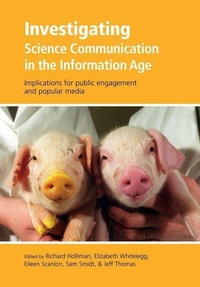
Investigating Science Communication in the Information Age
Implications for public engagement and popular media
Published on 25. September 2008
Book
Paperback/Softback
312 pages
978-0-19-955266-5 (ISBN)
Description
How are recent policy changes affecting how scientists engage with the public? How are new technologies influencing how scientists disseminate their work and knowledge? How are new media platforms changing the way the public interact with scientific information?
Investigating Science Communication in the Information Age is a collection of newly-commissioned chapters by leading science communication scholars. It addresses current theoretical, practical and policy developments in science communication, including recent calls for greater openness and transparency; and engagement and dialogue on the part of professional scientists with members of the public. It provides a timely and wide-ranging review of contemporary issues in science
communication, focusing on two broad themes.
The first theme critically reviews the recent dialogic turn and ascendant branding of 'public engagement with science'. It addresses contemporary theoretical and conceptual issues facing science communication researchers, and draws on a range of methodological approaches and examples.
The second theme, popular media, examines recent trends in the theory and research of these forms of science communication. It includes contemporary accounts of the study of 'traditional' forms of popular media, including television and newspapers, examining how they are produced, represented and consumed. This theme also documents examples where novel forms of popular media are challenging researchers to re-think how they approach these forms of science communication.
A companion volume, Practising science communication in the information age, provides an ideal introduction to anyone wishing to reflect on the practices of contemporary science communication.
Investigating Science Communication in the Information Age is a collection of newly-commissioned chapters by leading science communication scholars. It addresses current theoretical, practical and policy developments in science communication, including recent calls for greater openness and transparency; and engagement and dialogue on the part of professional scientists with members of the public. It provides a timely and wide-ranging review of contemporary issues in science
communication, focusing on two broad themes.
The first theme critically reviews the recent dialogic turn and ascendant branding of 'public engagement with science'. It addresses contemporary theoretical and conceptual issues facing science communication researchers, and draws on a range of methodological approaches and examples.
The second theme, popular media, examines recent trends in the theory and research of these forms of science communication. It includes contemporary accounts of the study of 'traditional' forms of popular media, including television and newspapers, examining how they are produced, represented and consumed. This theme also documents examples where novel forms of popular media are challenging researchers to re-think how they approach these forms of science communication.
A companion volume, Practising science communication in the information age, provides an ideal introduction to anyone wishing to reflect on the practices of contemporary science communication.
Reviews / Votes
Comprehensive, interesting, and for an academic and teacher in the area, really quite exciting. * Dr. Angela Cassidy, Institute for Food Research, University of East Anglia * The quality of contributions, the strong theoretical background and the emphasis on methodological issues will make it an extremely valuable resource for teaching and researching in this area in the years to come. * Massimiano Bucchi, Professor of Science in Society, University of Trento, Italy * This book provides an overview of how public engagement and popular media influence the way science is communicated. It is well suited as a college text and presents options for further readings and additional web resources for each article. It is accessible to readers, regardless of expertise, due to the use of clear examples and detailed discussions of research findings."Integrative and Comparative Biology journal The originality of this book is to bring a strongly sociological angle to science communication, a very necessary one to understand the place of science in society and the dynamics of the different actors concerned. * Suzanne de Cheveigne, Centre national de la Recherche Scientifique, France *
More details
Series
Language
English
Place of publication
Oxford
United Kingdom
Target group
College/higher education
Professional and scholarly
Product notice
Paperback (trade)
Unsewn / adhesive bound
Illustrations
11 BW line, 8 BW half-tone, 2 plates
Dimensions
Height: 253 mm
Width: 174 mm
Thickness: 18 mm
Weight
543 gr
ISBN-13
978-0-19-955266-5 (9780199552665)
Copyright in bibliographic data and cover images is held by Nielsen Book Services Limited or by the publishers or by their respective licensors: all rights reserved.
Schweitzer Classification
Persons
Richard Holliman is Senior Lecturer in Science Communication at the Open University (OU), UK and production course team chair of Communicating Science in the Information Age. After completing a PhD investigating the representation of contemporary scientific research in television and newspapers in the Department of Sociology at the OU, in 2000 he moved across the campus to the Faculty of Science. Since that time he has worked on a number of
undergraduate and postgraduate course teams, producing mixed media materials that address the interface between science and society. He is a member of the Centre for Research in Education and Educational Technology and is currently leading (with colleagues) the ISOTOPE (Informing Science Outreach and Public Engagement) and
(In)visible Witnesses research project teams.
Elizabeth Whitelegg is Senior Lecturer in Science Education working in the Science Faculty at the Open University (OU), and Award Director for Science Short Courses. She recently produced (with Professor Patricia Murphy) a review of the research literature on the participation of girls in physics, for the Institute of Physics. Her main research interest is in girls' and women's participation in science and in learning science (particularly physics) at all levels; she is
currently leading (with colleagues) the (In)visible Witnesses project. In 2003 she was invited to become a Fellow of the Institute of Physics.
Eileen Scanlon is Professor of Educational Technology and co-Director of the Centre for Research in Education and Educational Technology at the Open University. She is also Visiting Professor in the Moray House School of Education at the University of Edinburgh.
Sam Smidt is a senior lecturer based in the Department of Physics and Astronomy at the Open University, and Programme Director of the MSc in Science. She has interests in physics education and outreach work in promoting science to the public.
Jeff Thomas is a senior lecturer within the Department of Biological Sciences at the Open University. He has worked at the OU all his professional life, contributing to a wide range of teaching initiatives in biology and in health sciences, and more recently to a range of projects concerned with contemporary science issues and on the relationships between science and different publics, at both undergraduate and Masters level. His research interests are concerned with the
influence of contemporary science controversies on public attitude, on conceptual problems of learning biological science, and in public involvement in science-based policy-making. He also teaches part-time for Birkbeck College, University of London on its Diploma in Science Communication.
undergraduate and postgraduate course teams, producing mixed media materials that address the interface between science and society. He is a member of the Centre for Research in Education and Educational Technology and is currently leading (with colleagues) the ISOTOPE (Informing Science Outreach and Public Engagement) and
(In)visible Witnesses research project teams.
Elizabeth Whitelegg is Senior Lecturer in Science Education working in the Science Faculty at the Open University (OU), and Award Director for Science Short Courses. She recently produced (with Professor Patricia Murphy) a review of the research literature on the participation of girls in physics, for the Institute of Physics. Her main research interest is in girls' and women's participation in science and in learning science (particularly physics) at all levels; she is
currently leading (with colleagues) the (In)visible Witnesses project. In 2003 she was invited to become a Fellow of the Institute of Physics.
Eileen Scanlon is Professor of Educational Technology and co-Director of the Centre for Research in Education and Educational Technology at the Open University. She is also Visiting Professor in the Moray House School of Education at the University of Edinburgh.
Sam Smidt is a senior lecturer based in the Department of Physics and Astronomy at the Open University, and Programme Director of the MSc in Science. She has interests in physics education and outreach work in promoting science to the public.
Jeff Thomas is a senior lecturer within the Department of Biological Sciences at the Open University. He has worked at the OU all his professional life, contributing to a wide range of teaching initiatives in biology and in health sciences, and more recently to a range of projects concerned with contemporary science issues and on the relationships between science and different publics, at both undergraduate and Masters level. His research interests are concerned with the
influence of contemporary science controversies on public attitude, on conceptual problems of learning biological science, and in public involvement in science-based policy-making. He also teaches part-time for Birkbeck College, University of London on its Diploma in Science Communication.
Editor
Senior Lecturer in Science Communication, The Open University
Senior Lecturer in Science Education, The Open University
Professor of Educational Technology and co-Director of the Centre for Research in Education and Educational Technology, The Open University
Senior Lecturer, Department of Physics and Astronomy and Programme Director of MSc in Science, The Open University
Senior Lecturer, Department of Biological Sciences, The Open University
Content
SECTION 1 - ENGAGING WITH PUBLIC ENGAGEMENT ; 1.1 Moving forwards or in circles? Science communication and scientific governance in an age of innovation ; 1.2 The new politics of public engagement with science? ; 1.3 (In)authentic sciences and (im)partial publics: (re)constructing the science outreach and public engagement agenda ; SECTION 2 - RESEARCHING PUBLIC ENGAGEMENT ; 2.1 Investigating science communication to inform science outreach and public engagement ; 2.2 Learning to engage; engaging to learn: the purposes of informal science-public dialogue ; 2.3 Engaging with interactive science exhibits: A study of children's activity and the value of experience ; SECTION 3 - STUDYING SCIENCE IN POPULAR MEDIA ; 3.1 Science, communication and media ; 3.2 Models of science communication ; SECTION 4 - MEDIATING SCIENCE NEWS ; 4.1 Making science newsworthy: exploring the conventions of science journalism ; 4.2 Science reporting in the electronic embrace of the Internet ; SECTION 5 - COMMUNICATING SCIENCE IN POPULAR MEDIA ; 5.1 From flow to user-flows: Understanding 'good science' programming in the UK digital television landscape ; 5.2 Image-music-text of popular science ; SECTION 6 - EXAMINING AUDIENCES FOR POPULAR SCIENCE ; 6.1 Reinterpreting the audiences for media messages about science ; 6.2 Investigating gendered representations of scientists, technologists, engineers and mathematicians on UK children's television ; 6.3 Interpreting contested science: media influence and scientific citizenship