

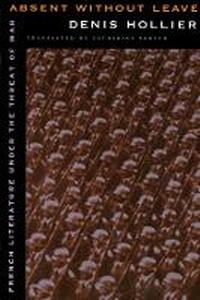
Absent without Leave
French Literature under the Threat of War
Published on 15. November 1997
Book
Paperback/Softback
244 pages
978-0-674-21271-8 (ISBN)
Description
They were not the "Banquet Years," those anxious wartime years when poets and novelists were made to feel embarrassed by their impulse to write literature. And yet it was the attitude of those writers and critics in the 1930s and 1940s that shaped French literature--the ideas of Derrida, Foucault, de Man, Deleuze, and Ricoeur--and has so profoundly influenced literary enterprise in the English-speaking world since 1968. This literary history, the prehistory of postmodernism, is what Denis Hollier recovers in his interlocking studies of the main figures of French literary life before the age of anxiety gave way to the era of existentialist commitment.
Georges Bataille, Michel Leiris, Roger Caillois, Andre Malraux, the early Jean-Paul Sartre are the figures Hollier considers, writers torn between politics and the pleasures of the text. They appear here uneasily balancing the influences of the philosopher and the man of action. These studies convey the paradoxical heroism of writers fighting for a world that would extend no rights or privileges to writers, writing for a world in which literature would become a reprehensible frivolity. If the nineteenth century was that of the consecration of the writer, this was the time for their sacrificial death, and Hollier captures the comical pathos of these writers pursuing the ideal of "engagement" through an exercise in dispossession. His work identifies, as none has before, the master plot for literature that was crafted in the 1940s, a plot in which we are still very much entangled.
Georges Bataille, Michel Leiris, Roger Caillois, Andre Malraux, the early Jean-Paul Sartre are the figures Hollier considers, writers torn between politics and the pleasures of the text. They appear here uneasily balancing the influences of the philosopher and the man of action. These studies convey the paradoxical heroism of writers fighting for a world that would extend no rights or privileges to writers, writing for a world in which literature would become a reprehensible frivolity. If the nineteenth century was that of the consecration of the writer, this was the time for their sacrificial death, and Hollier captures the comical pathos of these writers pursuing the ideal of "engagement" through an exercise in dispossession. His work identifies, as none has before, the master plot for literature that was crafted in the 1940s, a plot in which we are still very much entangled.
Reviews / Votes
[A] fine collection of essays...which are forceful and ingenious in argument and substantive in effect. The themes are broadly political and the writers that [Hollier] attends to are from the late 1930s and the 40s...Where [he] succeeds is in gathering the scattered and sometimes ambiguous evidence of dialectical tension in the writers he is involved with here--Sartre, Leiris, Roger Caillois, Bataille, Malraux. -- John Sturrock * Times Literary Supplement * In his examination of five writers, Hollier reveals how the self-inflicted and self-willed 'depersonalization' that these writers promote in their work allows it to be subsumed by a mythical dimension, which in turn can lead to an irresponsible abandonment of the self and the individual in favour of a totalitarian environment. Such writers indulge in 'self-mutilation' because they commit themselves to writing on behalf of a kind of world from which they would be excluded...These wide-ranging essays contain new insights and analyses of works that are generally not very well known, so that, for this reason alone, anyone interested in the social, cultural, political, or literary issues of this period will find them worth consulting. -- Peter Tame * Modern & Contemporary France [UK * Proposing his book as a 'prehistory of postmodernism,' Hollier considers the theoretical writings of a group of novelist/critics during the interwar years--George Bataille, Michel Leiris, Roger Caillois, Andre Malraux, and the early Jean-Paul Sartre. The book documents the self-consciousness that characterizes these writers as they theorize about the possibility of writing a novel in the years leading up to WWII. Perhaps unwittingly, the author demonstrates that the authorial narcissism and self-absorption that have crippled the French novel over the past 35 years have their roots in these interwar years. Students of French literature who are interested in minor and marginal literary groups and movements of the 1930s will find interesting information in this study. -- D. O'Connell * Choice *More details
Language
English
Place of publication
Cambridge, Mass
United States
Target group
College/higher education
Professional and scholarly
Dimensions
Height: 235 mm
Width: 156 mm
Weight
322 gr
ISBN-13
978-0-674-21271-8 (9780674212718)
Copyright in bibliographic data and cover images is held by Nielsen Book Services Limited or by the publishers or by their respective licensors: all rights reserved.
Schweitzer Classification
Other editions
Additional editions
E-Book
11/1997
1st Edition
Harvard University Press
€115.99
Available for download
Persons
Denis Hollier is Chairman of the Department of French at Yale University. He is the author of many books, including works on Sartre and Bataille.
Content
Must Literature Be Possible? Deeds without Words Mimesis and Castration 1937 Bataille's Tomb Unsatisfied Desire On Equivocation between Literature and Politics Fear and Trembling in the Age of Surrealism Under the Heading of Holofernes (Notes on Judith) Poetry from A to Z The Use Value of the Impossible When Existentialism Was Not Yet a Humanism A Farewell to Art Desperanto Notes Credits Index