

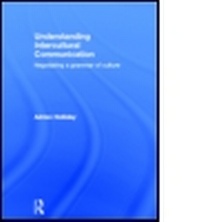
Understanding Intercultural Communication
Negotiating a Grammar of Culture
1st Edition
Published on 17. June 2013
Book
Hardback
188 pages
978-0-415-69131-4 (ISBN)
Description
In this book, Adrian Holliday provides a practical framework to help students analyse intercultural communication. Underpinned by a new grammar of culture developed by Holliday, this book will incorporate examples and activities to enable students and professionals to investigate culture on very new, entirely non-essentialist lines. This book will address key issues in intercultural communication including:
the positive contribution of people from diverse cultural backgrounds
the politics of Self and Other which promote negative stereotyping
the basis for a bottom-up approach to globalization in which Periphery cultural realities can gain voice and ownership
Written by a key researcher in the field, this book presents cutting edge research and a framework for analysis which will make it essential reading for upper undergraduate and postgraduate students studying intercultural communication and professionals in the field.
the positive contribution of people from diverse cultural backgrounds
the politics of Self and Other which promote negative stereotyping
the basis for a bottom-up approach to globalization in which Periphery cultural realities can gain voice and ownership
Written by a key researcher in the field, this book presents cutting edge research and a framework for analysis which will make it essential reading for upper undergraduate and postgraduate students studying intercultural communication and professionals in the field.
Reviews / Votes
"Through extending his seminal notion of `small cultures' to a much grander `grammar of culture', this is much more than a textbook in intercultural communication. Lucidly written and illustrated by fine-grained personal vignettes, Holliday provides a refreshing synthesis of culture and the intercultural which will both engage interested readers, and illuminate experienced researchers." - Malcolm N. MacDonald, University of Warwick, UK"Understanding Intercultural Communication is essentially a textbook aimed at helping students analyze cultural interactions from non-essentialist perspectives. The process is supported by ethnographic narratives within the text and by a variety of online access tools and activities." - George F. Simons, Founder of www.diversophy.com
More details
Language
English
Place of publication
London
United Kingdom
Publishing group
Taylor & Francis Ltd
Target group
College/higher education
Illustrations
7 s/w Abbildungen, 5 s/w Tabellen, 6 s/w Photographien bzw. Rasterbilder
6 Halftones, black and white; 31 Tables, black and white; 7 Illustrations, black and white
Dimensions
Height: 246 mm
Width: 171 mm
Weight
530 gr
ISBN-13
978-0-415-69131-4 (9780415691314)
Copyright in bibliographic data and cover images is held by Nielsen Book Services Limited or by the publishers or by their respective licensors: all rights reserved.
Schweitzer Classification
Other editions
New editions
Book
09/2018
2nd Edition
Routledge
€206.20
Shipment within 15-20 days
Additional editions
Book
06/2013
1st Edition
Routledge
€62.08
Article exhausted; check for reprint
Person
Adrian Holliday is a Professor of Applied Linguistics at Canterbury Christ Church University in the Department of Language Studies where he co-ordinates doctoral research in international English language education and intercultural issues. He is also Head of the Graduate School and Research Office and directs the University research degrees programme. He has published numerous works which generally concern the role of culture in international settings in the teaching of English.
Content
Chapter 1: The grammar of culture
Chapter 2: Cultural practices
Chapter 3: Investigating culture
Chapter 4: Constructing culture
Chapter 5: Dialogue with structure
Chapter 6: Historical narratives
Chapter 7: Discourses of culture
Chapter 8: Prejudice
Chapter 9: Cultural Travel and Innovation
Chapter 10: Epilogue: Theoretical Perspective
Chapter 2: Cultural practices
Chapter 3: Investigating culture
Chapter 4: Constructing culture
Chapter 5: Dialogue with structure
Chapter 6: Historical narratives
Chapter 7: Discourses of culture
Chapter 8: Prejudice
Chapter 9: Cultural Travel and Innovation
Chapter 10: Epilogue: Theoretical Perspective