


Intercultural Communication
An advanced resource book for students
Published on 24. June 2004
Book
Hardback
256 pages
978-0-415-27060-1 (ISBN)
Description
Intercultural Communication:
introduces the key theories of intercultural communication
explores ways in which people communicate within and across social groups
is built around three themes - identity, otherization and representation - which are followed and developed over the book's three sections
gathers together influential readings from key names in the discipline, including: James Paul Gee, James P. Lantolf, Les Back, Richard Dyer, Jacques Derrida, and Alastair Pennycook.
The accompanying website to this book can be found at http://www.routledge.com/texbooks/0415270618
introduces the key theories of intercultural communication
explores ways in which people communicate within and across social groups
is built around three themes - identity, otherization and representation - which are followed and developed over the book's three sections
gathers together influential readings from key names in the discipline, including: James Paul Gee, James P. Lantolf, Les Back, Richard Dyer, Jacques Derrida, and Alastair Pennycook.
The accompanying website to this book can be found at http://www.routledge.com/texbooks/0415270618
Reviews / Votes
'This book is a useful reminder that culture is constructed, perpetuated and changed through small acts of communication in everyday life. It offers a clear, practical methodology for escaping the essentialization of people, behaviors and events ... Most enjoyable are the illustrative anecdotes of intercultural (mis)communication presented for analysis and interpretation.' - Claire Kramsch, University of California, Berkeley, USAMore details
Series
Language
English
Place of publication
London
United Kingdom
Publishing group
Taylor & Francis Ltd
Target group
College/higher education
Postgraduate
Illustrations
20 Tables, black and white
Dimensions
Height: 246 mm
Width: 174 mm
ISBN-13
978-0-415-27060-1 (9780415270601)
Copyright in bibliographic data is held by Nielsen Book Services Limited or its licensors: all rights reserved.
Schweitzer Classification
Other editions
New editions
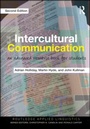
Adrian Holliday | John Kullman | Martin Hyde
Intercultural Communication
An Advanced Resource Book for Students
Book
06/2010
2nd Edition
Routledge
€133.70
Article exhausted; check for reprint
Persons
Canterbury Christchurch University, UK
Canterbury Christchurch University, UK
Canterbury Christchurch University, UK
Canterbury Christchurch University, UK
Canterbury Christchurch University, UK
Content
Section A: Introduction 1: Identity Unit 1: People Like me Unit 2: Artefacts of Culture Unit 3: Identity Card 2. Otherization Unit 4: Communication is About not Presuming Unit 5: Cultural Dealing Unit 6: Power and Language 3. Representation Unit 7: Cultural Refugee Unit 8: Complex Images Disciplines for Intercultural Communication Section B: Extension Unit 1: 'Culture' and 'Community' in Everyday Discourse Unit 2: 'Culture': Definitions and Perspectives 1: Identity Unit 3: - Identity as a Personal Project Unit 4: Globalization and Identity Unit 5:Discourse, Identity, and Culture Unit 6: Identity and Language Learning Unit 7: Identity, Community and the Internet 2: Otherization Unit 8: Otherization: Focus on Japan Unit 9: Images of the Other: 'Listen to the Image Speak' Unit 10: Absence and Invisibility in Otherization White Unit 11: The Other and the Tourist Gaze Unit 12: 'Undemonizing' 3: Representation Unit 13: Representation in the Mass Media: The Case of 'Asylum Seekers' Unit 14: Representation: Sport and Stereotyping in the Mass Media Unit 15: The Representation of Identity: Personality and its Social Construction Unit 16: Cultural Constructs Individualism and Collectivism Section C: Exploration 1: Identity Unit 1: The Story of the Self Unit 2: Becoming the Self Through Defining the Other Unit 3: Undoing Cultural Fundamentalism Unit 4: Investigating Discourse and Power Unit 5: Locality and Transcendence of Locality: Factors in Identity Formation 2: Otherization Unit 6: Otherization Unit 7: As you Speak Therefore you Are Unit 8: The 'Located' S