

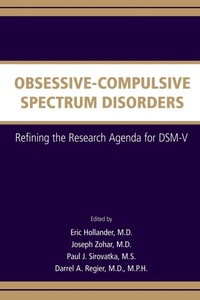
Obsessive-Compulsive Spectrum Disorders
Refining the Research Agenda for DSM-V
Published on 27. July 2010
Book
Paperback/Softback
257 pages
978-0-89042-659-3 (ISBN)
Description
The five-year process of preparing for the revision of the
Diagnostic and Statistical Manual (DSM) has been organized around a series
of conferences convened by the American Psychiatric Association, in
collaboration with the World Health Organization and the U.S. National
Institutes of Health, to address the future of psychiatric diagnosis.
Obsessive-Compulsive Spectrum Disorders: Refining the Research Agenda
for DSM-V is the fruit of one of those conferences and presents the
most academically sound, thought-provoking, and timely papers from the
proceedings.
As the conference and book demonstrate, recent advances
in psychiatric diagnosis suggest a new approach to obsessive-compulsive
disorder (OCD) classification:
* Research into the pathogenesis of OCD increasingly supports
reclassification out of the anxiety disorders and into a separate group of
obsessive-compulsive-related disorders (OCRDs).
* The relationships
among OCRDs may be better defined, delineated, and understood if the current
categorical diagnostic approach is supplemented with a dimensional approach
which assesses obsessive-compulsive symptom domains.
*
Obsessive-compulsive disorders are believed to be underdiagnosed in patients
who complain of broad symptoms of anxiety, and reclassification of OCD as an
OCRD would promote more careful examination of distinct obsessive-compulsive
symptoms, yield more accurate diagnosis, and result in more effective
treatments.
* Reclassification may facilitate future research directions
in examining the biological underpinnings of these disorders.
In
addition to examining the genetic, neurological, and ethno-cultural bases
for OCRDs, the book gives special attention to disorders that cross current
diagnostic categories, including:
* Body dysmorphic disorder (BDD)
* Tourette's syndrome and
trichotillomania
* Impulse-control disorders
The process leading
to publication of DSM-V is by its nature an exhaustive and complex one, and
the conferences play a critical role in reviewing relevant research,
assessing the status of scientific knowledge, and advancing that knowledge
base. Obsessive-Compulsive Spectrum Disorders: Refining the Research
Agenda for DSM-V represents the cutting-edge thinking that will
culminate in new diagnoses, classifications, and standards of practice for
this debilitating set of disorders. Clinicians and academicians will be
fascinated by this glimpse into the next generation of the DSM-V.
Diagnostic and Statistical Manual (DSM) has been organized around a series
of conferences convened by the American Psychiatric Association, in
collaboration with the World Health Organization and the U.S. National
Institutes of Health, to address the future of psychiatric diagnosis.
Obsessive-Compulsive Spectrum Disorders: Refining the Research Agenda
for DSM-V is the fruit of one of those conferences and presents the
most academically sound, thought-provoking, and timely papers from the
proceedings.
As the conference and book demonstrate, recent advances
in psychiatric diagnosis suggest a new approach to obsessive-compulsive
disorder (OCD) classification:
* Research into the pathogenesis of OCD increasingly supports
reclassification out of the anxiety disorders and into a separate group of
obsessive-compulsive-related disorders (OCRDs).
* The relationships
among OCRDs may be better defined, delineated, and understood if the current
categorical diagnostic approach is supplemented with a dimensional approach
which assesses obsessive-compulsive symptom domains.
*
Obsessive-compulsive disorders are believed to be underdiagnosed in patients
who complain of broad symptoms of anxiety, and reclassification of OCD as an
OCRD would promote more careful examination of distinct obsessive-compulsive
symptoms, yield more accurate diagnosis, and result in more effective
treatments.
* Reclassification may facilitate future research directions
in examining the biological underpinnings of these disorders.
In
addition to examining the genetic, neurological, and ethno-cultural bases
for OCRDs, the book gives special attention to disorders that cross current
diagnostic categories, including:
* Body dysmorphic disorder (BDD)
* Tourette's syndrome and
trichotillomania
* Impulse-control disorders
The process leading
to publication of DSM-V is by its nature an exhaustive and complex one, and
the conferences play a critical role in reviewing relevant research,
assessing the status of scientific knowledge, and advancing that knowledge
base. Obsessive-Compulsive Spectrum Disorders: Refining the Research
Agenda for DSM-V represents the cutting-edge thinking that will
culminate in new diagnoses, classifications, and standards of practice for
this debilitating set of disorders. Clinicians and academicians will be
fascinated by this glimpse into the next generation of the DSM-V.
Reviews / Votes
The book provides an organized and well-written reflectionof the conference proceedings concerning OCD and obsessive-compulsive
spectrum disorders for DSM-5. The chapters give a comprehensive and
up-to-date review of a large body of literature and flow easily. -- Jessica Rasmussen, Ph.D. and Sabine Wilhelm, Ph.D. * The American Journal of Psychiatry *
More details
Language
English
Place of publication
VA
United States
Target group
College/higher education
Professional and scholarly
US School Grade: College Graduate Student and over
Product notice
Paperback (trade)
Illustrations
1 Line drawings, black and white; 10 Tables, unspecified
Dimensions
Height: 229 mm
Width: 152 mm
Thickness: 14 mm
Weight
351 gr
ISBN-13
978-0-89042-659-3 (9780890426593)
Copyright in bibliographic data and cover images is held by Nielsen Book Services Limited or by the publishers or by their respective licensors: all rights reserved.
Schweitzer Classification
Other editions
Additional editions
Eric Hollander | Joseph Zohar | Paul J. Sirovatka
Obsessive-Compulsive Spectrum Disorders
Refining the Research Agenda for DSM-V
E-Book
05/2010
1st Edition
American Psychiatric Association
€56.99
Available for download
Persons
Eric Hollander, M.D., is on the faculty in the
Department of Psychiatry and Behavioral Sciences at Montefiore Medical
Center and Albert Einstein College of Medicine in Bronx, New
York.
Joseph Zohar, M.D., is Professor of Psychiatry in the
Department of Psychiatry at Chaim Sheba Medical Center in Tel-Hashomer,
Israel; and International Editor of CNS
Spectrums.
Paul J. Sirovatka, M.S. (1947-2007), was
Director of Research Policy Analysis in the Division of Research and
American Psychiatric Institute for Research and Education at the American
Psychiatric Association in Arlington, Virginia.
Darrel A. Regier,
M.D., M.P.H., is Executive Director of the American Psychiatric
Institute for Research and Education and Director of the Division of
Research at the American Psychiatric Association in Arlington, Virginia.
Department of Psychiatry and Behavioral Sciences at Montefiore Medical
Center and Albert Einstein College of Medicine in Bronx, New
York.
Joseph Zohar, M.D., is Professor of Psychiatry in the
Department of Psychiatry at Chaim Sheba Medical Center in Tel-Hashomer,
Israel; and International Editor of CNS
Spectrums.
Paul J. Sirovatka, M.S. (1947-2007), was
Director of Research Policy Analysis in the Division of Research and
American Psychiatric Institute for Research and Education at the American
Psychiatric Association in Arlington, Virginia.
Darrel A. Regier,
M.D., M.P.H., is Executive Director of the American Psychiatric
Institute for Research and Education and Director of the Division of
Research at the American Psychiatric Association in Arlington, Virginia.
Content
CONTRIBUTORS
DISCLOSURE
STATEMENT
PREFACE
INTRODUCTION: Cross-Cutting Issues and Future
Directions for the Obsessive-Compulsive Spectrum Disorders
Chapter 1.
OBSESSIVE-COMPULSIVE DISORDER: Boundary Issues
Chapter 2. RELATIONSHIP
OF BODY DYSMORPHIC DISORDER AND EATING DISORDERS TO OBSESSIVE-COMPULSIVE
DISORDER
Chapter 3. TOURETTE'S SYNDROME, TRICHOTILLOMANIA, AND
OBSESSIVE-COMPULSIVE DISORDER: How Closely Are They Related?
Chapter 4.
RELATIONSHIP BETWEEN IMPULSE-CONTROL DISORDERS AND OBSESSIVE-COMPULSIVE
DISORDER: A Current Understanding and Future Research Directions
Chapter
5. SYMPTOM DIMENSIONS IN OBSESSIVE-COMPULSIVE DISORDER: Implications for
DSM-V
Chapter 6. OVERVIEW OF GENETICS AND OBSESSIVE-COMPULSIVE
DISORDER
Chapter 7. NEUROLOGICAL CONSIDERATIONS: Autism and Parkinson's
Disease
Chapter 8. CROSS-SPECIES MODELS OF OBSESSIVE-COMPULSIVE SPECTRUM
DISORDERS
Chapter 9. OBSESSIVE-COMPULSIVE SPECTRUM DISORDERS:
Cross-National and Ethnic Issues
INDEX
DISCLOSURE
STATEMENT
PREFACE
INTRODUCTION: Cross-Cutting Issues and Future
Directions for the Obsessive-Compulsive Spectrum Disorders
Chapter 1.
OBSESSIVE-COMPULSIVE DISORDER: Boundary Issues
Chapter 2. RELATIONSHIP
OF BODY DYSMORPHIC DISORDER AND EATING DISORDERS TO OBSESSIVE-COMPULSIVE
DISORDER
Chapter 3. TOURETTE'S SYNDROME, TRICHOTILLOMANIA, AND
OBSESSIVE-COMPULSIVE DISORDER: How Closely Are They Related?
Chapter 4.
RELATIONSHIP BETWEEN IMPULSE-CONTROL DISORDERS AND OBSESSIVE-COMPULSIVE
DISORDER: A Current Understanding and Future Research Directions
Chapter
5. SYMPTOM DIMENSIONS IN OBSESSIVE-COMPULSIVE DISORDER: Implications for
DSM-V
Chapter 6. OVERVIEW OF GENETICS AND OBSESSIVE-COMPULSIVE
DISORDER
Chapter 7. NEUROLOGICAL CONSIDERATIONS: Autism and Parkinson's
Disease
Chapter 8. CROSS-SPECIES MODELS OF OBSESSIVE-COMPULSIVE SPECTRUM
DISORDERS
Chapter 9. OBSESSIVE-COMPULSIVE SPECTRUM DISORDERS:
Cross-National and Ethnic Issues
INDEX