

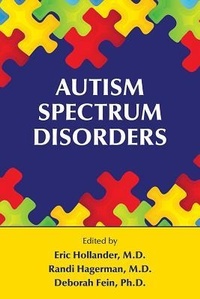
Autism Spectrum Disorders
Published on 29. June 2018
Book
Paperback/Softback
376 pages
978-1-61537-052-8 (ISBN)
Description
In DSM-5, published in 2013, the classification of autism
spectrum disorder (ASD) was created, subsuming several diagnoses and
representing a significant evolution from its first appearance in the
DSM-III three decades earlier. Autism Spectrum Disorders reflects
this evolution, offering clinicians and families a succinct, definitive, and
up-to-date guide to current research in the field and its impact on
assessment and treatment. The book begins with the epidemiology of ASDs,
which have increased in prevalence, and explores genetic heritability and
environmental risk factors. It then explains the roles of the psychiatrist,
neurologist and pediatrician in assessing the patient, examines assessment
tools and processes, and describes the latest advances in a variety of
treatments and interventions. The text's focus is on educating and
empowering families and health care providers to determine whether
appropriate genetic testing and counseling have been undertaken, whether the
individual has had the relevant assessment, and whether skilled behavioral
treatment and additional medical assessment or treatment are
required.
Specifically, the text:
* Reviews existing prevalence estimates for ASDs since 2000 and
discusses methodological factors impacting the estimation of prevalence and
the interpretation of changes in prevalence estimates over time.
*
Evaluates genomic and epigenomic research over the last decade in the
context of translating findings to practice, in terms of testing (e.g., copy
number variants and whole-exome sequencing) and counseling.
* Examines
the role of environmental toxicity in immune dysregulation, which has now
been noted among individuals with ASD and their family members by numerous
studies.
* Reviews medical and cognitive assessments that may be
needed.
* Reviews targeted treatments that have the potential to reverse
neurobiological abnormalities in ASD
* Reviews behavioral treatments
that are effective in promoting development and improving behavior.
*
Describes the Developmental, Individual Difference, Relationship-based (DIR)
model, a comprehensive developmental theory with relevance across the
lifespan, which targets the core deficits of ASD identified in DSM-5.
*
Provides an overview of school-based interventions for students with autism,
exploring the rationale for conducting school-based research and examining
existing teacher-, paraprofessional-, and peer-mediated interventions
school-based interventions.
* Explores other approaches to ASDs, such as
complementary and integrative approaches and non-invasive brain stimulation
technologies, including transcranial magnetic stimulation.
The push
for early screening is resulting in earlier diagnosis of ASDs and the
provision of evidence-based interventions that have a positive impact on
outcomes. Autism Spectrum Disorders provides a bench-to-bedside guide
that is essential reading for health care providers and families facing the
challenges inherent in these complex disorders.
spectrum disorder (ASD) was created, subsuming several diagnoses and
representing a significant evolution from its first appearance in the
DSM-III three decades earlier. Autism Spectrum Disorders reflects
this evolution, offering clinicians and families a succinct, definitive, and
up-to-date guide to current research in the field and its impact on
assessment and treatment. The book begins with the epidemiology of ASDs,
which have increased in prevalence, and explores genetic heritability and
environmental risk factors. It then explains the roles of the psychiatrist,
neurologist and pediatrician in assessing the patient, examines assessment
tools and processes, and describes the latest advances in a variety of
treatments and interventions. The text's focus is on educating and
empowering families and health care providers to determine whether
appropriate genetic testing and counseling have been undertaken, whether the
individual has had the relevant assessment, and whether skilled behavioral
treatment and additional medical assessment or treatment are
required.
Specifically, the text:
* Reviews existing prevalence estimates for ASDs since 2000 and
discusses methodological factors impacting the estimation of prevalence and
the interpretation of changes in prevalence estimates over time.
*
Evaluates genomic and epigenomic research over the last decade in the
context of translating findings to practice, in terms of testing (e.g., copy
number variants and whole-exome sequencing) and counseling.
* Examines
the role of environmental toxicity in immune dysregulation, which has now
been noted among individuals with ASD and their family members by numerous
studies.
* Reviews medical and cognitive assessments that may be
needed.
* Reviews targeted treatments that have the potential to reverse
neurobiological abnormalities in ASD
* Reviews behavioral treatments
that are effective in promoting development and improving behavior.
*
Describes the Developmental, Individual Difference, Relationship-based (DIR)
model, a comprehensive developmental theory with relevance across the
lifespan, which targets the core deficits of ASD identified in DSM-5.
*
Provides an overview of school-based interventions for students with autism,
exploring the rationale for conducting school-based research and examining
existing teacher-, paraprofessional-, and peer-mediated interventions
school-based interventions.
* Explores other approaches to ASDs, such as
complementary and integrative approaches and non-invasive brain stimulation
technologies, including transcranial magnetic stimulation.
The push
for early screening is resulting in earlier diagnosis of ASDs and the
provision of evidence-based interventions that have a positive impact on
outcomes. Autism Spectrum Disorders provides a bench-to-bedside guide
that is essential reading for health care providers and families facing the
challenges inherent in these complex disorders.
More details
Language
English
Place of publication
VA
United States
Target group
Professional and scholarly
US School Grade: College Graduate Student and over
Product notice
Paperback (trade)
Illustrations
7 Illustrations, color; 6 Figures; 14 Tables, unspecified
Dimensions
Height: 229 mm
Width: 152 mm
Weight
621 gr
ISBN-13
978-1-61537-052-8 (9781615370528)
Copyright in bibliographic data and cover images is held by Nielsen Book Services Limited or by the publishers or by their respective licensors: all rights reserved.
Schweitzer Classification
Other editions
Additional editions
Eric Hollander | Randi J. Hagerman | Deborah Fein
Autism Spectrum Disorders
E-Book
04/2018
1st Edition
American Psychiatric Association Publishing
€47.99
Available for download
Persons
Eric Hollander, M.D., is Professor of Psychiatry and
Behavioral Sciences at Albert Einstein College of Medicine and Director of
the Autism and Obsessive-Compulsive Spectrum Program, and the Anxiety and
Depression Program, in the Department of Psychiatry and Behavioral Sciences
at Montefiore Medical Center and Albert Einstein College of Medicine in
Bronx, New York.
Randi Hagerman, M.D., is a Developmental and
Behavioral Pediatrician, Medical Director of the UC Davis MIND Institute and
Distinguished Professor and Endowed Chair in Fragile X Research in the
Department of Pediatrics at the University of California Davis School of
Medicine in Sacramento, California.
Deborah Fein, Ph.D., is
Board of Trustees Distinguished Professor and Clinical Division Head in the
Department of Psychological Sciences at the University of Connecticut in
Storrs, Connecticut and Professor of Pediatrics at the University of
Connecticut School of Medicine in Farmington, Connecticut.
Behavioral Sciences at Albert Einstein College of Medicine and Director of
the Autism and Obsessive-Compulsive Spectrum Program, and the Anxiety and
Depression Program, in the Department of Psychiatry and Behavioral Sciences
at Montefiore Medical Center and Albert Einstein College of Medicine in
Bronx, New York.
Randi Hagerman, M.D., is a Developmental and
Behavioral Pediatrician, Medical Director of the UC Davis MIND Institute and
Distinguished Professor and Endowed Chair in Fragile X Research in the
Department of Pediatrics at the University of California Davis School of
Medicine in Sacramento, California.
Deborah Fein, Ph.D., is
Board of Trustees Distinguished Professor and Clinical Division Head in the
Department of Psychological Sciences at the University of Connecticut in
Storrs, Connecticut and Professor of Pediatrics at the University of
Connecticut School of Medicine in Farmington, Connecticut.
Content
Chapter 1. Foreword
Chapter 2. Epidemiology
Chapter
3. Genomics and Epigenomics
Chapter 4. Environmental Toxicity and Immune
Dysregulation
Chapter 5. Psychiatric Assessment and
Treatment
Chapter 6. Pediatric and Neurological Assessment and Targeted
Treatments
Chapter 7. Cognitive Assessment
Chapter 8. Behavioral
Treatment
Chapter 9. Developmental, Individual Difference, Relationship
Based Model for Assessment and Intervention (DIR Model)
Chapter 10.
Autism Interventions in Schools
Chapter 11. Language, Communication and
Occupational Therapy Interventions
Chapter 12. Complementary and
Integrative Approaches
Chapter 13. Transcranial Magnetic Stimulation
and Non-invasive Brain Stimulation
Chapter 2. Epidemiology
Chapter
3. Genomics and Epigenomics
Chapter 4. Environmental Toxicity and Immune
Dysregulation
Chapter 5. Psychiatric Assessment and
Treatment
Chapter 6. Pediatric and Neurological Assessment and Targeted
Treatments
Chapter 7. Cognitive Assessment
Chapter 8. Behavioral
Treatment
Chapter 9. Developmental, Individual Difference, Relationship
Based Model for Assessment and Intervention (DIR Model)
Chapter 10.
Autism Interventions in Schools
Chapter 11. Language, Communication and
Occupational Therapy Interventions
Chapter 12. Complementary and
Integrative Approaches
Chapter 13. Transcranial Magnetic Stimulation
and Non-invasive Brain Stimulation