

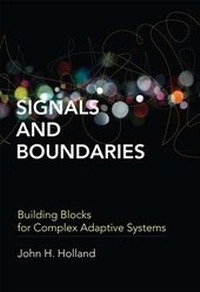
Signals and Boundaries
Building Blocks for Complex Adaptive Systems
Published on 13. July 2012
Book
Hardback
316 pages
978-0-262-01783-1 (ISBN)
Description
Complex adaptive systems (cas), including ecosystems, governments, biological cells,
and markets, are characterized by intricate hierarchical arrangements of boundaries and signals. In
ecosystems, for example, niches act as semi-permeable boundaries, and smells and visual patterns
serve as signals; governments have departmental hierarchies with memoranda acting as signals; and so
it is with other cas. Despite a wealth of data and descriptions concerning different cas, there
remain many unanswered questions about "steering" these systems. In Signals and
Boundaries, John Holland argues that understanding the origin of the intricate
signal/border hierarchies of these systems is the key to answering such questions. He develops an
overarching framework for comparing and steering cas through the mechanisms that generate their
signal/boundary hierarchies.
Holland lays out a path for developing the framework
that emphasizes agents, niches, theory, and mathematical models. He discusses, among other topics,
theory construction; signal-processing agents; networks as representations of signal/boundary
interaction; adaptation; recombination and reproduction; the use of tagged urn models (adapted from
elementary probability theory) to represent boundary hierarchies; finitely generated systems as a
way to tie the models examined into a single framework; the framework itself, illustrated by a
simple finitely generated version of the development of a multi-celled organism; and Markov
processes.
and markets, are characterized by intricate hierarchical arrangements of boundaries and signals. In
ecosystems, for example, niches act as semi-permeable boundaries, and smells and visual patterns
serve as signals; governments have departmental hierarchies with memoranda acting as signals; and so
it is with other cas. Despite a wealth of data and descriptions concerning different cas, there
remain many unanswered questions about "steering" these systems. In Signals and
Boundaries, John Holland argues that understanding the origin of the intricate
signal/border hierarchies of these systems is the key to answering such questions. He develops an
overarching framework for comparing and steering cas through the mechanisms that generate their
signal/boundary hierarchies.
Holland lays out a path for developing the framework
that emphasizes agents, niches, theory, and mathematical models. He discusses, among other topics,
theory construction; signal-processing agents; networks as representations of signal/boundary
interaction; adaptation; recombination and reproduction; the use of tagged urn models (adapted from
elementary probability theory) to represent boundary hierarchies; finitely generated systems as a
way to tie the models examined into a single framework; the framework itself, illustrated by a
simple finitely generated version of the development of a multi-celled organism; and Markov
processes.
More details
Language
English
Place of publication
Cambridge, Mass.
United States
Publishing group
MIT Press Ltd
Target group
Professional and scholarly
Interest Age: From 18 years
Illustrations
27 Schaubilder
27 figures
Dimensions
Height: 203 mm
Width: 127 mm
Thickness: 0 mm
Weight
454 gr
ISBN-13
978-0-262-01783-1 (9780262017831)
Copyright in bibliographic data and cover images is held by Nielsen Book Services Limited or by the publishers or by their respective licensors: all rights reserved.
Schweitzer Classification
Other editions
Additional editions
Book
01/2014
MIT Press
€23.60
Article exhausted; check different version
E-Book
07/2012
MIT Press
€24.49
Available for download
Person
John H. Holland is Professor of Psychology and Professor of Computer Science and Engineering at the University of Michigan; he is also Trustee and External Professor at the Santa Fe Institute. He is the author of Hidden Order: How Adaptation Builds Complexity and other books.