

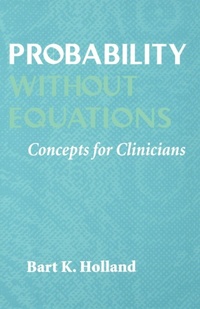
Probability without Equations
Concepts for Clinicians
Published on 4. February 1998
Book
Paperback/Softback
128 pages
978-0-8018-5760-7 (ISBN)
Description
Although few physicians, nurses, dentists, and other health professionals perform laboratory tests themselves, they all need to be able to interpret the results as well as understand findings reported in the medical literature. A general understanding of probability and statistics is essential for those needing to make daily decisions about the significance of research data, drug interaction precautions, or a patient's positive laboratory test for a rare disease. Written with these needs in mind, Probability without Equations offers a thorough explanation of the subject without overwhelming the reader with equations and footnotes. Award-winning teacher Bart Holland presents a nontechnical treatment of intuitive concepts and presents numerous examples from medical research and practice. In plain language, this book explains the topics that clinicians need to understand: * Analysis of variance * "P-values" and the "t-test" * Hazard models * Regression and correlations * Alpha and beta errors "The Nobel prize-winning physicist Ernest Rutherford was fond of saying that if you need statistics to analyze the results of an experiment, you don't have a very good experiment.
In a way he was right. However, a recurrent problem in medicine is that in a certain sense you commonly don't have a good experiment-but not because medical research scientists are generally incompetent! The nature of the data they work with is simply not as predictable as the data in some other fields, so the predictive nature of findings in medical science is generally rather imperfect."-from the introduction
In a way he was right. However, a recurrent problem in medicine is that in a certain sense you commonly don't have a good experiment-but not because medical research scientists are generally incompetent! The nature of the data they work with is simply not as predictable as the data in some other fields, so the predictive nature of findings in medical science is generally rather imperfect."-from the introduction
More details
Language
English
Place of publication
Baltimore, MD
United States
Target group
Professional and scholarly
Product notice
Paperback (trade)
Illustrations
10 s/w Zeichnungen
10 Line drawings, black and white
Dimensions
Height: 216 mm
Width: 140 mm
Thickness: 7 mm
Weight
177 gr
ISBN-13
978-0-8018-5760-7 (9780801857607)
DOI
10.56021/9780801857591
Copyright in bibliographic data and cover images is held by Nielsen Book Services Limited or by the publishers or by their respective licensors: all rights reserved.
Schweitzer Classification
Other editions
Additional editions

Book
02/1998
Johns Hopkins University Press
€76.33
Article not available for order
E-Book
02/1998
Johns Hopkins University Press
€22.49
Available for download
Person
Bart K. Holland is a consultant in probability and statistics for medical applications and has been involved with the design and analysis of many clinical trials. He has also taught probability, biostatistics, and epidemiology for more than ten years at the New Jersey Medical School, where he is an associate professor in the Department of Preventive Medicine and Community Health. His lectures have won him the medical school's award for outstanding teaching.
Content
Acknowledgments
Introduction: Probability, Uncertainty, and Medical Knowledge
Chapter 1. The Meaning of "Tests of Significance"
Chapter 2. Alphabet Soup: t, Z, F, r, and Other Statistics Found in the Medical Literature
Chapter 3. Your Patient Tests Positive: Is Disease Present?
Chapter 4. Epidemiological Study Designs
Chapter 5. Clinical Trials
Additional Reading
Index
Introduction: Probability, Uncertainty, and Medical Knowledge
Chapter 1. The Meaning of "Tests of Significance"
Chapter 2. Alphabet Soup: t, Z, F, r, and Other Statistics Found in the Medical Literature
Chapter 3. Your Patient Tests Positive: Is Disease Present?
Chapter 4. Epidemiological Study Designs
Chapter 5. Clinical Trials
Additional Reading
Index