

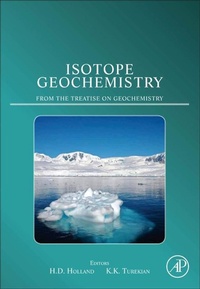
Isotope Geochemistry
A derivative of the Treatise on Geochemistry
Published on 27. September 2010
Book
Paperback/Softback
752 pages
978-0-08-096710-3 (ISBN)
Description
After the discovery that elements were commonly composed of isotopes, there developed a range of studies of the variability of isotopic compositions in Earth materials, which was able to add to our understanding of Earth processes and history.
This collection of chapters from the Treatise on Geochemistry describes the range of isotopic studies. The chapters are grouped into the following categories: light stable isotopes, radiogenic tracers, noble gases and radioactive tracers. The first three groups depend on mass spectrometric measurements. The section on radioactive tracers employs both radioactive counting techniques and the newly developed accelerator mass spectrometric techniques.
This collection of chapters from the Treatise on Geochemistry describes the range of isotopic studies. The chapters are grouped into the following categories: light stable isotopes, radiogenic tracers, noble gases and radioactive tracers. The first three groups depend on mass spectrometric measurements. The section on radioactive tracers employs both radioactive counting techniques and the newly developed accelerator mass spectrometric techniques.
More details
Language
English
Place of publication
London
United Kingdom
Publishing group
Elsevier Science & Technology
Target group
College/higher education
Professional and scholarly
professionals, researchers, and upper level undergraduate and graduate geochemistry students
Product notice
Paperback (trade)
sewn/stitched
Dimensions
Height: 266 mm
Width: 189 mm
Thickness: 42 mm
Weight
1720 gr
ISBN-13
978-0-08-096710-3 (9780080967103)
Copyright in bibliographic data and cover images is held by Nielsen Book Services Limited or by the publishers or by their respective licensors: all rights reserved.
Schweitzer Classification
Other editions
Additional editions
Heinrich D. Holland | Karl K. Turekian
Isotope Geochemistry
A derivative of the Treatise on Geochemistry
E-Book
09/2010
Academic Press
€80.95
Available for download
Persons
KARL KAREKIN TUREKIAN (1927-2013)
Karl Turekian was a man of remarkable scientific breadth, with innumerable important contributions to marine geochemistry, atmospheric chemistry, cosmochemistry, and global geochemical cycles. He was mentor to a long list of students, postdocs, and faculty (at Yale and elsewhere), a leader in geochemistry, a prolific author and editor, and had a profound influence in shaping his department at Yale University.
In 1949 Karl joined a graduate program in the new field of geochemistry at Columbia University under Larry Kulp with students Dick Holland and his fellow Wheaton alums Wally Broecker and Paul Gast. This was a propitious time as Columbia's Lamont Geological Observatory had only been established a few years beforehand. It was during these years that Karl began to acquire the skills that led to his rapid emergence as a leader in geochemistry.
After a brief postdoc at Columbia, Karl accepted a position as Assistant Professor of Geology at Yale University in 1956, where he set out to create a program in geochemistry from scratch. Karl spent the rest of his life on the Yale faculty and was immersed in geochemistry to the end. He was deeply involved in editing this edition of the massive Treatise on Geochemistry, which has grown to 15 volumes, until only a month before his passing away on 15 March 2013.
Karl turned to the study of deep-sea cores and especially the analysis of trace elements to study the wide variety of geochemical processes that are recorded there. His work with Hans Wedepohl in writing and tabulating the Handbook of Geochemistry (Turekian, 1969) was a major accomplishment and this work was utilized by many generations of geochemists. Teaming up with his graduate students and in association with Paul Gast, he developed a mass spectrometry lab at Yale and began to thoroughly investigate the Rb-Sr isotopic systematics of deep-sea clays, not only as repositories but also as sites for exchange to occur and serve as a control of the geochemistry of ocean water.
Karl was a major player in a revolutionary marine geochemistry campaign known as the Geochemical Ocean Section Study (GEOSECS). GEOSECS was part of the International Decade of Ocean Exploration in the 1970s, and it took aim at measuring and understanding the distribution of geochemical tracers for circulation and biogeochemistry in the world's oceans.. It was also within this same time period that another large-scale 'geochemical' sampling program known as Apollo 11 came along. Here Karl utilized his INAA techniques to examine some of the first returned lunar samples for their trace elements. Karl was particularly proud of being the holder of the Silliman Chair and being curator of the Yale meteorite collection. In a continuation of Karl's foray into cosmochemistry, Andy Davis came to Yale to study with Karl and Sydney Clark.
Equally important to the legacy of what Karl did for science in his research contributions on and across the planet was his influence on scientists. His legendary daily coffee hours were a training ground for many generations of students, postdocs, and visitors, as well as a proving ground for Karl's own ideas. He had a great love for vigorous scientific debate. Karl loved to question and be questioned. Nothing was sacred and, in the act of questioning as in exploring, new science arises. He was extraordinarily supportive of people, always had time to discuss and listen, and helped everyone from students to his fellow faculty at Yale. Karl was twice department chair and even when not chair, a steadying influence in times of departmental difficulty.
Andrew M. Davis, Lawrence Grossman and Albert S. Colman
University of Chicago, Chicago, IL, USA
Mark H. Thiemens
University of California at San Diego, La Jolla, CA, USA
This Obituary was first published in PNAS, Vol. 110, No. 41, 16290-16291, 10th October 2013 (c) 2013
Karl Turekian was a man of remarkable scientific breadth, with innumerable important contributions to marine geochemistry, atmospheric chemistry, cosmochemistry, and global geochemical cycles. He was mentor to a long list of students, postdocs, and faculty (at Yale and elsewhere), a leader in geochemistry, a prolific author and editor, and had a profound influence in shaping his department at Yale University.
In 1949 Karl joined a graduate program in the new field of geochemistry at Columbia University under Larry Kulp with students Dick Holland and his fellow Wheaton alums Wally Broecker and Paul Gast. This was a propitious time as Columbia's Lamont Geological Observatory had only been established a few years beforehand. It was during these years that Karl began to acquire the skills that led to his rapid emergence as a leader in geochemistry.
After a brief postdoc at Columbia, Karl accepted a position as Assistant Professor of Geology at Yale University in 1956, where he set out to create a program in geochemistry from scratch. Karl spent the rest of his life on the Yale faculty and was immersed in geochemistry to the end. He was deeply involved in editing this edition of the massive Treatise on Geochemistry, which has grown to 15 volumes, until only a month before his passing away on 15 March 2013.
Karl turned to the study of deep-sea cores and especially the analysis of trace elements to study the wide variety of geochemical processes that are recorded there. His work with Hans Wedepohl in writing and tabulating the Handbook of Geochemistry (Turekian, 1969) was a major accomplishment and this work was utilized by many generations of geochemists. Teaming up with his graduate students and in association with Paul Gast, he developed a mass spectrometry lab at Yale and began to thoroughly investigate the Rb-Sr isotopic systematics of deep-sea clays, not only as repositories but also as sites for exchange to occur and serve as a control of the geochemistry of ocean water.
Karl was a major player in a revolutionary marine geochemistry campaign known as the Geochemical Ocean Section Study (GEOSECS). GEOSECS was part of the International Decade of Ocean Exploration in the 1970s, and it took aim at measuring and understanding the distribution of geochemical tracers for circulation and biogeochemistry in the world's oceans.. It was also within this same time period that another large-scale 'geochemical' sampling program known as Apollo 11 came along. Here Karl utilized his INAA techniques to examine some of the first returned lunar samples for their trace elements. Karl was particularly proud of being the holder of the Silliman Chair and being curator of the Yale meteorite collection. In a continuation of Karl's foray into cosmochemistry, Andy Davis came to Yale to study with Karl and Sydney Clark.
Equally important to the legacy of what Karl did for science in his research contributions on and across the planet was his influence on scientists. His legendary daily coffee hours were a training ground for many generations of students, postdocs, and visitors, as well as a proving ground for Karl's own ideas. He had a great love for vigorous scientific debate. Karl loved to question and be questioned. Nothing was sacred and, in the act of questioning as in exploring, new science arises. He was extraordinarily supportive of people, always had time to discuss and listen, and helped everyone from students to his fellow faculty at Yale. Karl was twice department chair and even when not chair, a steadying influence in times of departmental difficulty.
Andrew M. Davis, Lawrence Grossman and Albert S. Colman
University of Chicago, Chicago, IL, USA
Mark H. Thiemens
University of California at San Diego, La Jolla, CA, USA
This Obituary was first published in PNAS, Vol. 110, No. 41, 16290-16291, 10th October 2013 (c) 2013
Content
Oxygen isotopes in meteorites, Structural and isotopic analysis of organic matter in carbonaceous chondrites, Trace element and isotopic fluxes/subducted slab, Nonmass-dependent isotopic fractionation processes: Mechanisms and recent observations in terrestrial and extraterrestrial environments, The stable isotopic composition of atmospheric CO2, Water stable isotopes: Atmospheric composition and applications in Polar ice core studies, Stable isotope applications in hydrologic studies, Elemental and isotopic proxies of past ocean temperatures, Sulfur-rich sediments, Stable isotopes in the sedimentary record, The global oxygen cycle, High-molecular-weight petrogenic and pyrogenic hydrocarbons in aquatic environments, Radiocarbon, Natural radionuclides in the atmosphere, Noble gases, The origin of noble gases and major volatiles in the terrestrial planets, Noble gases as mantle tracers, Sampling mantle heterogeneities through oceanic basalts: Isotopes and trace elements, Radiogenic isotopes in weathering and hydrology, Long-lived isotopic tracers in oceanography, paleoceanography and ice-sheet dynamics, Records of Cenozoic ocean chemistry, Appendix 1, Appendix 2, Appendix 3, Appendix 4