

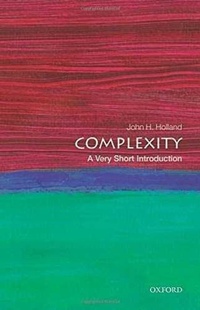
Complexity
A Very Short Introduction
Published on 24. July 2014
Book
Paperback/Softback
112 pages
978-0-19-966254-8 (ISBN)
Description
The importance of complexity is well-captured by Hawking's comment: "Complexity is the science of the 21st century". From the movement of flocks of birds to the Internet, environmental sustainability, and market regulation, the study and understanding of complex non-linear systems has become highly influential over the last 30 years.
In this Very Short Introduction, one of the leading figures in the field, John Holland, introduces the key elements and conceptual framework of complexity. From complex physical systems such as fluid flow and the difficulties of predicting weather, to complex adaptive systems such as the highly diverse and interdependent ecosystems of rainforests, he combines simple, well-known examples -- Adam Smith's pin factory, Darwin's comet orchid, and Simon's 'watchmaker' -- with an account of the approaches, involving agents and urn models, taken by complexity theory.
ABOUT THE SERIES: The Very Short Introductions series from Oxford University Press contains hundreds of titles in almost every subject area. These pocket-sized books are the perfect way to get ahead in a new subject quickly. Our expert authors combine facts, analysis, perspective, new ideas, and enthusiasm to make interesting and challenging topics highly readable.
In this Very Short Introduction, one of the leading figures in the field, John Holland, introduces the key elements and conceptual framework of complexity. From complex physical systems such as fluid flow and the difficulties of predicting weather, to complex adaptive systems such as the highly diverse and interdependent ecosystems of rainforests, he combines simple, well-known examples -- Adam Smith's pin factory, Darwin's comet orchid, and Simon's 'watchmaker' -- with an account of the approaches, involving agents and urn models, taken by complexity theory.
ABOUT THE SERIES: The Very Short Introductions series from Oxford University Press contains hundreds of titles in almost every subject area. These pocket-sized books are the perfect way to get ahead in a new subject quickly. Our expert authors combine facts, analysis, perspective, new ideas, and enthusiasm to make interesting and challenging topics highly readable.
More details
Series
Language
English
Place of publication
Oxford
United Kingdom
Target group
College/higher education
Product notice
Paperback (trade)
Illustrations
15 black and white line drawings
Dimensions
Height: 172 mm
Width: 108 mm
Thickness: 17 mm
Weight
114 gr
ISBN-13
978-0-19-966254-8 (9780199662548)
Copyright in bibliographic data and cover images is held by Nielsen Book Services Limited or by the publishers or by their respective licensors: all rights reserved.
Schweitzer Classification
Other editions
Additional editions
E-Book
07/2014
OUP eBook
€9.49
Available for download
E-Book
07/2014
OUP eBook
€9.49
Available for download
Person
John H. Holland is a leading figure in the field of complexity science who pioneered genetic algorithms. He is Professor of Psychology and Professor of Electrical Engineering and Computer Science at The University of Michigan, and a member of the Board of Trustees and Science Board of the Santa Fe Institute. He is also the author of Emergence (OUP, 1999).
Content
1. Complex systems ; 2. Complex physical systems ; 3. Complex adaptive systems ; 4. Agents, networks, degree, and recirculation ; 5. Specialization and diversity ; 6. Emergence ; 7. Co-evolution and the formation of niches ; 8. Putting it all together ; Further reading ; Index