

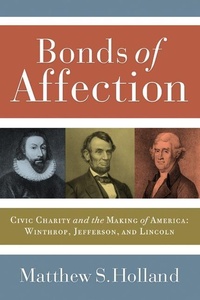
Bonds of Affection
Civic Charity and the Making of America--Winthrop, Jefferson, and Lincoln
Will be published approx. on 4. October 2007
Book
Paperback/Softback
336 pages
978-1-58901-183-0 (ISBN)
Description
Notions of Christian love, or charity, strongly shaped the political thought of John Winthrop, Thomas Jefferson, and Abraham Lincoln as each presided over a foundational moment in the development of American democracy. Matthew Holland examines how each figure interpreted and appropriated charity, revealing both the problems and possibilities of making it a political ideal. Holland first looks at early American literature and seminal speeches by Winthrop to show how the Puritan theology of this famed 17th century governor of the Massachusetts Colony (he who first envisioned America as a "City upon a Hill") galvanized an impressive sense of self-rule and a community of care in the early republic, even as its harsher aspects made something like Jefferson's "Enlightenment" faith in liberal democracy a welcome development. Holland then shows that between Jefferson's early rough draft of the Declaration of Independence and his First Inaugural Jefferson came to see some notion of charity as a necessary complement to modern political liberty.
However, Holland argues, it was Lincoln and his ingenious blend of Puritan and democratic insights who best fulfilled the promise of this nation's "bonds of affection." With his recognition of the imperfections of both North and South, his humility in the face of God's judgment on the Civil War, and his insistence on "charity for all," including the defeated Confederacy, Lincoln personified the possibilities of religious love turned civic virtue. Weaving a rich tapestry of insights from political science and literature and American religious history and political theory, "Bonds of Affection" is a major contribution to the study of American political identity. Matthew Holland makes plain that civic charity, while commonly rejected as irrelevant or even harmful to political engagement, has been integral to our national character. This book includes the full texts of Winthrop's speech "A Model of Christian Charity"; Jefferson's rough draft of the Declaration and his First Inaugural; and, Lincoln's Second Inaugural.
However, Holland argues, it was Lincoln and his ingenious blend of Puritan and democratic insights who best fulfilled the promise of this nation's "bonds of affection." With his recognition of the imperfections of both North and South, his humility in the face of God's judgment on the Civil War, and his insistence on "charity for all," including the defeated Confederacy, Lincoln personified the possibilities of religious love turned civic virtue. Weaving a rich tapestry of insights from political science and literature and American religious history and political theory, "Bonds of Affection" is a major contribution to the study of American political identity. Matthew Holland makes plain that civic charity, while commonly rejected as irrelevant or even harmful to political engagement, has been integral to our national character. This book includes the full texts of Winthrop's speech "A Model of Christian Charity"; Jefferson's rough draft of the Declaration and his First Inaugural; and, Lincoln's Second Inaugural.
Reviews / Votes
A book well worth reading, both in terms of its insights into American politics and as an example of how to read texts carefully. Politics and Religion A thoughtfully and carefully crafted book ... Holland's command of the literature and critical analysis of the texts are truly impressive. Library JournalMore details
Series
Language
English
Place of publication
Washington, DC
United States
Target group
Professional and scholarly
US School Grade: College Graduate Student and over
Product notice
Paperback (trade)
Illustrations
Not illustrated
Dimensions
Height: 226 mm
Width: 153 mm
Thickness: 19 mm
Weight
458 gr
ISBN-13
978-1-58901-183-0 (9781589011830)
Copyright in bibliographic data and cover images is held by Nielsen Book Services Limited or by the publishers or by their respective licensors: all rights reserved.
Schweitzer Classification
Persons
Matthew S. Holland is an assistant professor in the Department of Political Science at Brigham Young University.
Content
Acknowledgements Prologue: "Bonds of Affection"-Three Founding Moments Part One: Winthrop and America's Point of Departure Hawthorne's Suggestion 1 A Model of Christian Charity 2 Two Cities Upon a Hill Part Two: Jefferson and the Founding 1776-The Other Document 3 A Model of Natural Liberty 4 "To Close The Circle of our Felicities" Part Three: Lincoln and the Refounding of AmericaFrom Tom to Abe 5 "Hail Fall of Fury! Reign of Reason, All Hail!" 6 "This Nation Under God" 7 A Model of Civic Charity Conclusion: Bonds of Freedom Appendix A John Winthrop's "A Model of Christian Charity" Speech Appendix B Thomas Jefferson's "original Rough draught" of the Declaration of Independence Appendix C Thomas Jefferson's First Inaugural Appendix D Abraham Lincoln's Second Inaugural BibliographyIndex