

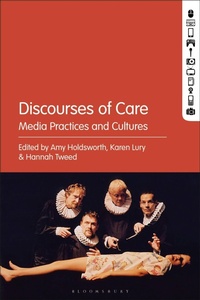
Discourses of Care
Media Practices and Cultures
Published on 30. December 2021
Book
Paperback/Softback
272 pages
978-1-5013-8984-9 (ISBN)
Description
Bringing together scholars from film and television studies, media and cultural studies, literary studies, medical humanities, and disability studies, Discourses of Care collectively examines how the analysis of media texts and practices can contribute to scholarship on and understandings of health and social care, and how existing research focusing on the ethics of care can inform our understanding of media.
Featuring a critical introductory essay and 13 specially commissioned original chapters, this is the first edited collection to address the relationship between media and the concept and practice of care and caregiving. Contributors consider the representation of care and caregiving through a range of forms and practices - the television documentary, photography, film, non-theatrical cinema, tabloid media, autobiography, and public service broadcasting - and engage with the labour, as well as the practical and ethical dimensions of media production. Together, they offer an original and wide ranging exploration of the various ways in which media forms represent, articulate and operate within caring relationships and practices of care; whether this is between individuals, communities as well as audiences and institutions.
Featuring a critical introductory essay and 13 specially commissioned original chapters, this is the first edited collection to address the relationship between media and the concept and practice of care and caregiving. Contributors consider the representation of care and caregiving through a range of forms and practices - the television documentary, photography, film, non-theatrical cinema, tabloid media, autobiography, and public service broadcasting - and engage with the labour, as well as the practical and ethical dimensions of media production. Together, they offer an original and wide ranging exploration of the various ways in which media forms represent, articulate and operate within caring relationships and practices of care; whether this is between individuals, communities as well as audiences and institutions.
Reviews / Votes
Discourses of Care is an innovative collection that explores how media both represents and enacts (or sometimes fails to enact) care. Essays on documentary, education films, photography, life writing, new media and news media detail the representation, circulation, production and reception of care, revealing productive affinities between care theory and media studies. This compelling foray into the entanglement of media and care is an important contribution to care studies and the medical humanities more broadly. * Amelia DeFalco, Associate Professor of Medical Humanities, University of Leeds, UK *More details
Language
English
Place of publication
New York
United States
Publishing group
Bloomsbury Publishing Plc
Target group
College/higher education
Illustrations
20 bw illus
Dimensions
Height: 229 mm
Width: 152 mm
Thickness: 15 mm
Weight
396 gr
ISBN-13
978-1-5013-8984-9 (9781501389849)
Copyright in bibliographic data and cover images is held by Nielsen Book Services Limited or by the publishers or by their respective licensors: all rights reserved.
Schweitzer Classification
Other editions
Additional editions
E-Book
05/2020
1st Edition
Bloomsbury Academic USA
€35.49
Available for download
E-Book
05/2020
1st Edition
Bloomsbury Academic USA
€35.49
Available for download
Persons
Amy Holdsworth is a senior lecturer in Film and Television Studies at the University of Glasgow, UK.
Karen Lury is Professor of Film and Television Studies at the University of Glasgow, UK.
Hannah Tweed is a Senior Policy Officer at the Health and Social Care Alliance Scotland.
Karen Lury is Professor of Film and Television Studies at the University of Glasgow, UK.
Hannah Tweed is a Senior Policy Officer at the Health and Social Care Alliance Scotland.
Content
List of contributors
Acknowledgements
INTRODUCTION
'Discourses of care and the media: an approach and an alliance'
Amy Holdsworth, Karen Lury & Hannah Tweed, University of Glasgow, UK
SECTION ONE: Media and end of life care
1. 'Signs of Care: assisted suicide on television' (Helen Wheatley, University of Warwick, UK)
2. 'Gestures of care in Briony Campbell's The Dad Project' (Agnese Sile, University of Aberdeen, UK)
3. Paul Sutton, 'Care, illness and television spectatorship' (Paul Sutton, University of Roehampton, UK)
SECTION TWO: Technology, care and facilitation
4. 'Are digital platforms and touchscreen devices effective caretakers? The touch-and-go of users with visual impairments' (Anna Piccoli, University of Amsterdam, The Netherlands)
5. 'Making Television Accessible with Audio Description' (Kerr Castle, University of Glasgow, UK)
6. 'Controversies of Care: Technology, Caregivers, and Autiebiography (Hannah Tweed, University of Glasgow, UK)
SECTION THREE: Education, media and care
7. 'Performances of Care: Film, Re-education and Shell-shock' (Robert Hemmings, University of Leeds, UK)
8. 'Care-full Cinema: Perspectives on care-relationships in French educational film, 1950s-1990s' (Christian Bonah & Joel Danet, University of Stroasburg, France)
9. 'Assessing changes to the welfare state: An investigation into the effects of regional media on local services and recipients of care in 1980s North East England' (Ben Lamb, Teesside University, UK)
SECTION FOUR: Bad care
10. '"Failings in the duty of care": Mediated discourses on "children at risk"' (Maggie Sweeney, University of the West of Scotland, UK)
11. 'Care and cultures of television news production: the case of BBC Newsnight' (Rowan Aust, Royal Holloway University of London, UK)
SECTION FIVE: Care and collaboration: reflections on caregiving, receiving and the creative process
12. 'B is for.... Body' (Andrew Koetting, University of the Creative Arts at Canterbury, UK)
13. 'Care as practice and provocation: A response to Andrew Koetting' (Amy Holdsworth,'University of Glasgow, UK)
Index
Acknowledgements
INTRODUCTION
'Discourses of care and the media: an approach and an alliance'
Amy Holdsworth, Karen Lury & Hannah Tweed, University of Glasgow, UK
SECTION ONE: Media and end of life care
1. 'Signs of Care: assisted suicide on television' (Helen Wheatley, University of Warwick, UK)
2. 'Gestures of care in Briony Campbell's The Dad Project' (Agnese Sile, University of Aberdeen, UK)
3. Paul Sutton, 'Care, illness and television spectatorship' (Paul Sutton, University of Roehampton, UK)
SECTION TWO: Technology, care and facilitation
4. 'Are digital platforms and touchscreen devices effective caretakers? The touch-and-go of users with visual impairments' (Anna Piccoli, University of Amsterdam, The Netherlands)
5. 'Making Television Accessible with Audio Description' (Kerr Castle, University of Glasgow, UK)
6. 'Controversies of Care: Technology, Caregivers, and Autiebiography (Hannah Tweed, University of Glasgow, UK)
SECTION THREE: Education, media and care
7. 'Performances of Care: Film, Re-education and Shell-shock' (Robert Hemmings, University of Leeds, UK)
8. 'Care-full Cinema: Perspectives on care-relationships in French educational film, 1950s-1990s' (Christian Bonah & Joel Danet, University of Stroasburg, France)
9. 'Assessing changes to the welfare state: An investigation into the effects of regional media on local services and recipients of care in 1980s North East England' (Ben Lamb, Teesside University, UK)
SECTION FOUR: Bad care
10. '"Failings in the duty of care": Mediated discourses on "children at risk"' (Maggie Sweeney, University of the West of Scotland, UK)
11. 'Care and cultures of television news production: the case of BBC Newsnight' (Rowan Aust, Royal Holloway University of London, UK)
SECTION FIVE: Care and collaboration: reflections on caregiving, receiving and the creative process
12. 'B is for.... Body' (Andrew Koetting, University of the Creative Arts at Canterbury, UK)
13. 'Care as practice and provocation: A response to Andrew Koetting' (Amy Holdsworth,'University of Glasgow, UK)
Index