

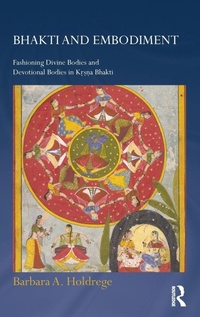
Bhakti and Embodiment
Fashioning Divine Bodies and Devotional Bodies in Krsna Bhakti
1st Edition
Published on 10. September 2015
Book
Hardback
432 pages
978-0-415-67070-8 (ISBN)
Description
The historical shift from Vedic traditions to post-Vedic bhakti (devotional) traditions is accompanied by a shift from abstract, translocal notions of divinity to particularized, localized notions of divinity and a corresponding shift from aniconic to iconic traditions and from temporary sacrificial arenas to established temple sites. In Bhakti and Embodiment Barbara Holdrege argues that the various transformations that characterize this historical shift are a direct consequence of newly emerging discourses of the body in bhakti traditions in which constructions of divine embodiment proliferate, celebrating the notion that a deity, while remaining translocal, can appear in manifold corporeal forms in different times and different localities on different planes of existence. Holdrege suggests that an exploration of the connections between bhakti and embodiment is critical not only to illuminating the distinctive transformations that characterize the emergence of bhakti traditions but also to understanding the myriad forms that bhakti has historically assumed up to the present time.
This study is concerned more specifically with the multileveled models of embodiment and systems of bodily practices through which divine bodies and devotional bodies are fashioned in Krsna bhakti traditions and focuses in particular on two case studies: the Bhagavata Purana, the consummate textual monument to Vaisnava bhakti, which expresses a distinctive form of passionate and ecstatic bhakti that is distinguished by its embodied nature; and the Gaudiya Vaisnava tradition, an important bhakti tradition inspired by the Bengali leader Caitanya in the sixteenth century, which articulates a robust discourse of embodiment pertaining to the divine bodies of Krsna and the devotional bodies of Krsna bhaktas that is grounded in the canonical authority of the Bhagavata Purana.
This study is concerned more specifically with the multileveled models of embodiment and systems of bodily practices through which divine bodies and devotional bodies are fashioned in Krsna bhakti traditions and focuses in particular on two case studies: the Bhagavata Purana, the consummate textual monument to Vaisnava bhakti, which expresses a distinctive form of passionate and ecstatic bhakti that is distinguished by its embodied nature; and the Gaudiya Vaisnava tradition, an important bhakti tradition inspired by the Bengali leader Caitanya in the sixteenth century, which articulates a robust discourse of embodiment pertaining to the divine bodies of Krsna and the devotional bodies of Krsna bhaktas that is grounded in the canonical authority of the Bhagavata Purana.
More details
Series
Language
English
Place of publication
London
United Kingdom
Publishing group
Taylor & Francis Ltd
Target group
College/higher education
Illustrations
2 s/w Abbildungen, 2 s/w Zeichnungen
2 Line drawings, black and white; 2 Illustrations, black and white
Dimensions
Height: 240 mm
Width: 161 mm
Thickness: 31 mm
Weight
898 gr
ISBN-13
978-0-415-67070-8 (9780415670708)
Copyright in bibliographic data and cover images is held by Nielsen Book Services Limited or by the publishers or by their respective licensors: all rights reserved.
Schweitzer Classification
Other editions
Additional editions
Barbara A. Holdrege
Bhakti and Embodiment
Fashioning Divine Bodies and Devotional Bodies in Krsna Bhakti
Book
01/2018
1st Edition
Routledge
€75.10
Shipment within 10-20 days
Barbara A. Holdrege
Bhakti and Embodiment
Fashioning Divine Bodies and Devotional Bodies in Krsna Bhakti
E-Book
08/2015
1st Edition
Routledge
€67.49
Available for download
Barbara A. Holdrege
Bhakti and Embodiment
Fashioning Divine Bodies and Devotional Bodies in Krsna Bhakti
E-Book
08/2015
1st Edition
Routledge
€67.49
Available for download
Person
Barbara A. Holdrege is Professor of Religious Studies and Chair of the South Asian Studies Committee at the University of California, Santa Barbara. Her publications include Refiguring the Body: Embodiment in South Asian Religions; Veda and Torah: Transcending the Textuality of Scripture; and Ritual and Power.
Content
Preface. Introduction 1. Bhakti and Divine Embodiment: Fashioning Divine Bodies 2. The Embodied Aesthetics of Bhakti: Fashioning Devotional Bodies 3. Bhagavata Purana as Text-Avatara: From Purana-Veda to Krishna-Veda to Embodiment of Bhagavan 4. Naman as Sound-Avatara: From Transcendent Vibration to Reverberating Name 5. Vraja-Dhaman as Place-Avatara: From Mythic Space to Pilgrimage Place to Transcendent Space 6: Meditation as Devotional Practice: Experiencing Krishna in His Transcendent Dhaman. Conclusion.