

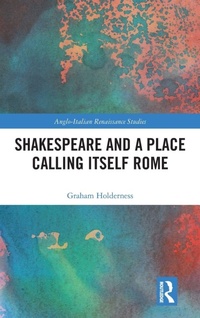
Shakespeare and a Place Calling Itself Rome
1st Edition
Published on 29. June 2025
Book
Hardback
200 pages
978-1-032-57813-2 (ISBN)
Description
This new examination of Shakespeare's four Roman tragedies (Julius Caesar, Titus Andronicus, Coriolanus and Antony and Cleopatra) revisits Shakespeare's dramatic recreations of ancient Rome in the light of considerations of place:
the places from which Shakespeare initiated his imaginative reconstructions, where plays are written and performed
the places he constructed within the plays, the places the plays imagine and recreate, together with the places from which he derived them
the places within which we as readers and spectators experience those creations, where such plays are read, viewed and critically analysed.
Alongside this analysis the book explores contemporary critical debates and the uses of place and space in selected modern adaptations - the Taviani brothers' Italian film Caesar Must Die, Julie Taylor's film Titus, John Osborne's play A Place Calling Itself Rome and Ahmed Shawqi's Arabic Death of Cleopatra.
The book provides a descriptive, palimpsestic map of the places within which Shakespeare's Roman plays operate, tracing the contours of Rome's Republic and Empire, overlaid with the Europe of Shakespeare's day, in which a Romanised London looked with fascination towards the East, towards Rome and Alexandria. Equipped with such a map we can attempt to do what Shakespeare did: to recreate ancient Rome in conjunction and rapprochement with its early modern and modern counterparts.
the places from which Shakespeare initiated his imaginative reconstructions, where plays are written and performed
the places he constructed within the plays, the places the plays imagine and recreate, together with the places from which he derived them
the places within which we as readers and spectators experience those creations, where such plays are read, viewed and critically analysed.
Alongside this analysis the book explores contemporary critical debates and the uses of place and space in selected modern adaptations - the Taviani brothers' Italian film Caesar Must Die, Julie Taylor's film Titus, John Osborne's play A Place Calling Itself Rome and Ahmed Shawqi's Arabic Death of Cleopatra.
The book provides a descriptive, palimpsestic map of the places within which Shakespeare's Roman plays operate, tracing the contours of Rome's Republic and Empire, overlaid with the Europe of Shakespeare's day, in which a Romanised London looked with fascination towards the East, towards Rome and Alexandria. Equipped with such a map we can attempt to do what Shakespeare did: to recreate ancient Rome in conjunction and rapprochement with its early modern and modern counterparts.
More details
Series
Language
English
Place of publication
London
United Kingdom
Publishing group
Taylor & Francis Ltd
Target group
College/higher education
Postgraduate
Dimensions
Height: 235 mm
Width: 157 mm
Thickness: 16 mm
Weight
471 gr
ISBN-13
978-1-032-57813-2 (9781032578132)
Copyright in bibliographic data and cover images is held by Nielsen Book Services Limited or by the publishers or by their respective licensors: all rights reserved.
Schweitzer Classification
Other editions
Additional editions
Graham Holderness
Shakespeare and a Place Calling Itself Rome
E-Book
06/2025
Routledge
€60.49
Available for download
Graham Holderness
Shakespeare and a Place Calling Itself Rome
E-Book
06/2025
Routledge
€60.49
Available for download
Person
Graham Holderness is Professor Emeritus at the University of Hertfordshire, UK.
Content
Prologue: A Journey through Londinium; Introduction: A Place Calling itself Rome; 1. Julius Caesar: The Ruins of Rome; 2. Titus Andronicus: The Place of the Classical; 3. Coriolanus: Knowing Your Place; 4. Antony and Cleopatra: 'All the world is Rome'; Epilogue: The Name of Rome; Bibliography; Index