

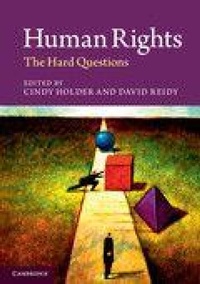
Human Rights
The Hard Questions
Published on 23. May 2013
Book
Paperback/Softback
490 pages
978-0-521-17626-2 (ISBN)
Description
The United Nations General Assembly adopted the Universal Declaration of Human Rights in 1948. A burgeoning human rights movement followed, yielding many treaties and new international institutions and shaping the constitutions and laws of many states. Yet human rights continue to be contested politically and legally and there is substantial philosophical and theoretical debate over their foundations and implications. In this volume, distinguished philosophers, political scientists, international lawyers, environmentalists and anthropologists discuss some of the most difficult questions of human rights theory and practice: what do human rights require of the global economy? Does it make sense to secure them by force? What do they require in jus post bello contexts of transitional justice? Is global climate change a human rights issue? Is there a human right to democracy? Does the human rights movement constitute moral progress? For students of political philosophy, human rights, peace studies and international relations.
Reviews / Votes
'... [a] superb book ... bring[s] together 23 timely and substantive papers, organized around seven pressing yet perennial questions ... The readability of Holder and Reidy's introduction, along with their perspicacious selection and grouping of readings, make this an ideal teaching text and also a valuable research volume. Summing up: highly recommended.' D. B. Boersema, Choice 'Cindy Holder and David Reidy have done a fine job assembling very useful discussions on many of the questions about human rights that keep philosophers, lawyers, political scientists, anthropologists and others busy.' Notre Dame Philosophical Reviews 'I highly recommend [the book] to anyone interested in human rights or in political philosophy generally.' Adam Hosein, EthicsMore details
Language
English
Place of publication
Cambridge
United Kingdom
Target group
Professional and scholarly
Product notice
Paperback (trade)
Illustrations
1 Tables, black and white; 1 Halftones, unspecified
Dimensions
Height: 244 mm
Width: 170 mm
Thickness: 27 mm
Weight
838 gr
ISBN-13
978-0-521-17626-2 (9780521176262)
Copyright in bibliographic data and cover images is held by Nielsen Book Services Limited or by the publishers or by their respective licensors: all rights reserved.
Schweitzer Classification
Other editions
Additional editions
Book
05/2013
Cambridge University Press
€128.90
Shipment within 15-20 days
E-Book
05/2013
1st Edition
Cambridge University Press
€30.99
Available for download
Persons
Cindy Holder is Associate Professor of Philosophy at the University of Victoria. She has published articles on minority rights and the human rights of groups. David Reidy is Professor of Philosophy and Adjunct Professor of Political Science at the University of Tennessee. His most recent publications include Rawls (edited, 2008) and Coercion and the State (co-edited with Walter Riker, 2008). He is co-editor with Jon Mandle of The Cambridge Rawls Lexicon (Cambridge, 2014) and A Companion to Rawls (2013).
Content
Introduction Cindy Holder and David Reidy; Part I. What are Human Rights?: 1. Human rights and human nature Chris Brown; 2. Universalism and particularism in human rights Neil Walker; 3. Are human rights universal? Rex Martin; Part II. How do Human Rights Relate to Group Rights and Culture?: 4. The significance of cultural difference for human rights Alison Dundes Renteln; 5. Groups and human rights Peter Jones; 6. Entangled: family, religion and human rights Ayelet Shachar; 7. What does cultural difference require of human rights? Claudio Corradetti; Part III. What do Human Rights Require of the Global Economy?: 8. What do human rights require of the global economy? Beyond a narrow legal view Adam McBeth; 9. Universal human rights in the global political economy Tony Evans; 10. Human rights and global equal opportunity: inclusion not provision Ann Cudd; Part IV. How do Human Rights Relate to Environmental Policy?: 11. Human rights in a hostile climate Stephen M. Gardiner; 12. A human rights approach to energy, poverty and gender inequality Gail Karlsson; 13. Pollution wolves in scientific sheep's clothing: why environmental-risk assessors and policymakers ignore the 'hard issues' of the human rights of pollution victims Kristin Shrader-Frechette; Part V. Is There a Human Right to Democracy?: 14. Is there a human right to democracy? Hilary Charlesworth; 15. The human right to democracy and its global import Carol Gould; 16. An egalitarian argument for a human right to democracy Thomas Christiano; Part VI. What are the Limits of Rights Enforcement?: 17. Is it ever reasonable for one state to invade another for humanitarian reasons? The 'declaratory tradition' and the UN charter Julie Mertus; 18. Conflicting responsibilities to protect human rights Larry May; 19. Searching for the hard questions about women's human rights Marysia Zalewski; 20. Are human rights possible after conflict? Diary of a survivor Margaret Akello and Erin Baines; Part VII. Are Human Rights Progressive?: 21. Moral progress and human rights Allen Buchanan; 22. Human rights and moral agency Mark Goodale; 23. Gender mainstreaming human rights: a progressive path for equality? Laura Parisi.