


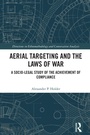
Aerial Targeting and the Laws of War
A Socio-Legal Study of the Achievement of Compliance
1st Edition
Published on 30. September 2025
Book
Hardback
206 pages
978-1-032-60874-7 (ISBN)
Description
A ground-breaking socio-legal investigation of the in situ legal considerations involved in targeting and the use of force, Aerial Targeting and the Laws of War develops a new kind of evidence base for international action relating to the protection of civilians.
Investigating the materials surrounding a civilian casualty incident that took place in Afghanistan in 2010, the book explores how a single strike - which was conducted in light of intelligence gathered by a militarised drone crew and resulted in the deaths of at least 15 civilians - became a lawful strike, that is, a strike that was deemed to have been compliant with the laws of war both at the point at which munitions were released and following two internal investigations. Through an ethnomethodological engagement with the transcripts, interviews, reports, and other materials associated with the incident, Alexander P. Holder examines the methods by which military personnel produce and maintain legitimate targets for the use of force.
Re-focusing debates surrounding civilian harm upon the praxeological details of the military practices, which generate such harms, this book will appeal to scholars of sociology, military studies, and socio-legal studies with interests in the rules of war and ethnomethodological approaches to research.
Investigating the materials surrounding a civilian casualty incident that took place in Afghanistan in 2010, the book explores how a single strike - which was conducted in light of intelligence gathered by a militarised drone crew and resulted in the deaths of at least 15 civilians - became a lawful strike, that is, a strike that was deemed to have been compliant with the laws of war both at the point at which munitions were released and following two internal investigations. Through an ethnomethodological engagement with the transcripts, interviews, reports, and other materials associated with the incident, Alexander P. Holder examines the methods by which military personnel produce and maintain legitimate targets for the use of force.
Re-focusing debates surrounding civilian harm upon the praxeological details of the military practices, which generate such harms, this book will appeal to scholars of sociology, military studies, and socio-legal studies with interests in the rules of war and ethnomethodological approaches to research.
More details
Series
Language
English
Place of publication
London
United Kingdom
Publishing group
Taylor & Francis Ltd
Target group
College/higher education
Postgraduate
Illustrations
4 s/w Abbildungen, 4 s/w Zeichnungen, 25 s/w Tabellen
25 Tables, black and white; 4 Line drawings, black and white; 4 Illustrations, black and white
Dimensions
Height: 240 mm
Width: 161 mm
Thickness: 16 mm
Weight
496 gr
ISBN-13
978-1-032-60874-7 (9781032608747)
Copyright in bibliographic data and cover images is held by Nielsen Book Services Limited or by the publishers or by their respective licensors: all rights reserved.
Schweitzer Classification
Other editions
Additional editions
Alexander P. Holder
Aerial Targeting and the Laws of War
A Socio-Legal Study of the Achievement of Compliance
E-Book
09/2025
Routledge
€60.49
Available for download
Alexander P. Holder
Aerial Targeting and the Laws of War
A Socio-Legal Study of the Achievement of Compliance
E-Book
09/2025
Routledge
€60.49
Available for download
Person
Alexander P. Holder is an ethnomethodologist based in Edinburgh, UK.
Content
1. Introduction, 2. The Uruzgan Incident and its Accounts, 3. The MQ-1 Predator's Socio-Technical, Socio-Cultural and Socio-legal Features, 4. IHL, The Rules of Engagement, and McChrystal's 2009 Tactical Directive, 5. Ethnomethodology, the Oriented-To Character of Rules, and the Constitutive Conception of Law, 6. The Prospective Achievement of Compliance, 7. The Retroactive Achievement of Compliance, 8. Conclusion