

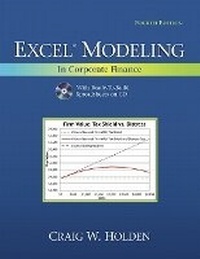
Excel Modeling in Corporate Finance
United States Edition
4th Edition
Published on 25. August 2011
Book
Mixed media product
240 pages
978-0-13-249784-8 (ISBN)
Description
An approach to building and estimating models through the use of Excel.
Excel Modeling in Corporate Finance focuses on active learning by showing readers how to build and estimate financial models using Excel. This approach shows the steps involved in building models, rather than solely providing readers with completed spreadsheets.
This edition contains updated information and data on the Excel model in Corporate Financial Planning, chapter on Estimating the Cost of Capital, and the Excel model used to estimate firm valuation.
Excel Modeling in Corporate Finance focuses on active learning by showing readers how to build and estimate financial models using Excel. This approach shows the steps involved in building models, rather than solely providing readers with completed spreadsheets.
This edition contains updated information and data on the Excel model in Corporate Financial Planning, chapter on Estimating the Cost of Capital, and the Excel model used to estimate firm valuation.
More details
Edition
4th edition
Language
English
Place of publication
United States
Publishing group
Pearson Education (US)
Target group
College/higher education
Dimensions
Height: 215 mm
Width: 276 mm
Thickness: 14 mm
Weight
588 gr
ISBN-13
978-0-13-249784-8 (9780132497848)
Copyright in bibliographic data is held by Nielsen Book Services Limited or its licensors: all rights reserved.
Schweitzer Classification
Other editions
New editions
Craig Holden
Excel Modeling in Corporate Finance
Book
08/2014
5th Edition
Pearson
€105.41
Article exhausted; check different version
Previous edition
Book
05/2008
3rd Edition
Pearson
€36.48
Article exhausted; check for reprint
Content
PART 1: TIME VALUE OF MONEY
Chapter 1: Single Cash Flow
Chapter 2: Annuity
Chapter 3: NPV Using Constant Discounting
Chapter 4: NPV Using General Discounting
Chapter 5: Loan Amortization
PART 2: VALUATION
Chapter 6: Bond Pricing
Chapter 7: Estimating the Cost of Capital
Chapter 8: Stock Valuation
Chapter 9: Firm and Project Valuation
Chapter 10: The Yield Curve
Chapter 11: US Yield Curve Dynamics
PART 3: CAPITAL STRUCTURE
Chapter 12: Capital Structure
PART 4: CAPITAL BUDGETING
Chapter 13: Project NPV
Chapter 14: Cost-Reducing Project
Chapter 15: Break-Even Analysis
PART 5: FINANCIAL PLANNING
Chapter 16: Corporate Financial Planning
Chapter 17: Du Pont System Of Ratio Analysis
Chapter 18: Life-Cycle Financial Planning
PART 6: INTERNATIONAL CORPORATE FINANCE
Chapter 19: International Parity
PART 7: OPTIONS AND CORPORATE FINANCE
Chapter 20: Binomial Option Pricing
Chapter 21: Real Options
Chapter 22: Black-Scholes Option Pricing
Chapter 23: Debt And Equity Valuation
PART 8: EXCEL SKILLS
Chapter 24: Useful Excel Tricks
Chapter 1: Single Cash Flow
Chapter 2: Annuity
Chapter 3: NPV Using Constant Discounting
Chapter 4: NPV Using General Discounting
Chapter 5: Loan Amortization
PART 2: VALUATION
Chapter 6: Bond Pricing
Chapter 7: Estimating the Cost of Capital
Chapter 8: Stock Valuation
Chapter 9: Firm and Project Valuation
Chapter 10: The Yield Curve
Chapter 11: US Yield Curve Dynamics
PART 3: CAPITAL STRUCTURE
Chapter 12: Capital Structure
PART 4: CAPITAL BUDGETING
Chapter 13: Project NPV
Chapter 14: Cost-Reducing Project
Chapter 15: Break-Even Analysis
PART 5: FINANCIAL PLANNING
Chapter 16: Corporate Financial Planning
Chapter 17: Du Pont System Of Ratio Analysis
Chapter 18: Life-Cycle Financial Planning
PART 6: INTERNATIONAL CORPORATE FINANCE
Chapter 19: International Parity
PART 7: OPTIONS AND CORPORATE FINANCE
Chapter 20: Binomial Option Pricing
Chapter 21: Real Options
Chapter 22: Black-Scholes Option Pricing
Chapter 23: Debt And Equity Valuation
PART 8: EXCEL SKILLS
Chapter 24: Useful Excel Tricks