

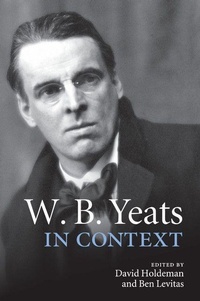
W. B. Yeats in Context
Published on 17. December 2015
Book
Paperback/Softback
460 pages
978-1-107-45680-8 (ISBN)
Description
W. B. Yeats is a writer who requires, and at the same time tests the limits of, contextual study. More than perhaps any other Irish writer, he produced his own context as much as it produced him. His cultural and political activities, combined with his prolific literary output, made an impact that can only be understood by close attention to his words in relation to the times in which he lived. W. B. Yeats in Context maps Yeats' world in concise, lively essays by distinguished critics and historians. The places, people, themes and intellectual frameworks most important to his development receive close attention, as do his artistic influences, and the production and reception of his work. As a gateway into the study of Yeats, this volume offers much new information for both students, scholars and anyone interested in the life and times of this enigmatic and influential poet.
More details
Series
Language
English
Place of publication
Cambridge
United Kingdom
Target group
Professional and scholarly
Product notice
Paperback (trade)
Dimensions
Height: 229 mm
Width: 152 mm
Thickness: 25 mm
Weight
661 gr
ISBN-13
978-1-107-45680-8 (9781107456808)
Copyright in bibliographic data and cover images is held by Nielsen Book Services Limited or by the publishers or by their respective licensors: all rights reserved.
Schweitzer Classification
Other editions
Additional editions
David Holdeman | Ben Levitas
W. B. Yeats in Context
Book
12/2009
Cambridge University Press
€159.00
Shipment within 15-20 days
Persons
David Holdeman is Professor of English at the University of North Texas. Ben Levitas is Lecturer in the Department of Drama at Goldsmiths College, University of London.
Content
Introduction David Holdeman and Ben Levitas; Part I. Times: 1. Church, state, childhood, and youth, 1865-85 W. J. McCormack; 2. The fin de siecle, 1885-97 Stephen Regan; 3. Anger management, 1898-1913 Adrian Frazier; 4. War, 1914-23 Ben Levitas; 5. The Irish Free State and the European crisis, 1924-39 Paul Scott Stanfield; Part II. Places: 6. Sligo David Fitzpatrick; 7. London Timothy Webb; 8. Dublin Anthony Roche; 9. Galway: Coole and Ballylee Jonathan Allison; Part III. Personalities: 10. John Butler Yeats Douglas Archibald; 11. Maud Gonne Karen Steele; 12. Lady Gregory Judith Hill; 13. J. M. Synge Nicholas Grene; 14. Ezra Pound Catherine E. Paul; 15. George Yeats Margaret Mills Harper; Part IV. Themes: 16. Class and eugenics Donald J. Childs; 17. Nationalism and postcolonialism David Lloyd; 18. Gender Vicki Mahaffey; 19. Aesthetics James Pethica; 20. Fascism R. F. Foster; Part V. Philosophies: 21. The Church in Ireland: Protestant and Catholic Nicholas Allen; 22. Occultism Timothy Materer; 23. Folklore Sinead Garrigan Mattar; 24. Indian thought Shalini Sikka; 25. Nietzsche Michael Valdez Moses; 26. Classical philosophy Matthew Gibson; 27. Landscape, family, eighteenth-century Ireland Jefferson Holdridge; Part VI. Arts: 28. Nineteenth-century Irish poetry Phillip L. Marcus; 29. The English Romantic Symbolists Matthew Campbell; 30. Modern poetry James Longenbach; 31. Theatrical culture Richard Cave; 32. The visual arts Elizabeth Bergmann Loizeaux; 33. Modern fiction Frank Shovlin; Part VII. Reception: 34. Manuscripts and revisions David Holdeman; 35. Publishers and the material text George Bornstein; 36. Critical debate, 1939-70 Edna Longley; 37. Critical debate, 1970-2006 Rob Doggett; 38. Popular culture Geraldine Higgins; Guide to further reading; Index.